BLUE VELVET (1986)
A young man finds a severed human ear that is somehow connected to a mysterious lounge singer and a group of psychopathic criminals who have kidnapped her child.



A young man finds a severed human ear that is somehow connected to a mysterious lounge singer and a group of psychopathic criminals who have kidnapped her child.
Something recently clicked into place, and I couldn’t believe it had taken me so long to realise: my love of movies is largely down to growing up at a particular time, when certain films were showing in cinemas. The era in question: the late-1970s to mid-1980s. Allow me to elaborate briefly. In 1978, aged five, I saw both Star Wars (1977) and Superman (1978) at the cinema. Those two films alone would probably have been enough to spark my lifelong passion for cinema, but soon after came Star Trek: The Motion Picture (1979), E.T. the Extra-Terrestrial (1982), Ghostbusters (1984)… you get the idea.
The home video boom kept things rolling through the rest of the eighties. As I hit my teenage years, my parents were liberal enough to let me watch grittier, more violent fare such as Mad Max (1979) and The Terminator (1984). By 1990, I thought I had a decent handle on what was out there. I was wrong. Two films from two very different directors: Martin Scorsese’s Goodfellas (1990) and David Lynch’s Blue Velvet opened the door to a completely different kind of cinema.
Chronologically, Goodfellas came second, arriving just as I turned 18, and with that, my Scorsese journey had begun. However, it was seeing Blue Velvet on cable TV a few months earlier that showed me just how dark and surreal a film could be. Soon afterwards, I caught Lynch’s Palme d’Or winner Wild at Heart (1990) on the big screen, and that was it. I was hooked on films that challenge you, drag you out of the everyday, and show you something edgier and less safe.
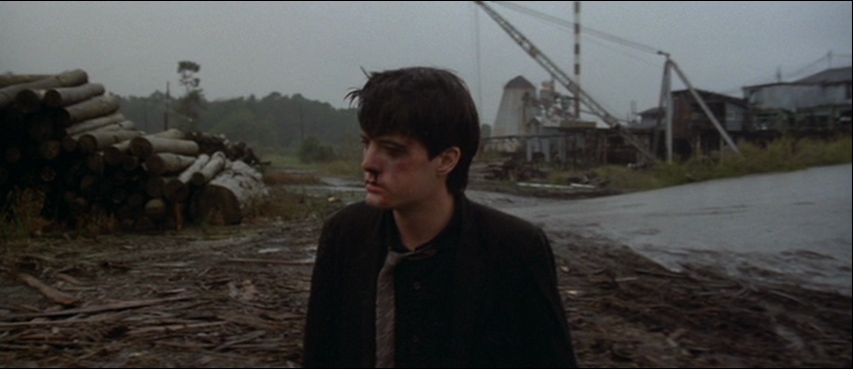
Blue Velvet, Lynch’s fourth feature, is set in Lumberton, North Carolina, a real place into which Lynch imbues a quasi-fifties aesthetic. Why? Probably because his formative childhood years were spent in that decade.
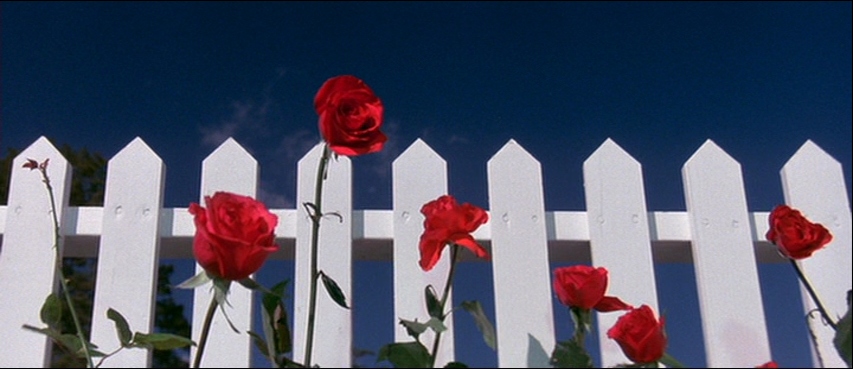
The credits roll over a blue velvet curtain to Angelo Badalamenti’s sweeping, faintly ominous score before cutting to a brilliant blue sky as Bobby Vinton’s 1963 recording of the title song plays. The camera pans down over deep red roses and bright yellow tulips set against a white picket fence; a fire engine rolls past with an officer waving and a Dalmatian sitting up front, and schoolchildren cross the street. This is Lynch’s picture-postcard suburbia, all sunshine and flowers, like a dream of an America from another time—but something sinister lurks underneath.
You then see a man watering his garden, while inside the house his wife watches a crime thriller on TV. As foreboding builds, the hose tangles—a visual metaphor for what follows as the man suffers a stroke and collapses while a small dog comically drinks from the running nozzle. The camera then drops into the undergrowth, where beetles and ants crawl and feed. In just a few seconds, Lynch sets up the film perfectly: you may not know exactly where he’s taking you, but you sense it will be weird and unique.
Following the stroke, the man ends up in hospital, wired to grim-looking life-support machinery. His son Jeffrey Beaumont (Kyle MacLachlan), a college student, visits him, and on the way home finds a severed ear in a field. He hands it over to police detective Williams, who seems to have an idea of what it is connected to. The detective’s daughter Sandy (Laura Dern) later tells Jeffrey that something she overheard in her father’s study may involve a nightclub singer, Dorothy Vallens (Isabella Rossellini).
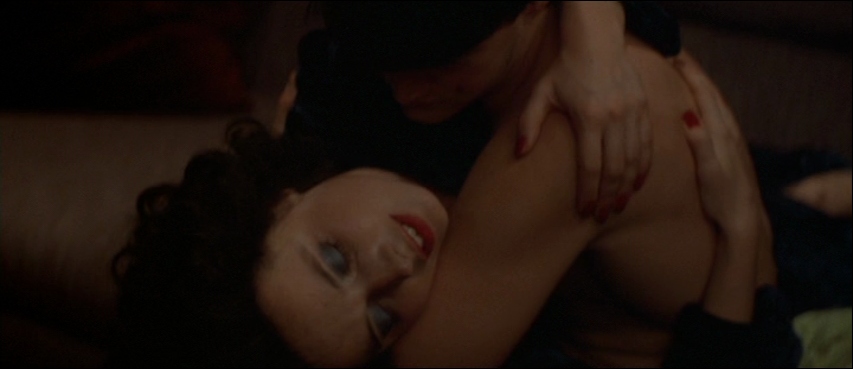
Fascinated, Jeffrey goes with Sandy to watch Dorothy perform (her opening number, fittingly, is Blue Velvet), then hatches a plan to search her flat while Sandy keeps watch from the car. Dorothy comes home early; Jeffrey hides in the wardrobe and watches her undress until she discovers him, holds him at knifepoint, and orders him to strip, turning the scene strange and sexual.
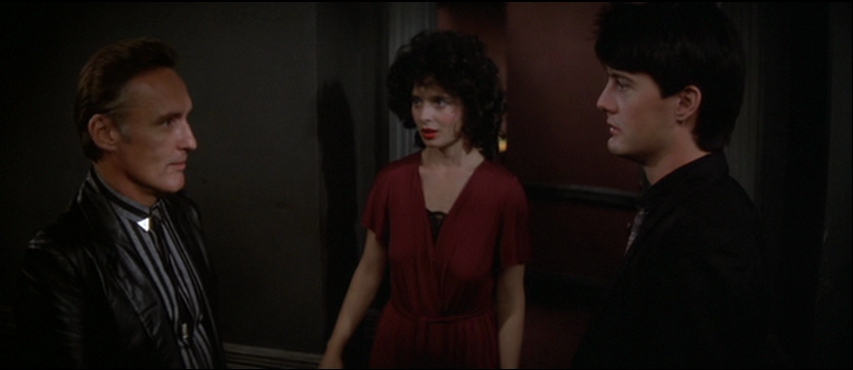
When a knock at the door interrupts them, she shoves him back into the wardrobe, and in walks Frank Booth (Dennis Hopper). From the outset, you can tell Frank is a scary guy. Even before he opens his mouth, there’s a menacing presence about the way he carries himself; almost like a coiled-up snake ready to pounce. Frank beats and rapes Dorothy, calling her “mommy” as his mood swings between rage, excitement, and something approaching genuine distress, inhaling gas from a canister that makes the sequence more disturbing still. Once Frank leaves, Jeffrey tries to comfort Dorothy, who becomes intimate with him and asks him to hit her; shocked, he flees. He then deduces that Frank has kidnapped Dorothy’s husband and young son. From here, the film descends further, growing ever more frightening as Lynch takes us deeper into the dark side of human nature.
Before going any further, it’s worth looking at the director himself. Lynch was born in Missoula, Montana, in 1946, into a comfortable, loving family. His father, Donald, was a research scientist for the US Department of Agriculture, and the family subsequently moved around: Idaho, Washington, North Carolina, and Virginia. Lynch described his childhood in almost ridiculously wholesome terms: “My childhood was elegant homes, tree-lined streets, the milkman, building backyard forts, droning airplanes, blue skies, picket fences, green grass, cherry trees. Middle America as it’s supposed to be.”
By his own account, he was sociable and well-adjusted—an Eagle Scout who made friends easily. He soaked up that small-town Americana, which later resurfaced in his work with something darker lurking beneath. You can see it in Lumberton, and later in his famous TV series, Twin Peaks (1990-91). Before turning to directing, he was drawn to fine art, happily creating paintings and sculptures—a practice he maintained throughout his life, taking over from filmmaking when poor health prevented him from directing feature-length films.
That’s part of what makes him so fascinating: art was always his core, whatever the medium, and there was never a traumatic childhood event feeding his work. He simply noticed the gap between the tidy, sunny world around him and the unspoken unease seeping through the cracks. There was, however, a troubling event he witnessed in his youth in Boise, Idaho, which inspired a pivotal scene involving Dorothy. More on that later.
Jeffrey isn’t an innocent dragged into Frank’s world against his will; he’s drawn to it. He wants to see behind the curtain. After everything he has witnessed, he returns to Dorothy’s flat, and when she again asks him to hit her, he complies—reluctantly, but he does strike her. That’s Lynch’s point: the gap between the “normal” college kid from the picket-fence environment and the leather-jacketed monster that is Frank is much thinner than we’d like to think. Jeffrey’s loss of innocence involves more than just learning the world is dangerous; he also discovers an erotic curiosity within himself that scares him, partly because he doesn’t entirely hate it.
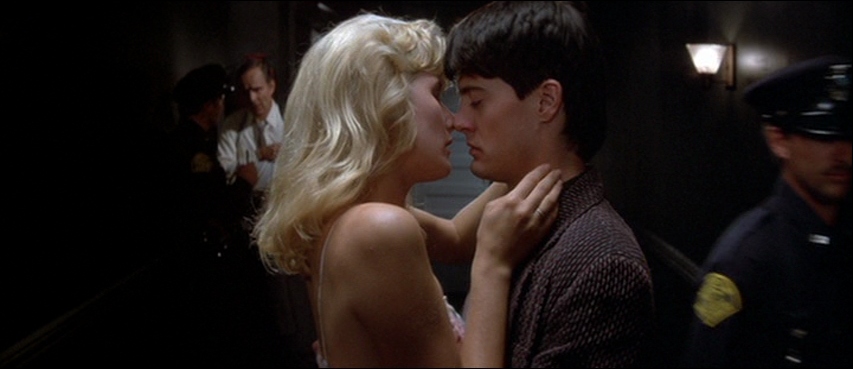
Sandy serves as the wholesome alternative to Dorothy’s damaged, dangerous sexuality. On the one hand, she comes across as the perfect girl-next-door; even her first appearance on screen shows her shimmering like an angel emerging from the dark shadows. But as the film progresses, you realise she’s far from perfect: she’s open to snooping around Dorothy’s flat, and she quickly abandons her boyfriend once romance blossoms between her and Jeffrey.
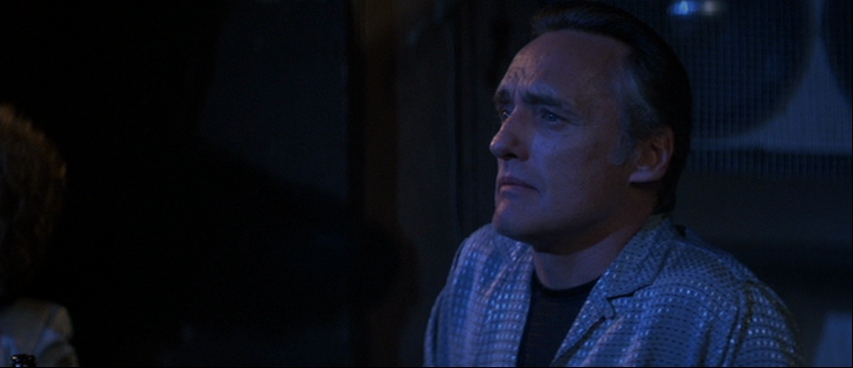
Here, Lynch demonstrates once again that even someone like Sandy, a decent human being, has flaws. There is a duality in her, just as there is in Jeffrey and even Frank—who, despite being a brutal psychopath, displays a vulnerability when he hears Dorothy singing and is clearly moved by her performance. This inner conflict between light and dark, good and evil, is something Lynch recognised as a universal human trait and explored throughout his career.
Lynch’s route to making Blue Velvet is almost as compelling as the story itself. Just a few years earlier, following his success with Eraserhead (1977) and The Elephant Man (1980), the director was convinced by the legendary Italian producer Dino De Laurentiis to helm a massive adaptation of Frank Herbert’s bestselling sci-fi novel Dune (1984). This was about as far removed from Lynch’s previous work as imaginable: The Elephant Man was made for just $5M, whereas Dune’s budget was a whopping $40M. Lynch knew from the outset that this was not his kind of project, but before production began, he had already put provisions in place that would benefit him later.
Most of the money was spent on elaborate special effects and 80 sets built across 16 sound stages in Mexico, involving a total crew of 1,700 and over 20,000 extras. A stellar ensemble cast featured well-known names such as Max von Sydow, Patrick Stewart, and Jürgen Prochnow—even rock star Sting turned up as Feyd-Rautha, Baron Harkonnen’s younger nephew. Lynch found himself completely out of his depth, but he stayed the course and finished the film.
Given Dune’s gargantuan scale and the fact that a relatively inexperienced Lynch was at the helm, it is hardly surprising the film ended up something of a mess, particularly after the studio cut 40 minutes from the director’s intended three-hour cut. While far from a commercial success, it still managed to recoup its budget. The real win for Lynch, however, was the deal De Laurentiis had already struck: following Dune, he would be given $6M to make Blue Velvet, along with complete artistic freedom and final-cut privileges. With no pressure to deliver another blockbuster, Lynch could make the film he actually wanted, rough edges included. That is why Blue Velvet feels so unmistakably like a Lynch film in a way few studio movies of the era do.
Alongside numerous standout scenes, the sequence towards the end when a naked, traumatised Dorothy stumbles onto a suburban front lawn, proves the most shocking and memorable. What makes it special is that it wasn’t conjured up purely to shock; it was drawn from a real event in the director’s past.
Lynch spoke several times about a childhood memory from Boise. One evening, he and his brother were playing outside on a dimly lit street when a naked woman emerged from the darkness towards them, crying out, her mouth bloodied and clearly beaten. His biography, Room to Dream, quotes him:
“Out of the darkness—it was so incredible—came this nude woman with white skin. Maybe it was something about the light and the way she came out of the darkness, but it seemed her skin was the colour of milk, and she had a bloodied mouth. She couldn’t walk very well; she was in bad shape, and she was completely naked. I’d never seen that. My brother started to cry and she sat down on the curb.”
He recalled not knowing what to do or how to help her. What stayed with him was that, frightening as she was, he also found her beautiful. That queasy blend of horror and beauty runs right through Blue Velvet, and it’s why I think the film holds up so well today.
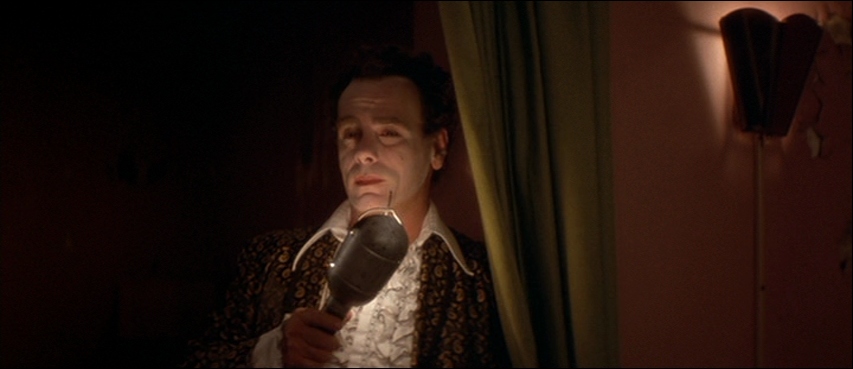
Strong performances also contribute significantly to its enduring power. Kyle MacLachlan, fresh off Dune and just 27 at the time, convincingly plays Jeffrey as someone who is fundamentally a nice guy but who, through meeting Dorothy, discovers a side to himself he fears yet is drawn towards.
Laura Dern was only 17 and had made just two other movies, yet she delivers an incredibly naturalistic and believable performance as a sweet teenage girl who, like Jeffrey, finds the murkier side of life alluring and is drawn into a situation beyond her comprehension.
However, as good as these two young actors are, it is Isabella Rossellini and Dennis Hopper who are the true stars here. Rossellini, daughter of Swedish actress Ingrid Bergman and Italian film director Roberto Rossellini, was by this point a successful model, but had also worked as a TV journalist for the Italian broadcaster RAI and had a few small film parts to her name. Despite her relative inexperience as an actor, she makes Dorothy Vallens feel authentic and fully developed from minute one. While her domestic crisis is clearly tearing her life apart, she still manages a degree of agency and sexual allure that is both powerful and tender.
Already a major star by this point, Hopper had acted alongside the likes of James Dean and John Wayne, and his career had hit a peak with his turn as director of the cult counterculture hit Easy Rider (1969). After that, his substance abuse spiralled out of control and he spent much of his time in New Mexico, cropping up sporadically in bit parts—most famously as a drug-crazed photojournalist in Francis Ford Coppola’s Apocalypse Now (1979).
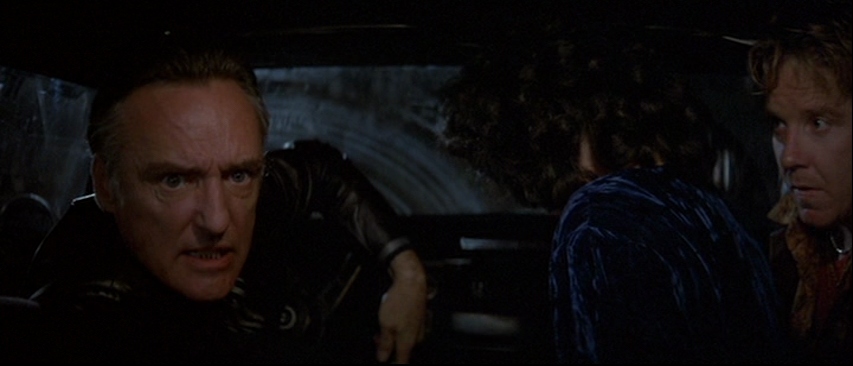
By the time Blue Velvet was moving into gear, he had just come out of rehab and was sober for the first time in years—and hungry to work, something Lynch recognised and capitalised on. Hopper famously told Lynch: “You did the right thing, because I am Frank,” and he drew on his recent experiences of addiction, volatility, and recovery to bring this terrifying character to life.
Other cast and crew members were initially wary of working with him, but Hopper surprised everyone with his commitment and professionalism. Without Hopper, Blue Velvet might not have worked. His performance is genuinely unsettling and hypnotic—totally unpredictable—and as appalling as Frank is, he remains a key anchor in the story. The role demands immense power, something Hopper pulls off magnificently.
Commercially, Blue Velvet was never going to be a blockbuster, and it wasn’t. It took roughly $8.6M at the North American box office—hardly spectacular by Hollywood standards—and its distributor, De Laurentiis Entertainment Group, was in serious financial trouble anyway. But the numbers were never the point. Lynch earned an Academy Award nomination for ‘Best Director’, and his career was secured from that point onward.
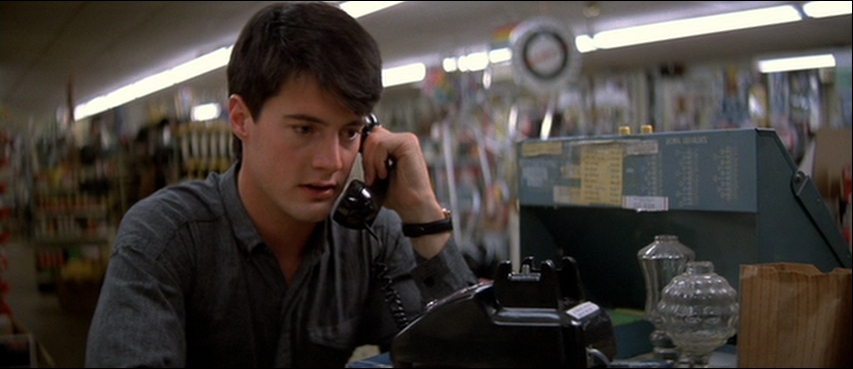
Personally, as much as I like most of his films—particularly The Elephant Man and Mulholland Drive (2001)—Blue Velvet is hands down his strongest work. Alongside the rich cinematography and superb acting, the script, while exploring complex themes, possesses an elegance and rhythm that is absent from his later films. The narrative structure pulls you in immediately, and the film barrels along at a deceptively brisk pace.
Critics were divided: Roger Ebert famously hated it, while his colleague Gene Siskel placed it fifth on his list of the best films of 1986. Upon its initial release, directors Woody Allen and Martin Scorsese both named Blue Velvet the best film of the year, and Peter Travers of Rolling Stone later called it the best film of the 1980s and an “American masterpiece”.
For me, watching it as a teenager, it was more than just a great film. It showed me that cinema could go somewhere genuinely uncomfortable. It could be disturbing and beautiful at the same time, leaving you with questions instead of answers—and somehow, that felt like the entire point. 40 years on, it still makes for an unforgettable viewing experience: completely original and brilliant. Much like the man who created it.
USA | 1986 | 120 MINUTES | 2.35:1 | COLOUR| ENGLISH

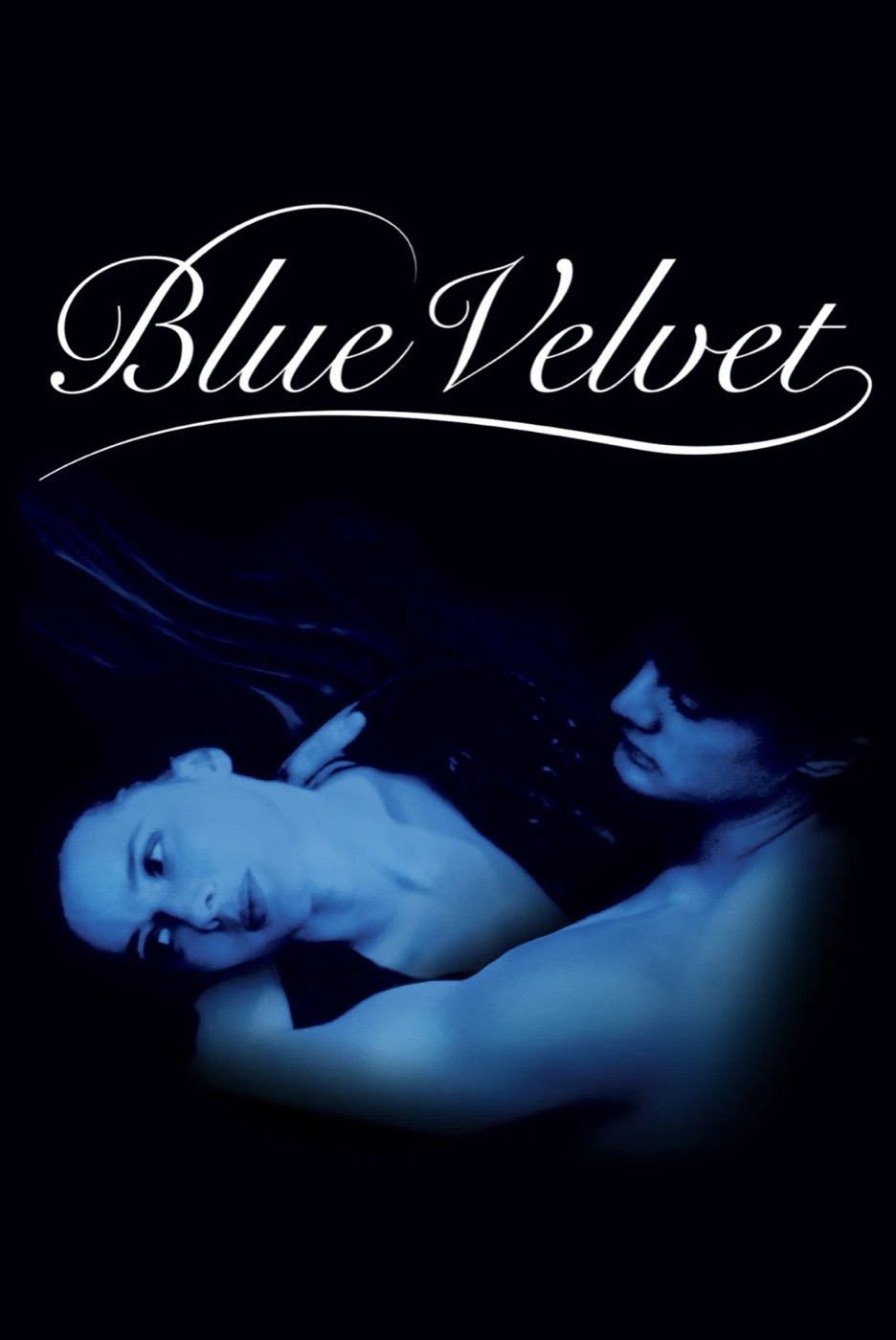
writer & director: David Lynch.
starring: Kyle MacLachlan, Isabella Rossellini, Dennis Hopper, Laura Dern, Hope Lange, George Dickerson & Dean Stockwell.