GILDA (1946)
A small-time gambler hired to work in a Buenos Aires casino discovers his employer's new wife is his former lover.


A small-time gambler hired to work in a Buenos Aires casino discovers his employer's new wife is his former lover.
For a film containing some of the most iconic movie-star images of the 20th century, it’s disarming to watch Gilda and realise that it’s a film about nobodies. There are plenty of films about people trying to “make it”—to secure their slice of happiness in a cruel world—but this is a film about nobodies of a different sort. These people are vaporous, ghostly. Their forms dazzle, but they are tulpas feeding on human misery.
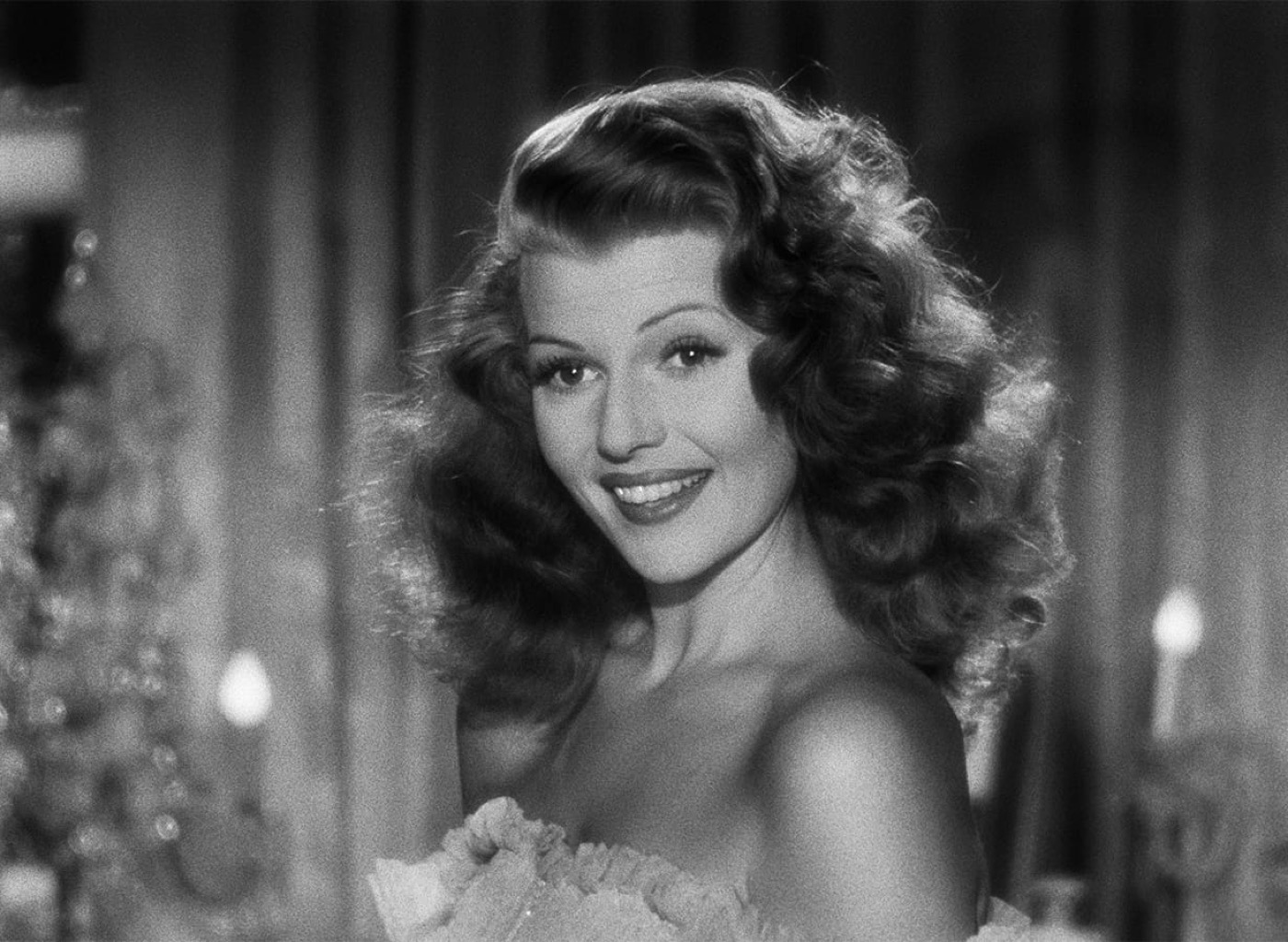
The vision of Rita Hayworth in a black satin dress, gloves sliding suggestively down her forearms as she sings ‘Put the Blame on Mame’, endures as a singular image of burgeoning Hollywood sexuality; it remains a bona fide “star is born” moment for Hayworth. As she sings, the words filling the room like cigarette smoke, we can’t help but wonder where she came from—seemingly dropped out of space into a nightclub to make every person question how the hell they ever lived without her.
But Gilda, both the film and the eponymous character, is loaded with artifice. They are moving illusions which director Charles Vidor delights in revealing over the course of a cruel, scintillating two hours. We find our characters down and out in Buenos Aires at the tail end of the Second World War. Gilda performs in an illegal casino, just a touch too gaudy to disguise its underlying seediness. It’s owned by her husband, a scar-faced sadist named Ballin Mundson (George Macready). He is cruel, controlling, and walks with a cane that conceals a knife at one end.
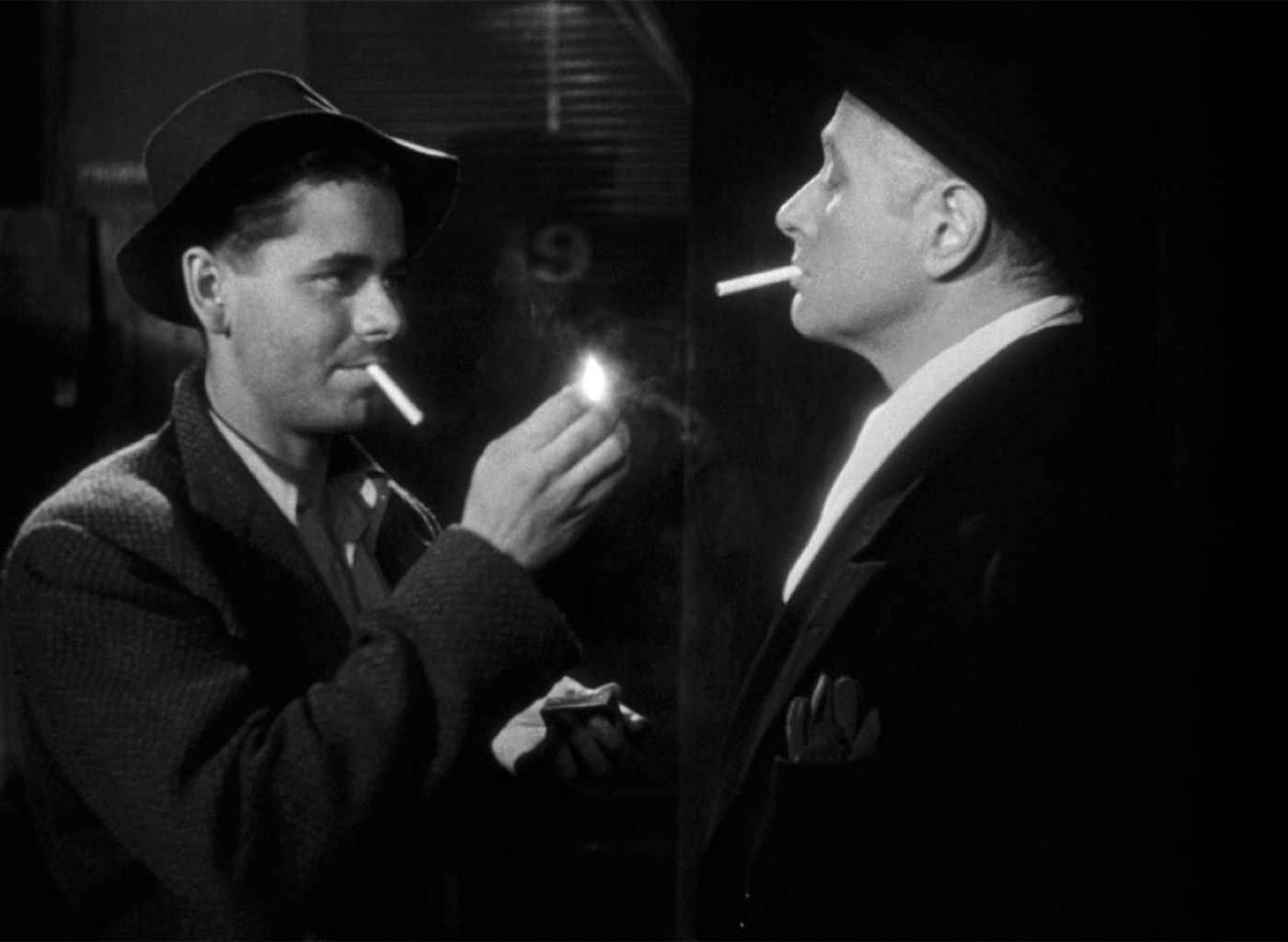
Completing the trio is our ersatz hero, Johnny Farrell (Glenn Ford), a chancer who carries his own set of loaded dice and has a knack for counting cards. Mundson rescues Johnny one night from a beating in a back alley and proposes he visit his casino—but what should feel like salvation seems more like entrapment. What kind of business tycoon hangs out in dark alleys in the wee small hours? And what kind of lowly con artist would agree to go anywhere with him?
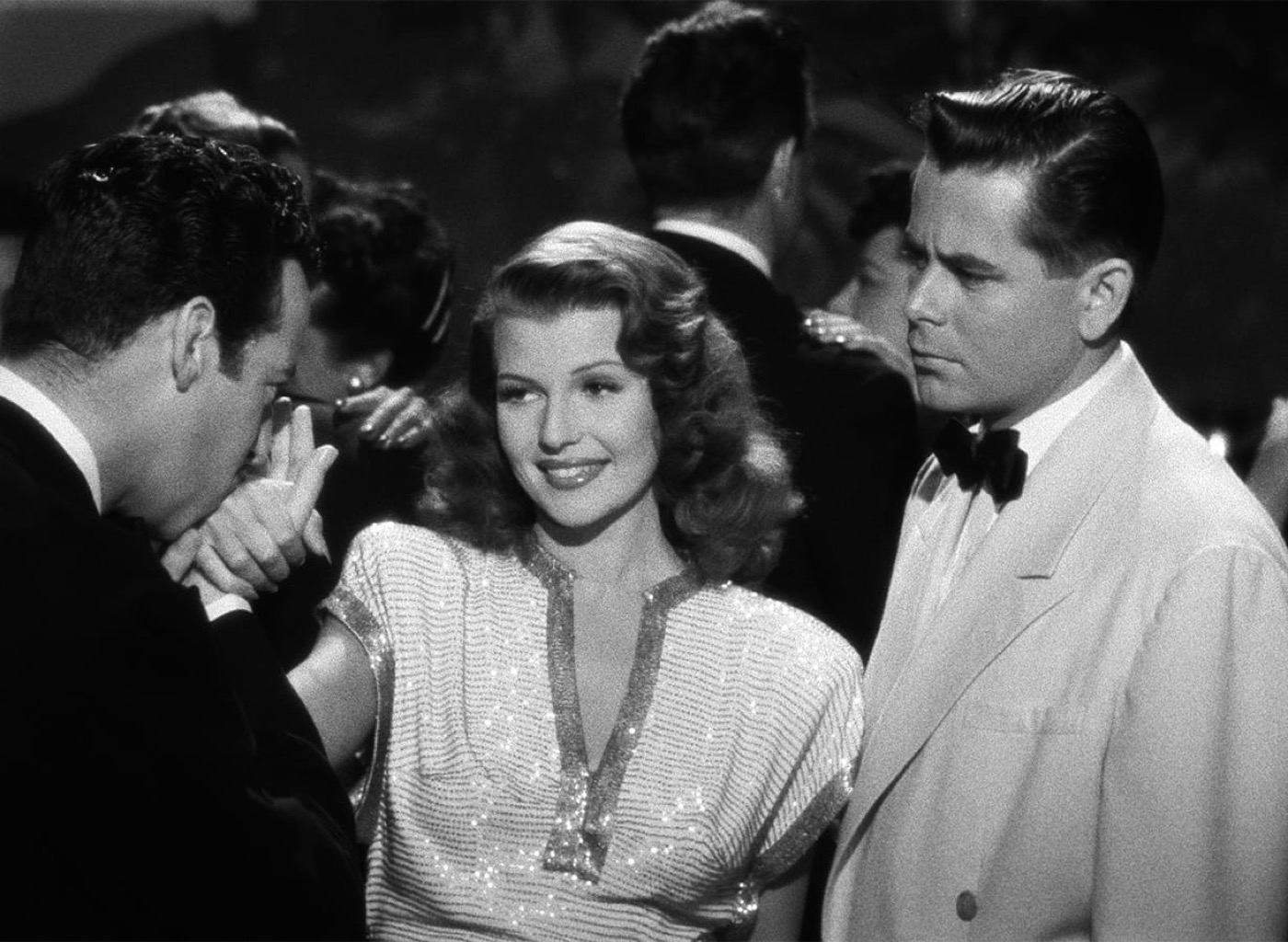
Charles Vidor and Jo Eisinger, a noir veteran who adapted the screenplay from a story by E.A Ellington, lay a trap for the audience so seductive that once we realise we’re in it, we’re as helpless as Johnny. But what makes Gilda stand out among its film noir peers is that the trap itself has little to do with anything practical or typical of the genre; Mundson, Gilda, and Johnny, pulled ever closer to the centre of their own storm, don’t appear to be driven by money or power. What fuels them instead is a twisted, sadomasochistic desire to inflict pain on each other. They are broken people looking to break each other.
Johnny pads around the floor of Mundson’s casino with a wry grin on his boyish face, his eyes darting in search of his next con. Yet his prowess slips away, his smirk laden with frustration and desire whenever Gilda appears. Her mere presence cuts him down to size. The devilishness in his demeanour is in the mould of classic noir masculinity, but with a child-bully inflection; sometimes it’s unclear whether Johnny wants to kiss Gilda or fire a slingshot at her.
Mundson and Gilda are recently married, having only met the day before they said their vows. As Gilda throws her head into the frame—captured in crisp black and white yet somehow burning red, gold, and wild—she responds to Mundson’s question, ‘Gilda, are you decent?’, with a coquettish smile: ‘Me? Sure, I’m decent.’ Is any of this decent? It certainly doesn’t feel it.
At all times there is a sense of manoeuvring. Just why would someone like Mundson want Johnny to manage his casino? And what are we to make of Mundson’s instruction that Johnny stay away from women, before he goes out of his way to introduce Johnny to Gilda?
The film’s allure lies in these questions, and in the strange valleys between how these people present themselves and what they truly desire. As Gilda, Hayworth maintains an enticing but distancing poker face. She plays the part perfectly: half swept up in the illusion of glamour and sex, half petrified that anyone might ask about her past.
And though this is perhaps the Rita Hayworth role—the one in which she became cinematically immortal—it feels tied into the fabric of the film that she had, in fact, been acting for 20 years with over 30 film credits to her name. Despite the bolt-of-lightning arrival of Hayworth in Gilda, she too had a story. And her name hadn’t always been Hayworth.
Hayworth was born Margarita Carmen Cansino to artist parents in Manhattan in 1918. Her father was of Romani and Spanish heritage; by the time she was under contract at Fox in the 1930s, short-sighted studio heads were worried that she was “too Mediterranean” and retooled her image to align with the All-American lie. Perhaps it was fitting that the film in which this artifice was laid bare would be helmed by an immigrant—Vidor was a Hungarian war veteran who surely felt a pang of outsiderism within the Hollywood studio system.
Gilda is nothing if not a film about outsiders. At its centre is an autonomous woman treated like an idiot child by everyone around her. Mundson won’t kiss or even touch Gilda, but his words are far more oppressive than any action could be. As he watches her evening routine after a show, dressing down and taking off her jewellery, he expresses his perspective: ‘You’re a child, Gilda. A beautiful, greedy child. And it amuses me to feed you beautiful things because you eat with such a good appetite.’
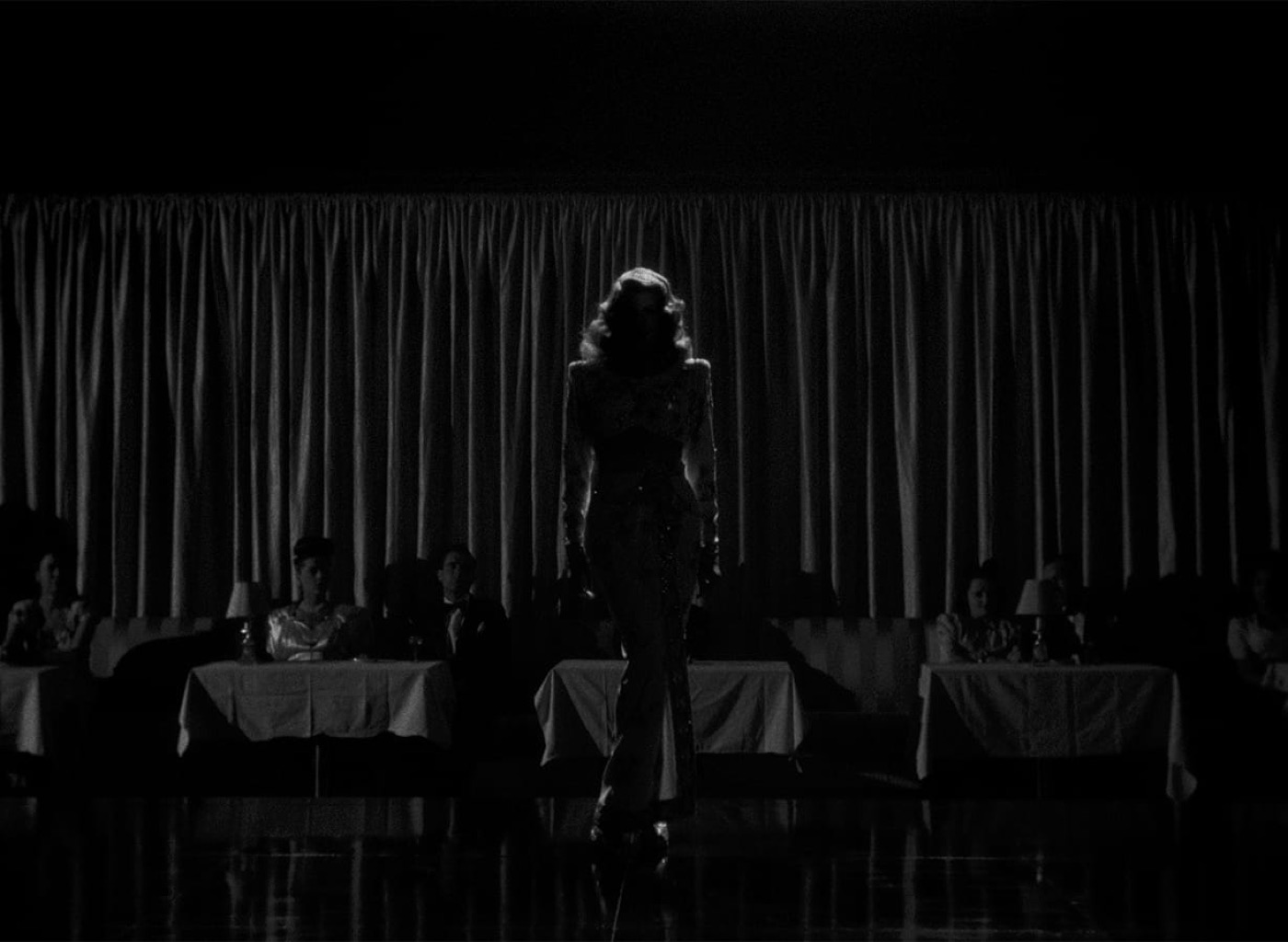
Gilda is desired by everyone and respected by no one. She is surrounded by rooms filled with lusting men who want what she can offer but none of the reality of her personhood. Yet it’s lust that gives the film its thrust and electricity. It’s a broken kind of lust, though—a confused, twisted version of desire that can only end in mutual destruction.
Simmering just beneath the surface is the unspoken, furtive tension between the men. Increasingly, we get the sense that Mundson is getting off on watching Johnny ogle what he can’t have. But there is something deeper and more forbidden astir: a tangible sexual tension between the two men.
What slowly emerges is a thorny, complicated vision of queer desire and a misplaced lust for ownership. If film noir was the genre that could play in the shadows and delve into the then-taboo, then Gilda is perhaps one of the most groundbreaking of its kind.
There is electricity between the men, buried under business and handshakes, but sporadically professed. ‘I was born last night when you met me in that alley,’ Johnny tells Mundson. ‘That way I’ve no past and all future, see?’ It’s easily the most romantic dialogue in the film—the words of someone enraptured in a whirlwind romance.
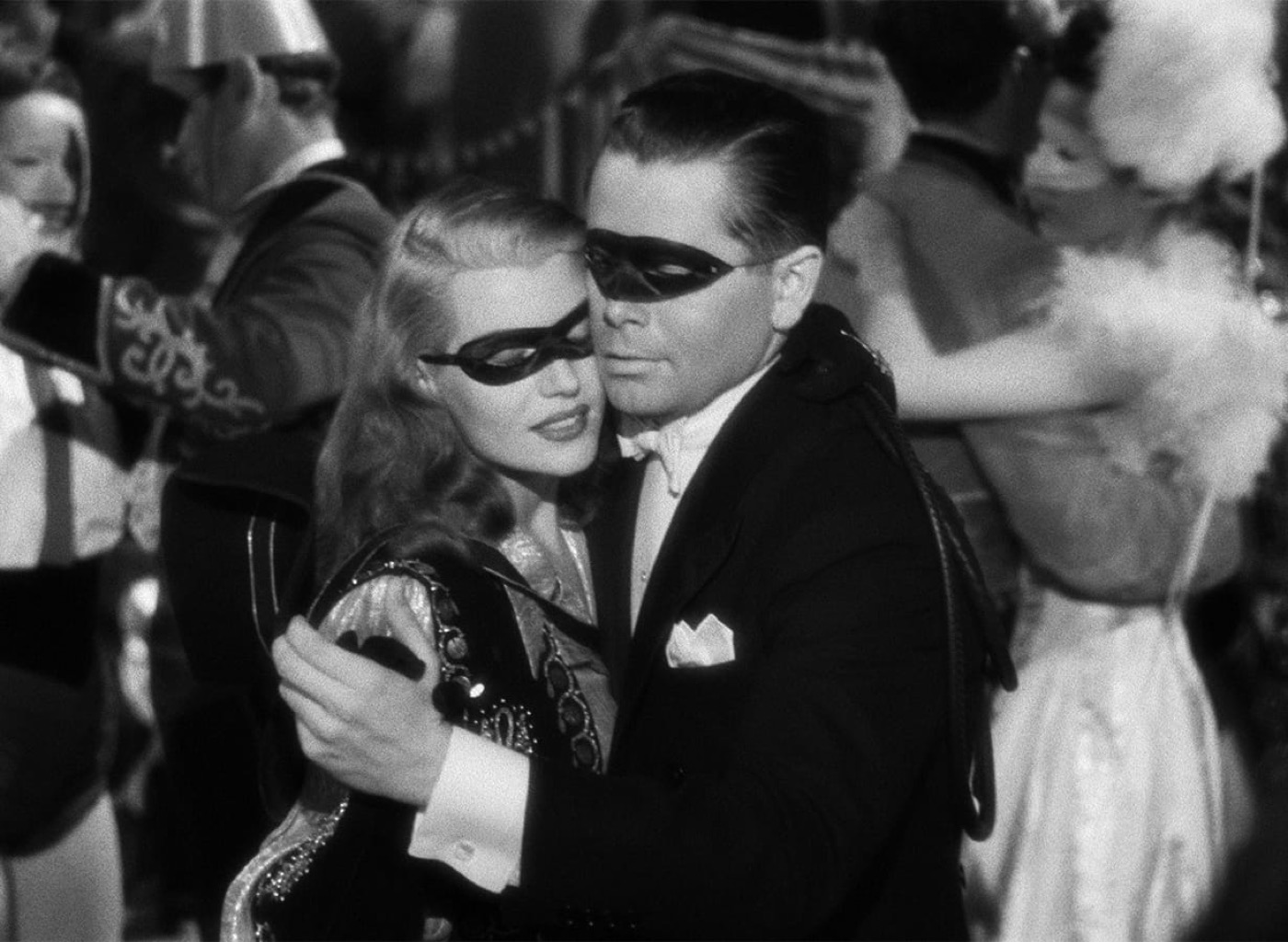
But there is mostly loathing, jealousy, and hatred, much of it carved out years ago. Johnny and Gilda have a past—largely mysterious and kept hidden from Mundson. Whatever happened between them, it ended badly. ‘I’ve been hearing her voice in my sleep for nights,’ Johnny narrates, Gilda taking on almost supernatural proportions of libidinous torture. Later, her smile breaking and her image faltering, she breathes the words she’s longed to tell Johnny between kisses: ‘I hate you so much I think I’m going to die from it, darling.’
And so we have a strange love triangle formed of deceit. Mundson, almost double the age of Johnny and Gilda, uses these “kids” for his amusement; both are too broken and confused, too clouded by impulse and desire, to get out while they can. While many film noir plots tug at a slow realisation that it’s all a big frame-up, Gilda’s strange potency comes from the fact that these people enjoy being playthings. They want to hurt and to be hurt. They toast to the three of them—all without pasts.
What ultimately thrills about Gilda is its moral ambiguity and its hedonism, because it exists beyond money, guns, and police. It’s something more recognisably human: a film about broken people making bad decisions in the pursuit of feeling anything at all.
They hold cigarettes but seldom take puffs, the ash whittling away to nothing. The war ends and none of them care. A gambler blows his brains out in the restroom, unable to repay his debts to the casino; an employee sees the aftermath and blows a raspberry. Life goes on, and we hardly ever see the sky. Our trio are damned by past lives and saddled with desire and no means to satisfy it. Gilda is where film noir goes when it dies: a limbo of vagabonds and lost souls paying for sins that they can no longer remember.
USA | 1946 | 110 MINUTES | 1.37:1 | COLOUR | ENGLISH • SPANISH • FRENCH • GERMAN

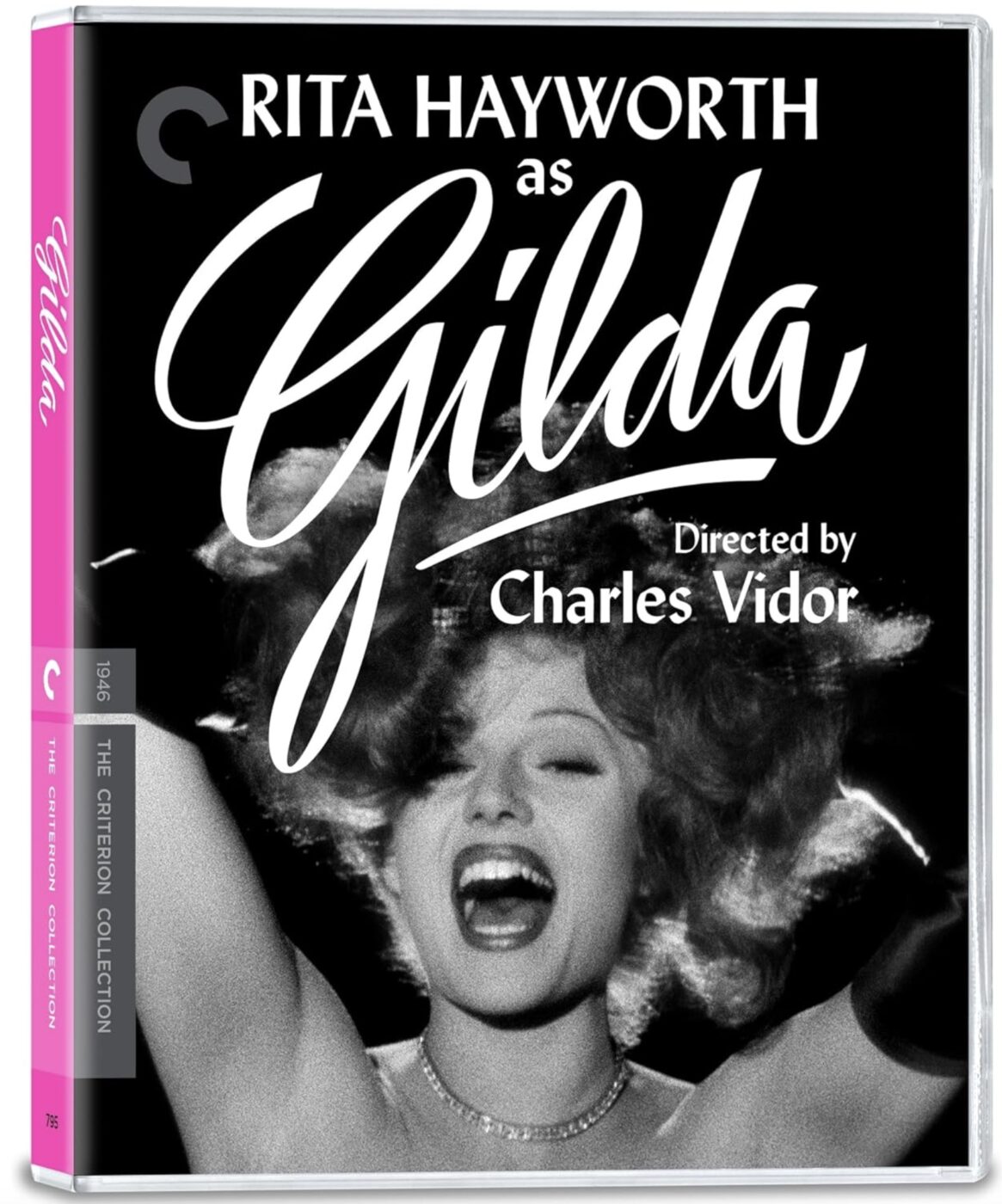
This new Criterion disc contains a new 4K digital restoration of the film with an uncompressed monaural soundtrack. Visually, the film is absolutely gorgeous. Rudolph Maté’s cinematography is stylish and rich; seeing the amount of detail in the world he and Vidor construct is a treat. The lavish sets are filled with striking details, from the props to the mise-en-scène, all of which stand out in this new restoration. There’s a real sense of glow and light, especially in the more Vaseline-smeared star-shots of Hayworth. It’s a film of shadows and light, and the contrast spectrum here is truly impressive. The film grain is present and, though it’s an 80-year-old film, the dialogue is clear throughout, while the music has clarity and heft.

director: Charles Vidor.
writers: Marion Parsonnet, Ben Hecht (uncredited) & Jo Eisinger (story by E.A Ellington).
starring: Rita Hayworth, Glenn Ford, George Macready & Joseph Calleia.