FALLING DOWN (1993)
Sitting one day in yet another traffic jam, an ordinary working man decides he’s had enough, and sets off on a violent spree across Los Angeles


Sitting one day in yet another traffic jam, an ordinary working man decides he’s had enough, and sets off on a violent spree across Los Angeles
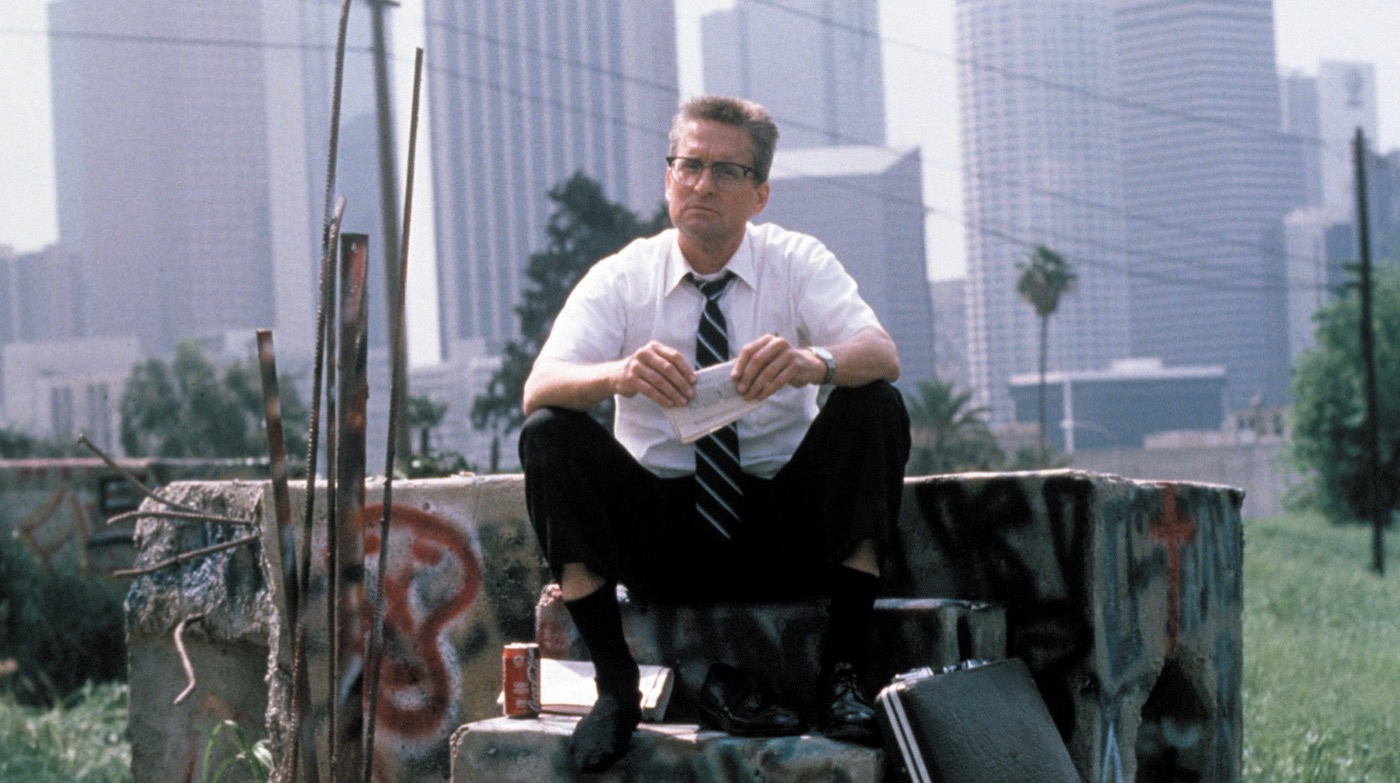
We don’t learn a great deal about the backstory of William Foster (Michael Douglas) in Falling Down, but we can be absolutely sure he voted for George Bush in 1988 and Ronald Reagan in the two preceding elections.
This is no minor detail: Falling Down is very much a film of its time. Critics often make much of the fact that this tale of urban frustration boiling over into street violence in Los Angeles appeared less than a year after the city’s 1992 riots – filming was even briefly suspended because of them. Equally important, however, is that the Cold War had suddenly evaporated between 1989 and 1991, taking with it the jobs of many American defence workers like Foster.
Foster was proud of his work; his custom licence plate reads ‘D-FENS’, a moniker he is sometimes called by. He sees himself as a man who gave everything to defend his country, only to be cast aside. “I’m the bad guy?” he asks rhetorically at the film’s climax. “How did that happen? I did everything they told me to… They lied to me.”
He did everything they told him to. Foster is a nostalgic conservative with a haircut straight out of the Eisenhower era. He wouldn’t fit well into today’s MAGA movement – he’d doubtless like to see America made great again, but in a sensible, well-organised way. Nor is he an out-and-out hater, despite the character’s reputation. There’s little doubt he’s something of a racist and a male chauvinist, but these traits stem from an old-fashioned worldview rather than deeply held malice; he’d probably be mystified if accused of either.
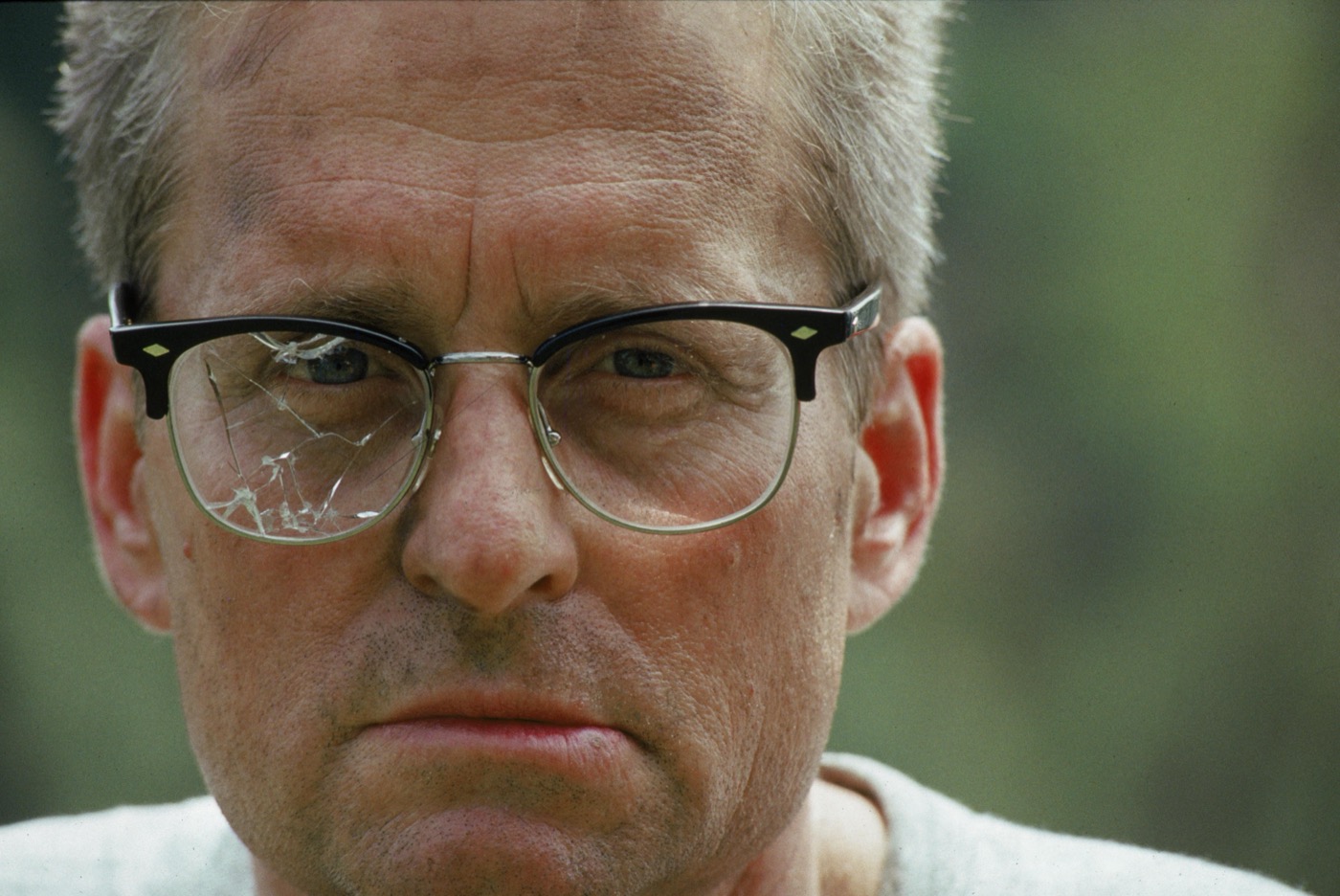
He’s also, possibly, unstable. There’s more than a touch of Travis Bickle from Martin Scorsese’s Taxi Driver (1976) in Foster. Though he barely loosens his tie for much of the film, notable visual changes near the end signal his spiralling loss of self-control. Just how unhinged Foster is remains uncertain, and much of the film’s success lies in the way he’s simultaneously sympathetic (some of his grudges don’t seem all that unreasonable) and terrifying.
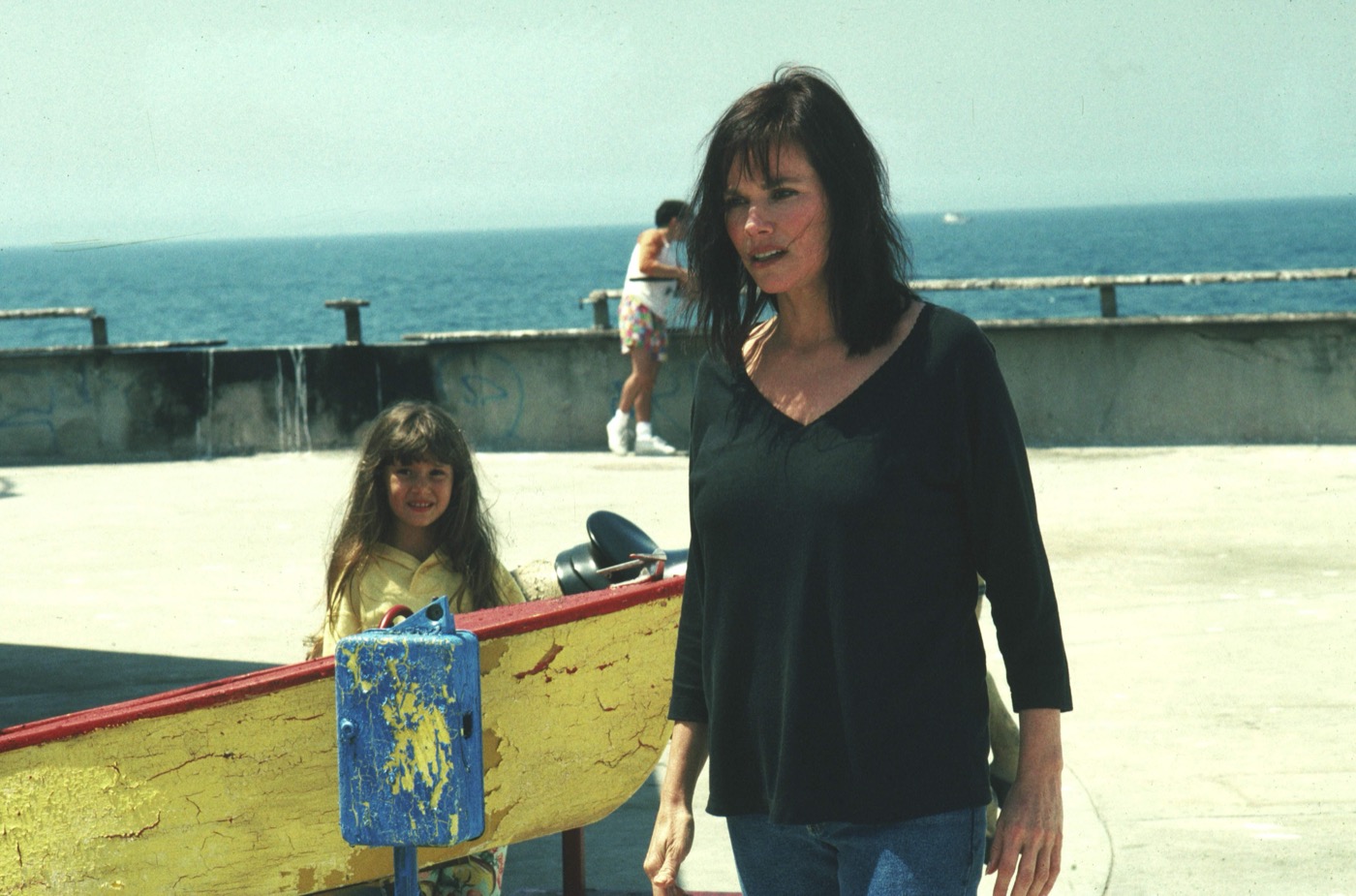
It may be his thinly veiled threats to kill his ex-wife that most alarm Police Detective Prendergast (Robert Duvall), but a sequence from an old home video is even more disturbing. In it, we see Foster forcing his young daughter to play with a toy that clearly upsets her. He’s fixated on what he imagines to be the external markers of good fatherhood,whilst being completely unable to connect with his actual child.
Foster’s character and Douglas’s performance utterly dominate the film. Even when Foster isn’t on screen, he’s almost always the central topic of conversation. Fittingly, Falling Down opens with an extreme close-up of him – first his mouth, then his eyes – before the camera pulls back to reveal him trapped in yet another Los Angeles traffic jam. The near-silence suggests how firmly the car insulates Foster from the outside world, like most Angelenos, yet tiny irritations still seep in.
A fly annoys him. You can feel the stifling heat. Exhaust fumes pour from the car ahead. A giant Stars and Stripes on a passing bus seems to mock the surrounding dysfunction with its supreme confidence in American superiority. Slowly, the soundtrack edges up, and James Newton Howard’s score becomes audible, ratcheting up the tension. Foster remains stuck, maddened by the fly. A little girl stares at him from a neighbouring vehicle; a grinning Garfield doll appears infuriatingly inane.
It’s a masterclass of an opening: every frame serves a purpose in setting the scene and heightening the contrast with what follows. Foster opens his door and steps out into the gridlock. The swell of sound abruptly cuts out; there’s a sense of immediate release, but also a feeling that he’s crossed a point of no return. The first line of dialogue – spoken by another driver who asks, “Where do you think you’re going?” – underlines this moment. The question highlights that Foster has done something almost unthinkable by simply opting out of the traffic jam, but it could just as easily apply to Foster’s moral trajectory or, indeed, to post-Cold War America itself.
So where is he going? Home, it turns out – or rather, to the house his ex-wife and daughter live in several miles away. It’s no longer his home, though he seems unwilling or unable to accept this reality. So off he sets, striding westwards through the streets of a city where nobody walks. There’s a faint echo here of a classic western hero: an upright,resolute figure carving a path through peril. That’s almost certainly how Foster sees himself.
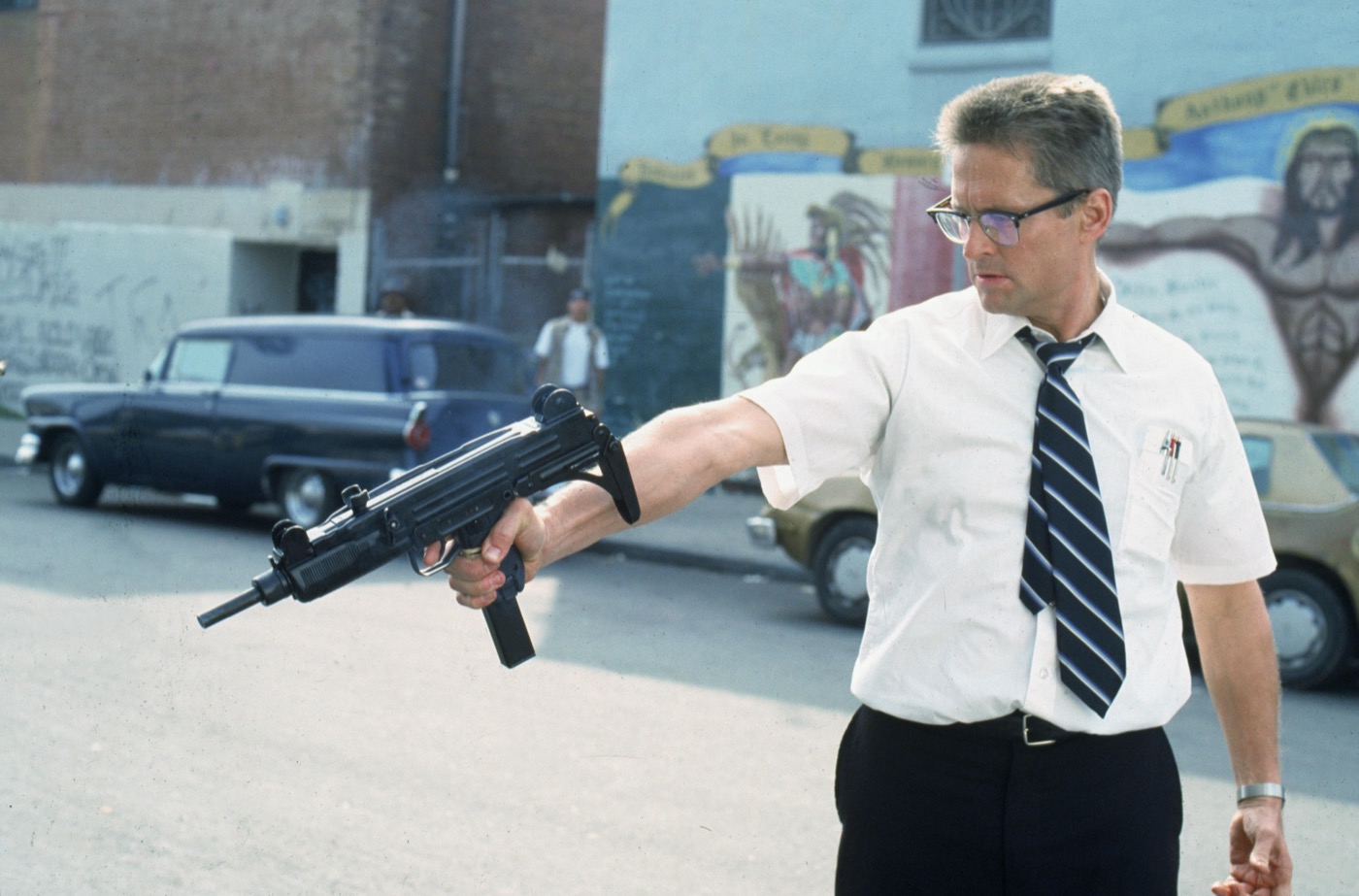
Along the way, he encounters several figures who draw his ire: a grocery store owner Foster believes is price-gouging (Michael Paul Chan), a pair of gang members, a neo-Nazi army surplus dealer (Frederic Forrest), fast-food employees, obstructive road workers, and two country club golfers who order him off “their” course. He eventually abandons his briefcase and steadily upgrades his arsenal, progressing from a baseball bat to a knife, handguns, and ultimately a rocket launcher.
Narratively, the screenplay fits together like clockwork, with virtually every scene feeding into the next. Chekhov’s gun appears early in the form of a plastic water pistol. The street backdrops constantly reflect Foster’s mindset and his perceived victimisation: one poster reads ‘KILL-KILL-KILL’, a bumper sticker reads ‘E’AT SHIT’, and another poster reads ‘I love you Daddy’. Meanwhile, his increasingly violent sprees inevitably attract police attention. It’s Detective Prendergast – working his final day before retirement – who connects the dots and realizes these incidents are all the work of one man.
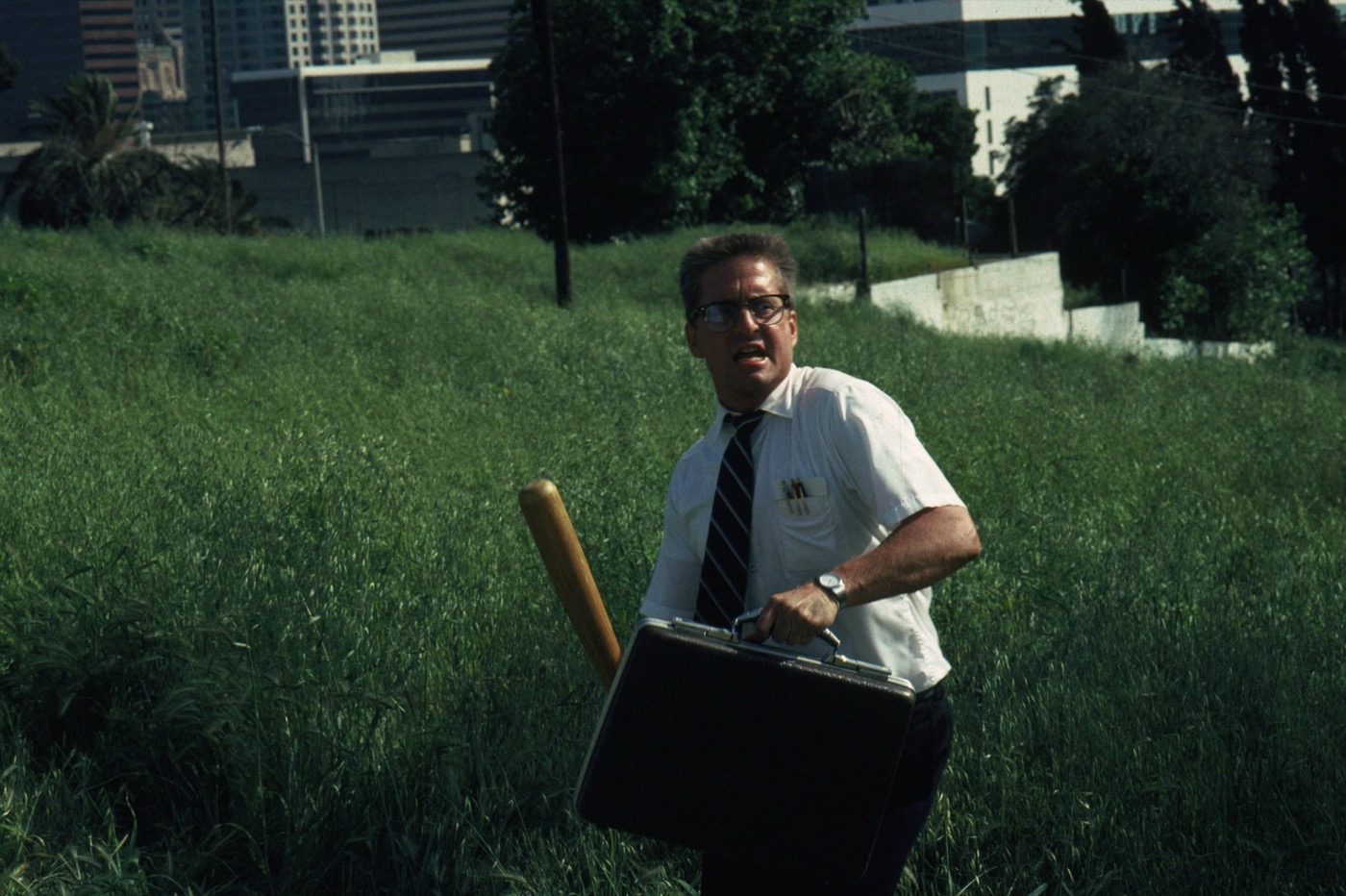
Ebbe Roe Smith’s screenplay is remarkably precise in the way it alternates between Prendergast and Foster, drawing constant parallels between the two men. Prendergast is trapped in the very same traffic jam at the start and also abandons his car (albeit for a practical reason). Both men are leaving their careers earlier than planned, though Prendergast is retiring voluntarily whilst Foster was made redundant. Both have lost daughters under different circumstances, and both repeatedly call their wives or ex-wives. Furthermore, Prendergast plans to move to Lake Havasu City, Arizona – home to the reconstructed London Bridge. He sings “London Bridge Is Falling Down” to his wife, whilst Foster buys a snowglobe of the bridge for his daughter. The nursery rhyme, of course, gives the film its title.
While these parallels between two conservative, white-collar men illustrate that violence isn’t the only response to life’s disappointments, Joel Schumacher’s direction uses the visual frame to highlight their fundamental differences. The Prendergast scenes are more intimate, relaxed, and tightly framed; the Foster scenes are mostly shot outdoors, framing him as a small, isolated figure against the cityscape.
Key details about Foster remain ambiguous. Just how unhinged is he? The world certainly treats him poorly at times,and many viewers will sympathize with his frustration. Yet his reactions are wildly disproportionate; he can’t even stand in a bus queue without letting his resentment boil over. Smith’s script keeps us guessing until the final act, and the triumph of Douglas’s performance is how little he gives away. We can only judge Foster by his actions: while many are clearly extreme, others feel surprisingly justified.
This ambiguity extends to the film’s handling of race. Critics sometimes argue Falling Down implicitly validates racist attitudes by failing to condemn Foster’s behaviour strongly enough. In reality, very little of what he does has a clear racial motive. Across nine violent incidents, his targets (excluding bystanders) consist of eight white people, three Hispanics, and one Asian – almost all of them men. Most of his adversaries belong to the white working class, just like him. (The scene where he wrecks a golf course was added specifically to show him taking aim at the wealthy elite as well as working-class stiffs.)
True, he does suggest that the Korean grocer has moved to “my country”, implying the other man isn’t fully American. However, what triggers the altercation is the grocer’s prices. The far more telling line is Foster’s shout: “I’m rolling prices back to 1965!” It isn’t the grocer’s ethnicity that infuriates him; it’s the fact that it isn’t 1965 anymore. When the neo-Nazi declares, “We’re the same,” Foster reacts with genuine disgust. Far from being a white supremacist rampage, his only interactions with Black characters are surprisingly friendly: one involves a protester outside a bank demonstrating against economic disenfranchisement (coining the phrase “not economically viable”), and the other features a young boy teaching Foster how to operate a rocket launcher after seeing it on television.
Whilst Douglas dominates the screen, Duvall is equally compelling in a quieter role. If we’re never entirely sure how to feel about Foster, we can’t help but root for Prendergast, who comes across as thoroughly decent and grounded. The supporting cast shines as well, particularly Chan as the grocer, Forrest as the neo-Nazi, Raymond J. Barry as Prendergast’s toxic superior, and Rachel Ticotin as his sharp junior colleague.
Falling Down is ultimately a tragedy. While it’s too polished and entertaining to be truly bleak, it remains deeply unsettling in its refusal to flatten Foster into a simple villain. Given these heavy themes, it’s easy to overlook how funny the film can be. Part of the humour comes from the sheer catharsis of watching Foster act out common urban fantasies, but it’s also present in the smaller details – like the absurd hamburger-shaped hats worn by the fast-food staff, or Foster’s dry exchanges with an incompetent liar in a park.
One might expect these satirical elements to clash with the darker themes, but Smith and Schumacher blend them seamlessly. The film’s narrative economy – where every line and action advances both plot and theme – gives it the heightened quality of a modern fable: the story of a man violently unraveling because he can’t accept that the world he knew has moved on without him.
USA | 1993 | 113 MINUTES | 2.39:1 | COLOUR | ENGLISH

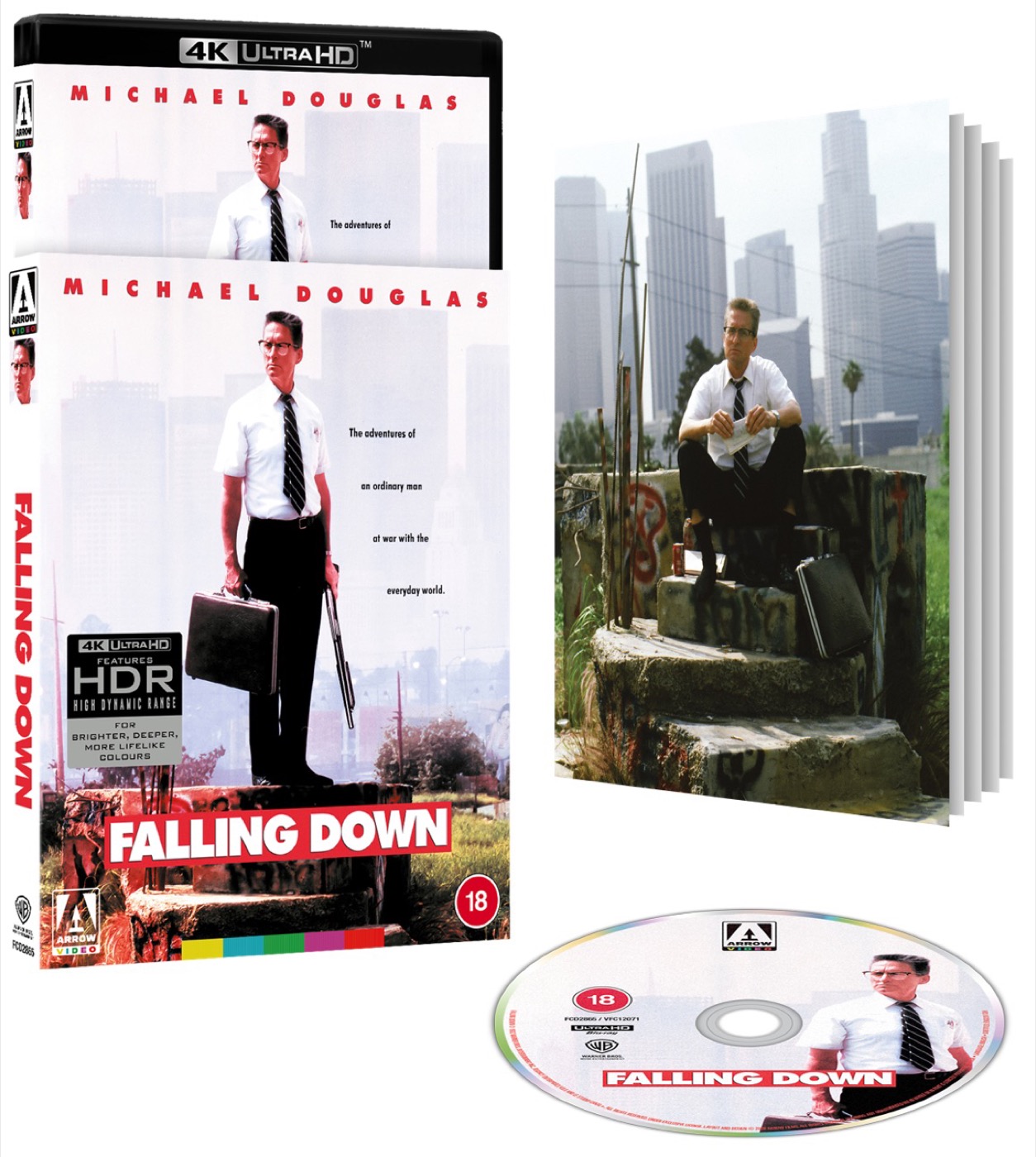
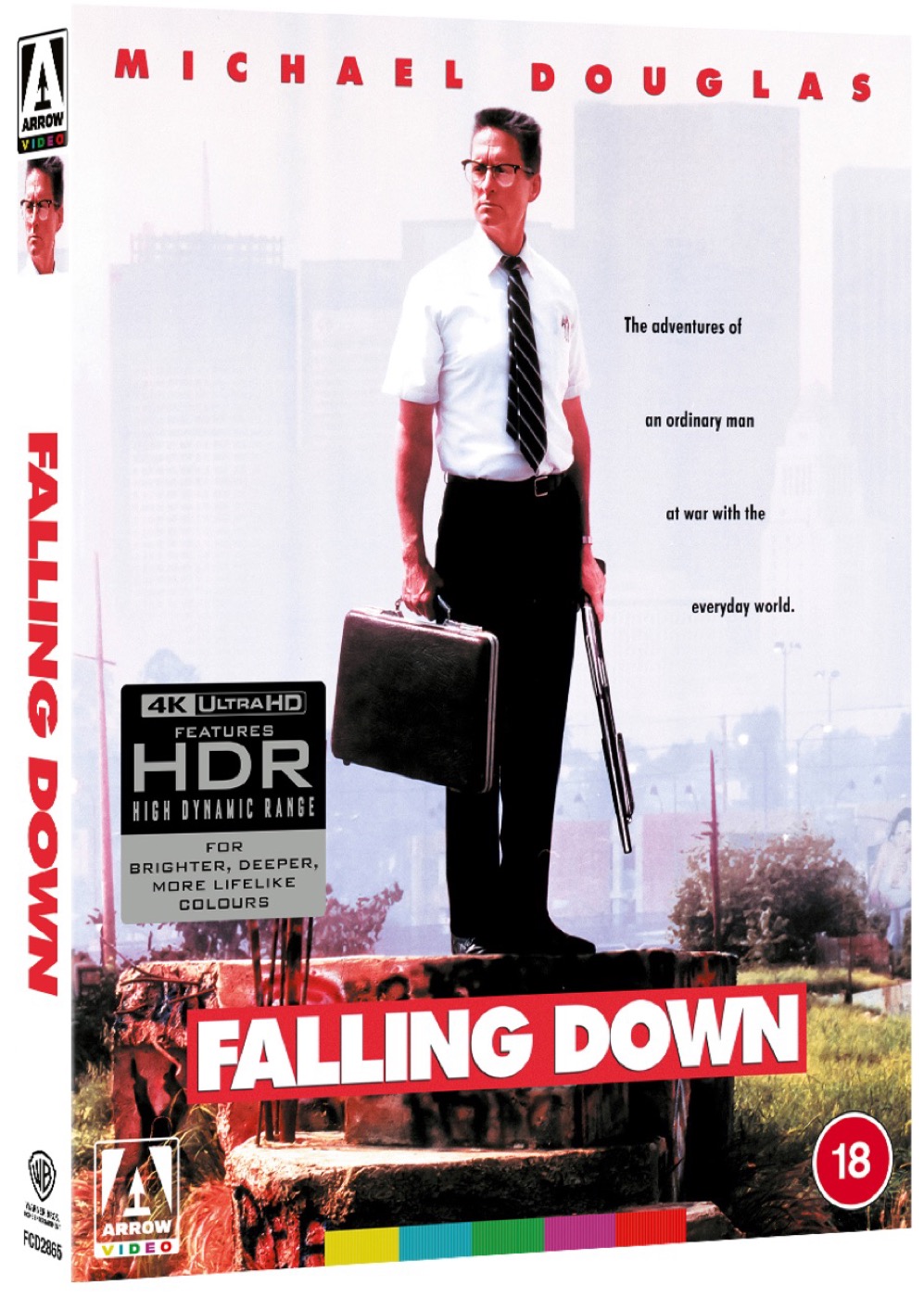

director: Joel Schumacher.
writer: Ebbe Roe Smith.
starring: Michael Douglas, Robert Duvall, Barbara Hershey, Rachel Ticotin & Tuesday Weld.