WEST SIDE STORY (1961)
Two youngsters from rival New York City gangs fall in love, but tensions between their respective friends build toward tragedy.


Two youngsters from rival New York City gangs fall in love, but tensions between their respective friends build toward tragedy.
Before there is an image, there’s a whistle. Three calls emerge from complete darkness. Then Leonard Bernstein’s overture begins, accompanied by Saul and Elaine Bass’s composition of vertical lines and changing colours. The shapes remain abstract for several minutes before resolving into the Manhattan skyline. An aerial sequence follows, sweeping across New York before descending towards a handful of streets on the Upper West Side. An apparently limitless metropolis contracts into a small territory over which two rival gangs are prepared to fight. Sound, colour and movement have already begun telling the story before anyone speaks.
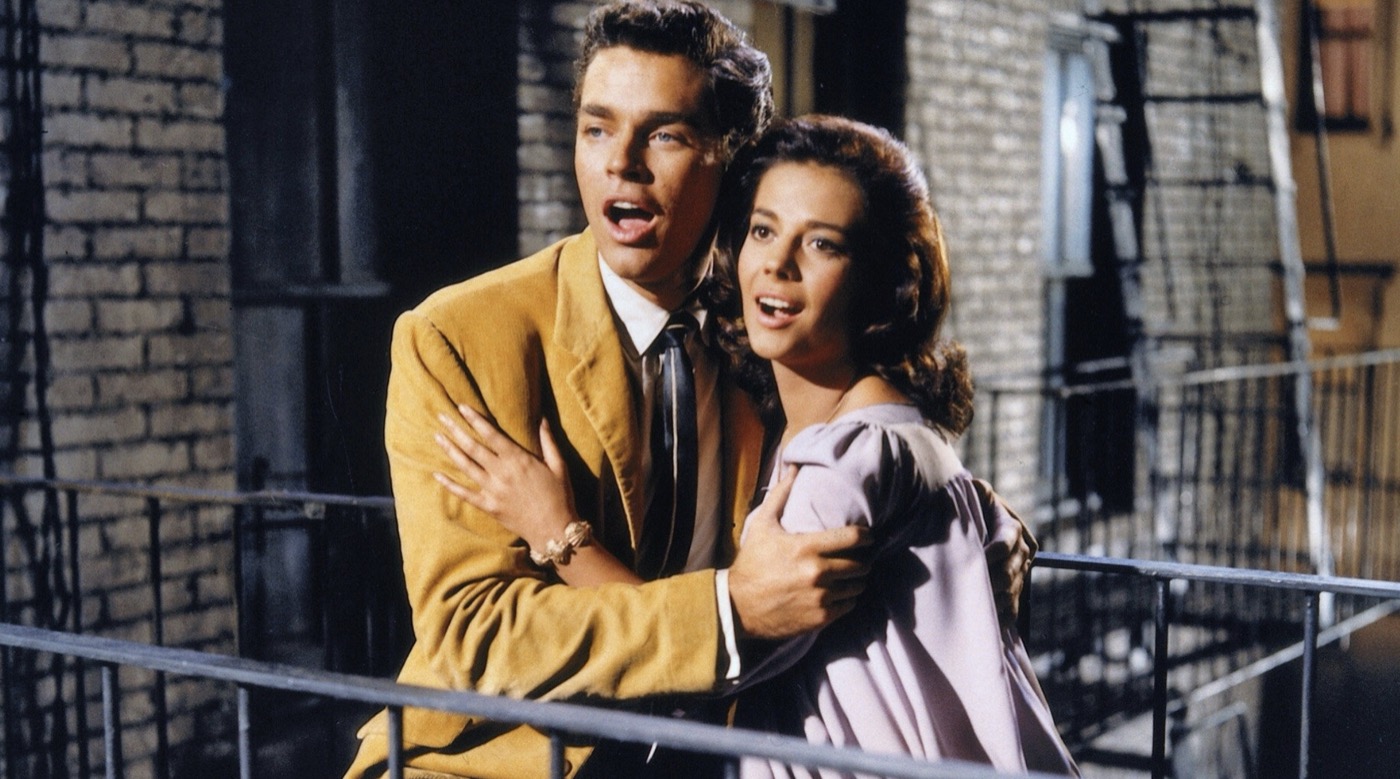
Adapted from the Broadway musical by Arthur Laurents, Bernstein, Stephen Sondheim and Jerome Robbins, West Side Story relocates Shakespeare’s Romeo and Juliet to 1950s New York. Tony (Richard Beymer), a former member of the white working-class Jets, falls in love with Maria (Natalie Wood), whose brother Bernardo (George Chakiris) leads their Puerto Rican rivals, the Sharks. The narrative’s familiar, its emotions direct, and its conclusion hardly surprising.Pauline Kael famously dismissed the film as a ‘piece of cinematic technology’. Yet Robert Wise and Robbins achieve something more interesting than spectacle imposed upon a simple story: music, choreography, performance and photography become inseparable from its dramatic construction. The film’s emotional complexity emerges through their interaction.
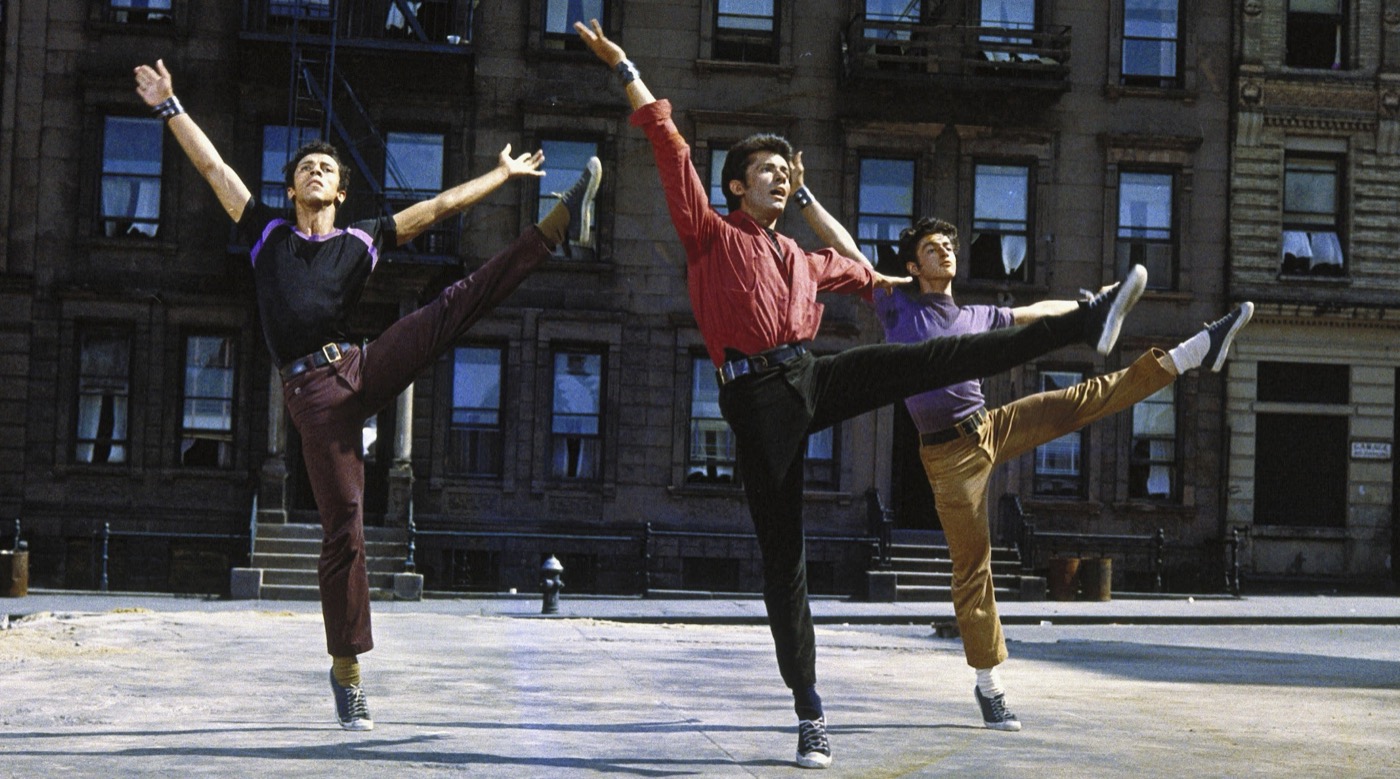
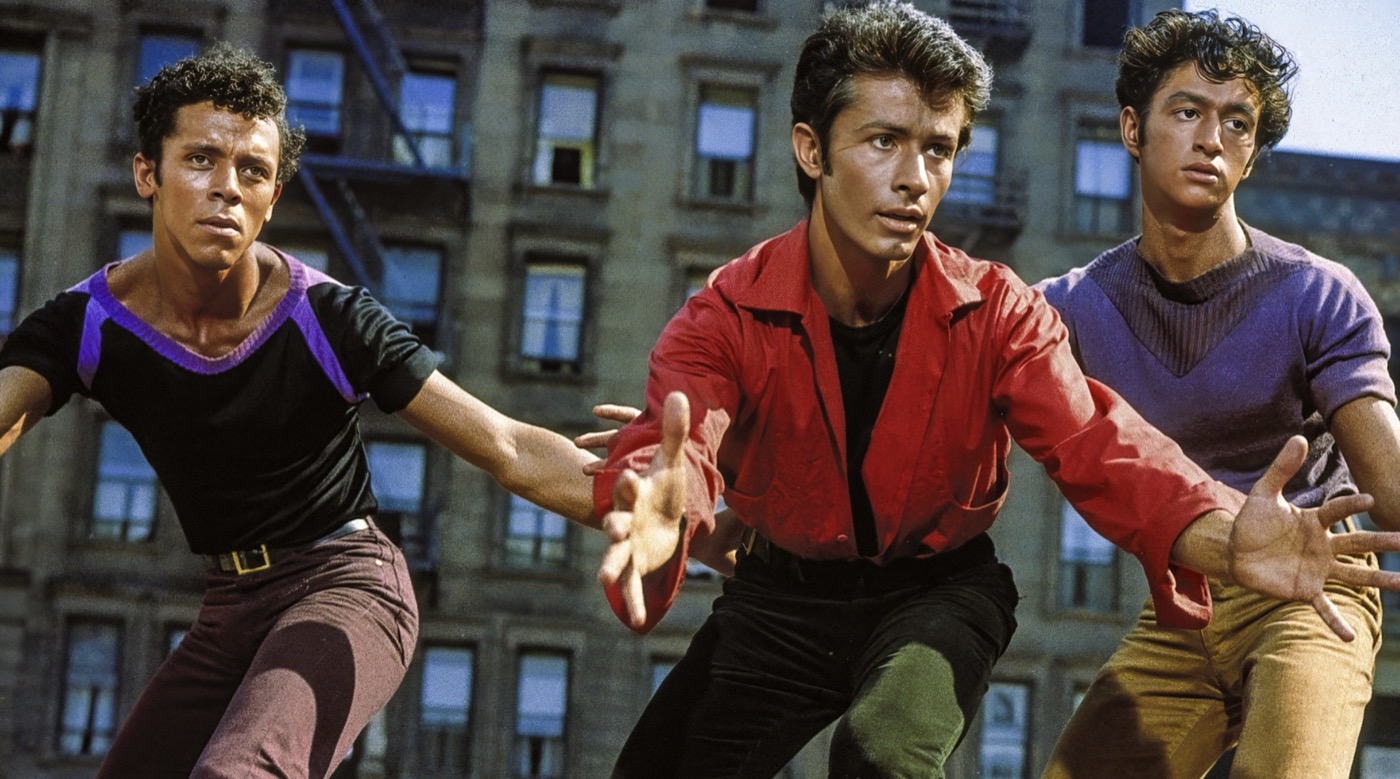
The opening street sequence establishes this principle. Fingers snap, shoulders shift, and ordinary movements develop into an organised language of territorial aggression. Robbins’s choreography is playful, athletic and exhilarating, though its purpose is intimidation. Wise turns pavements, playgrounds and fences into active elements of the composition, while Thomas Stanford’s editing preserves the continuity of the dancers’ movements. Watching these beautifully coordinated bodies creates an uncomfortable relationship with what they represent. Their energy makes the attraction of belonging immediately understandable, even as the consequences become threatening. Parts of the sequence were filmed amid the demolition associated with the Lincoln Square redevelopment, adding an irony to the territorial struggle: these young men fight for streets whose future is being determined by forces beyond their control.
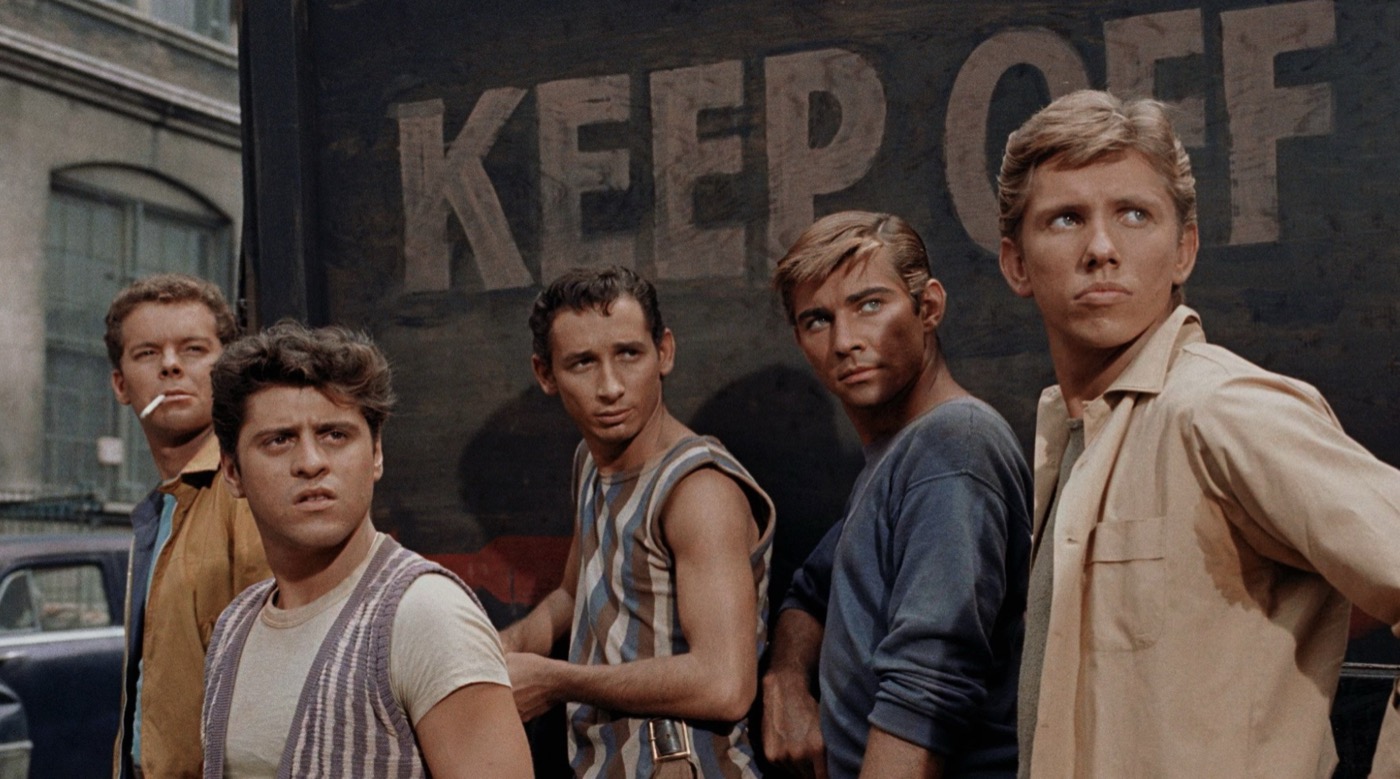
Tony’s already begun to recognise the limitations of that world. Having left the Jets to work at Doc’s drugstore, he imagines an existence beyond the group’s rivalries, but his friendship with Riff (Russ Tamblyn) continues to bind him to his former companions. Beymer’s restrained performance contrasts with Tamblyn’s nervous athleticism and Chakiris’s commanding physical presence. His relative stillness suits someone who no longer needs to demonstrate his identity through collective action. Yet his separation remains incomplete. When he suggests replacing the planned confrontation with an unarmed contest, he hopes to limit the violence while accepting the gangs’ right to settle their differences through physical domination. Tony’s escaped the organisation without entirely abandoning its values.
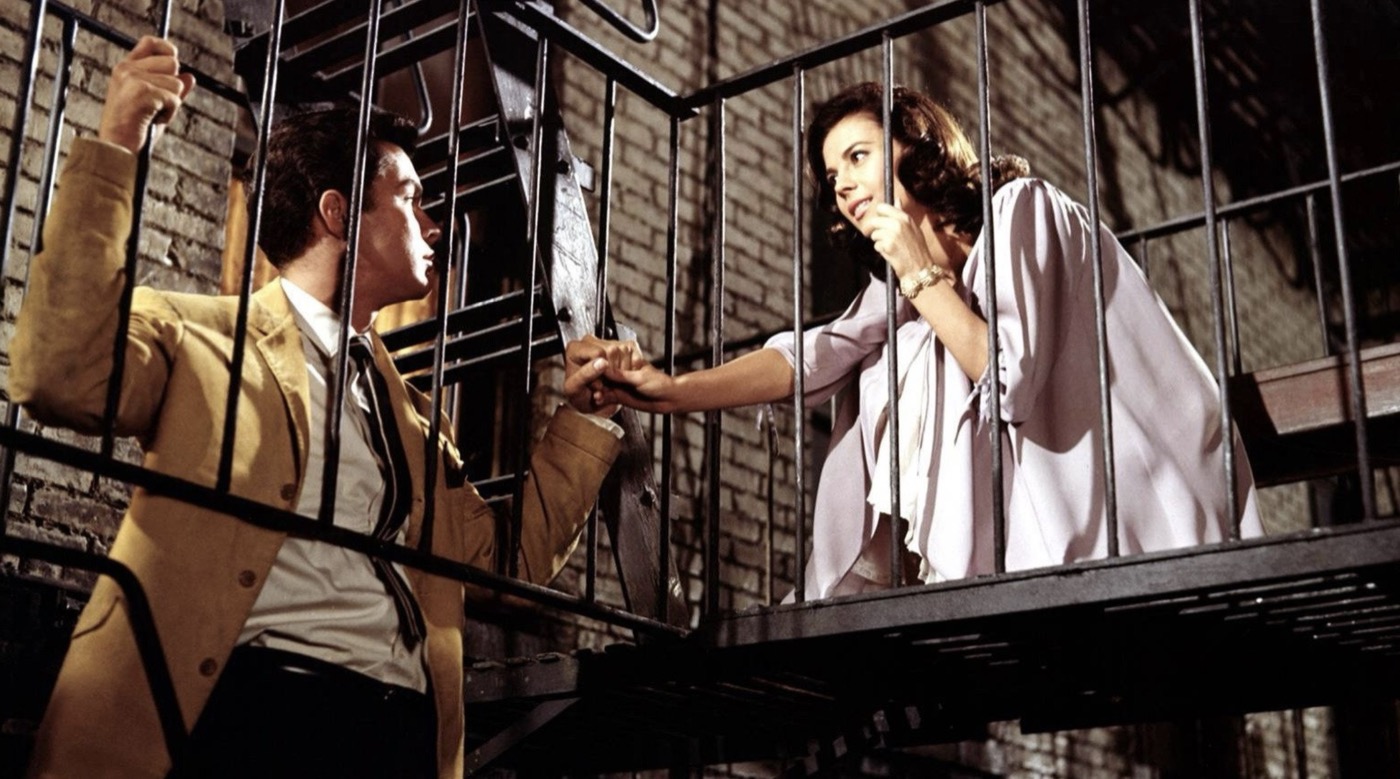
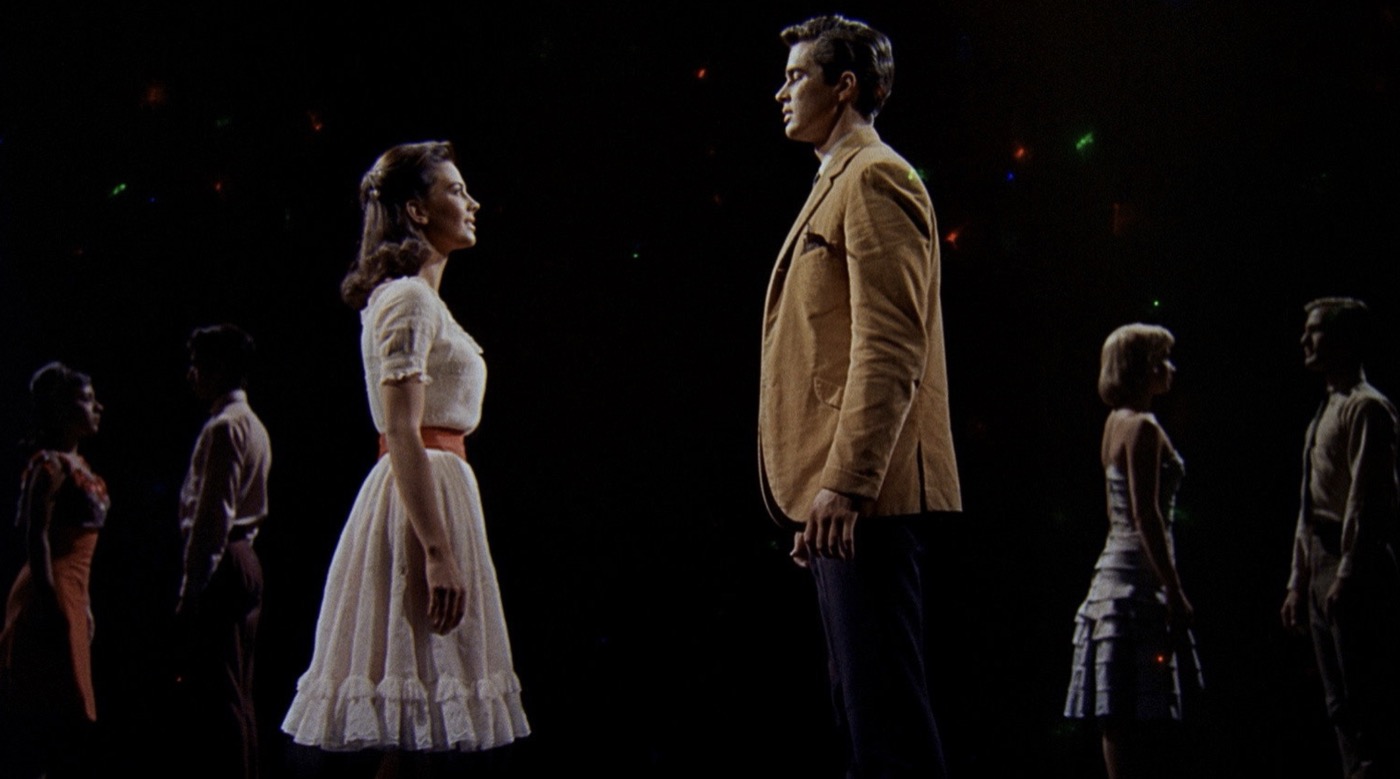
The romance introduces another visual language. At the school dance, surrounded by competitive choreography and brilliantly coloured costumes, Tony and Maria recognise one another across the crowd. Their surroundings lose definition, the dancers become indistinct, and the crowded gymnasium gives way to an abstract space. Daniel L. Fapp’s photography makes the transformation striking: a film capable of displaying intricate spatial relationships in its expansive Super Panavision 70 compositions suddenly withdraws much of that information. Two faces become the centre of a world that’s momentarily lost its importance. The image allows us to experience an alteration of perception familiar to anyone who’s fallen in love.
Wood and Beymer have sometimes been criticised for lacking the energy of their supporting players, but their quieter performances create a necessary contrast. Their beauty contributes to the film’s idealisation of love, while their measured gestures suggest an intimacy removed from the competitive physicality surrounding them. This defence of their acting can’t resolve the troubling question of their casting. Wood, an American actress of Russian descent, plays a Puerto Rican girl, while the Greek-American Chakiris portrays Bernardo. The production also darkened performers’ complexions, including that of Rita Moreno, who was herself Puerto Rican and later criticised the practice. These decisions reduce ethnic identity to a visual opposition that the film’s ambitions deserved to examine more carefully.The performers’ achievements remain appreciable, but the limitations of the production’s representational choices belong to the finished work.
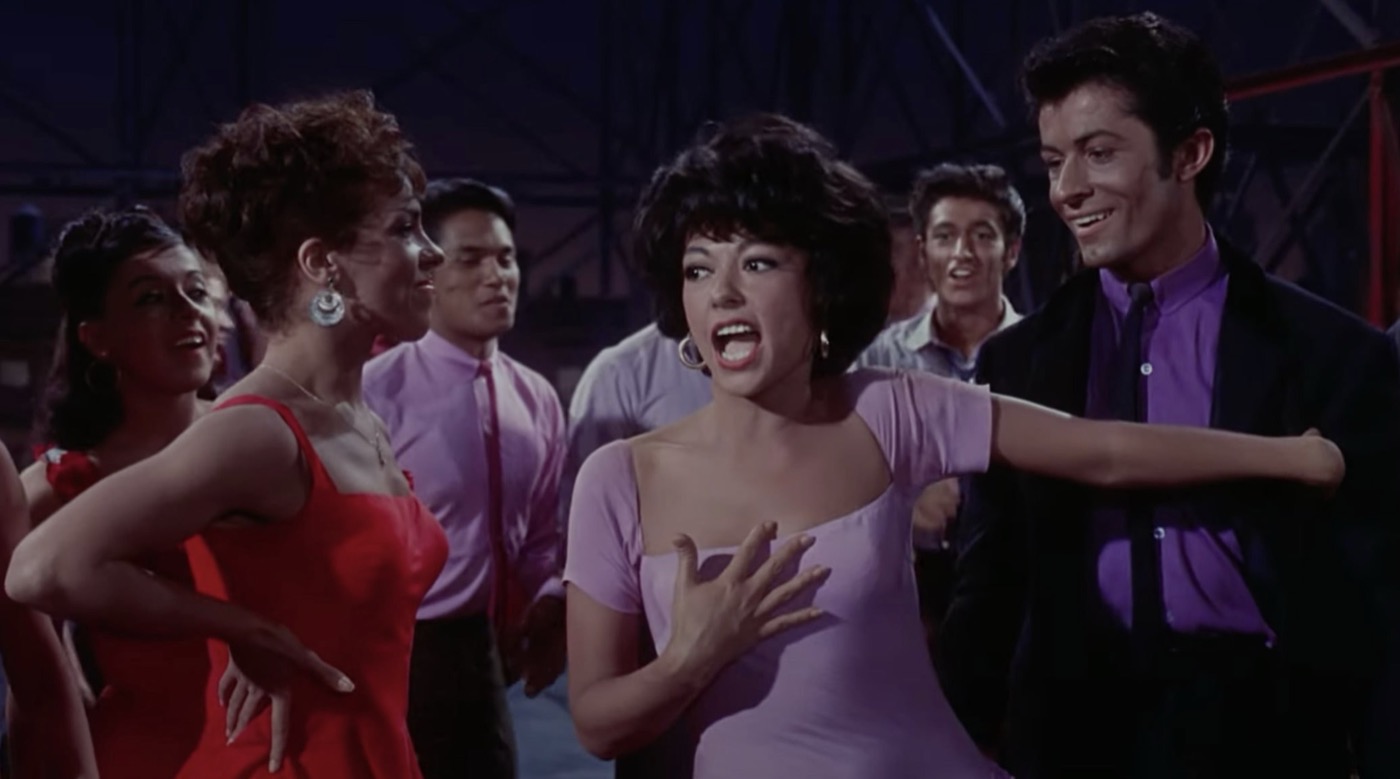
Much of the singing heard in the film also belongs to performers who never appear on screen. Marni Nixon supplies Maria’s principal singing voice, Jimmy Bryant sings for Tony, and Betty Wand performs Anita’s vocal part in “A Boy Like That”. Such substitutions reveal how musical performance can be constructed for cinema. The emotional continuity of a character emerges from the collaboration of different artists. Wood’s expression, Beymer’s physical restraint, the recorded voices and the orchestral accompaniment combine to create performances the audience experiences as unified.
The bridal-shop sequence demonstrates why their acting deserves closer attention. Tony and Maria play at getting married, assigning the surrounding mannequins the roles of relatives and guests. Their exchanges are affectionate, funny, and occasionally childish. Gradually, the game acquires genuine emotional weight. The teasing gives way to pauses, their expressions become more serious, and an overhead light lends the imaginary ceremony a sacred quality. Bernstein’s music enters discreetly beneath the dialogue before developing into “One Hand, One Heart”. Wood and Beymer establish the transformation before the song begins. The ceremony remains imaginary, but the commitment they express becomes credible through their participation in the game. They’ve briefly created the future that their circumstances deny them.
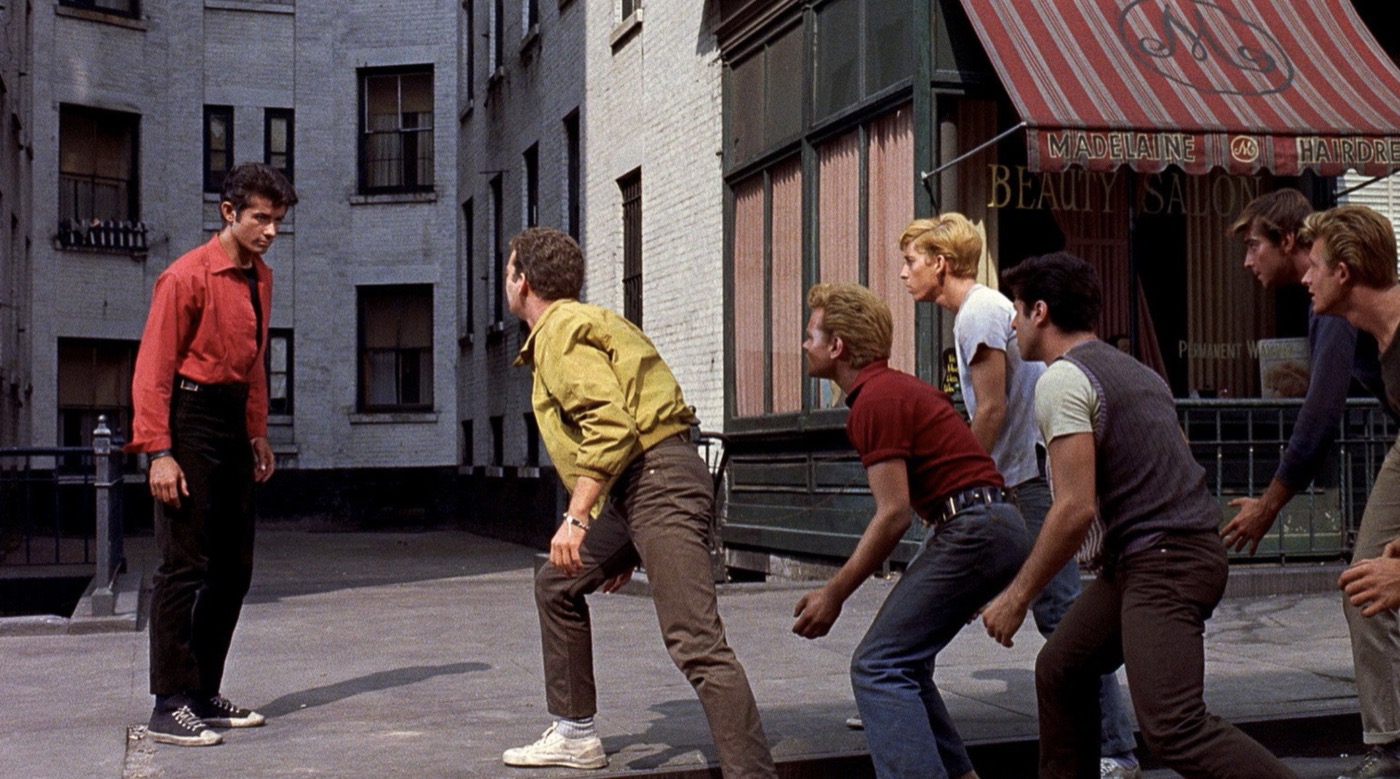
The scene finds an unexpected counterpart in “Gee, Officer Krupke”, where the Jets imitate policemen, judges and specialists to ridicule the institutions supposedly responsible for understanding them. Both sequences involve young people playing adults, though their intentions differ. Tony and Maria invent a community capable of welcoming their love; the Jets parody a society that continually assigns them roles and diagnoses. Representation gives them a temporary freedom unavailable in their ordinary lives. West Side Story frequently allows its characters to imagine alternatives without suggesting that imagination alone can bring them into existence.
Rita Moreno brings intelligence and vitality to Anita, whose independence is expressed through movement as much as dialogue. In “America”, her enthusiasm for the opportunities offered by the US encounters Bernardo’s objections concerning prejudice and exclusion. The argument becomes an exhilarating contest of voices and bodies,with Moreno and Chakiris turning disagreement into physical pleasure. Anita’s optimism is complicated by her attraction to Bernardo’s competitive masculinity, while Moreno’s control makes her sensuality inseparable from her determination. Neither side of the argument entirely cancels the other.
Bernstein’s ‘Tonight’ quintet develops this principle into a sophisticated dramatic structure. Tony and Maria anticipate their reunion, Anita looks forward to seeing Bernardo, and the rival gangs prepare for confrontation. Their expectations concern the same evening but remain incompatible. Bernstein introduces the different musical materials before combining them in a contrapuntal construction that preserves their individual identities. Wise’s editing moves between the separate groups while the music allows their expectations to coexist. We see one part of the situation and hear the presence of others. The audience experiences relationships that remain inaccessible to the characters themselves. The musical achieves a unity that their lives can’t sustain, making the approaching conflict more painful.
That conflict eventually erupts beneath the elevated roadway, where concrete supports and restrictive geometry replace the relative openness of the earlier street scenes. Tony’s attempt to prevent the violence fails. Bernardo kills Riff, and Tony responds by killing Bernardo, exposing how fragile his departure from the Jets has been. His love for Maria can’t immediately overcome the force of his attachment to his friend. When Maria discovers what’s happened, Wood gives one of her strongest performances. Her repeated cries of ‘Killer!’ combine fury, disbelief and desperation. The accusation is clear, but her feelings resist any equally simple resolution. She knows what Tony’s done and continues to love him. Their movement towards “Somewhere” gives that contradiction a musical form without diminishing his responsibility.
Moreno’s later confrontation with Maria in “A Boy Like That / I Have a Love” is equally impressive. Her performance has the urgency of someone trying to change another person’s mind rather than the composure of a singer presenting a number. Anita’s grief for Bernardo becomes anger towards Maria, whose love for his killer seems intolerable. Yet the confrontation gradually alters her position. As Maria expresses her feelings, Anita begins to recognise something of her own experience of love. Although Betty Wand supplies the principal vocal performance, Moreno’s gestures,expressions and reactions give the scene its physical intensity. Here, singing becomes dramatic action: an argument develops into a genuine change of understanding.
That achievement makes what follows particularly cruel. Anita goes to Doc’s drugstore intending to help Maria, only to be surrounded, humiliated and sexually assaulted by the Jets before Doc intervenes. The music accompanying their taunts recalls the rhythmic language of ‘America’, whose earlier exuberance now acquires a disturbing character. The woman who defended the possibilities of American life experiences the brutality Bernardo had warned against. In her anger and humiliation, she falsely announces that Chino has killed Maria. The lie contributes to the catastrophe, just as Tony’s reaction to Riff’s death had done earlier. Their responsibilities are profoundly different, particularly given the violence Anita has suffered, but both sequences show how overwhelming emotion can produce consequences beyond a character’s immediate intentions.
The final encounter between Tony and Maria is devastating in its economy. Discovering that Maria’s alive, Tony runs towards her, only for Chino’s gunshot to destroy their reunion. After so much elaborate choreography and musical expression, the decisive act is brutally simple. As Tony dies, Maria reprises a fragment of “Somewhere”, transforming their earlier vision of a shared future into a final expression of loss. Her grief becomes fury when she takes the gun and confronts the assembled gangs. She considers killing the others and leaving a bullet for herself, but ultimately lowers the weapon. Nothing she does can restore Tony. She must confront a future that will no longer include him.
Then the Jets and Sharks approach his body. The young men who initially claimed the streets through coordinated gestures of intimidation begin to carry him together. Others step forward to help. Their movements have lost the athletic brilliance that once made their aggression so exhilarating. They must now accommodate the weight of a dead man, adjusting themselves to one another for a task that neither group can claim as its own. Their cooperation is brief,hesitant and made possible by the recognition of a shared loss.
The film’s final movement belongs to Saul and Elaine Bass. As the procession disappears, the closing credits emerge across the walls, doors, fences and weathered surfaces of New York, incorporated into graffiti and urban markings. The camera returns to the streets. Names appear amongst the marks that other people have left there. The city that first emerged from an abstract drawing is visible once again, this time in the texture of its walls.
USA | 1961 | 152 MINUTES | 2.20:1 | COLOUR | ENGLISH • SPANISH

directors: Robert Wise & Jerome Robbins.
writer: Ernest Lehman (based on the 1957 stage musical by Jerome Robbins, Leonard Bernstein, Stephen Sondheim & Arthur Laurents, itself inspired by William Shakespeare’s ‘Romeo & Juliet’).
starring: Natalie Wood, Richard Beymer, Rita Moreno, George Chakiris & Russ Tamblyn.