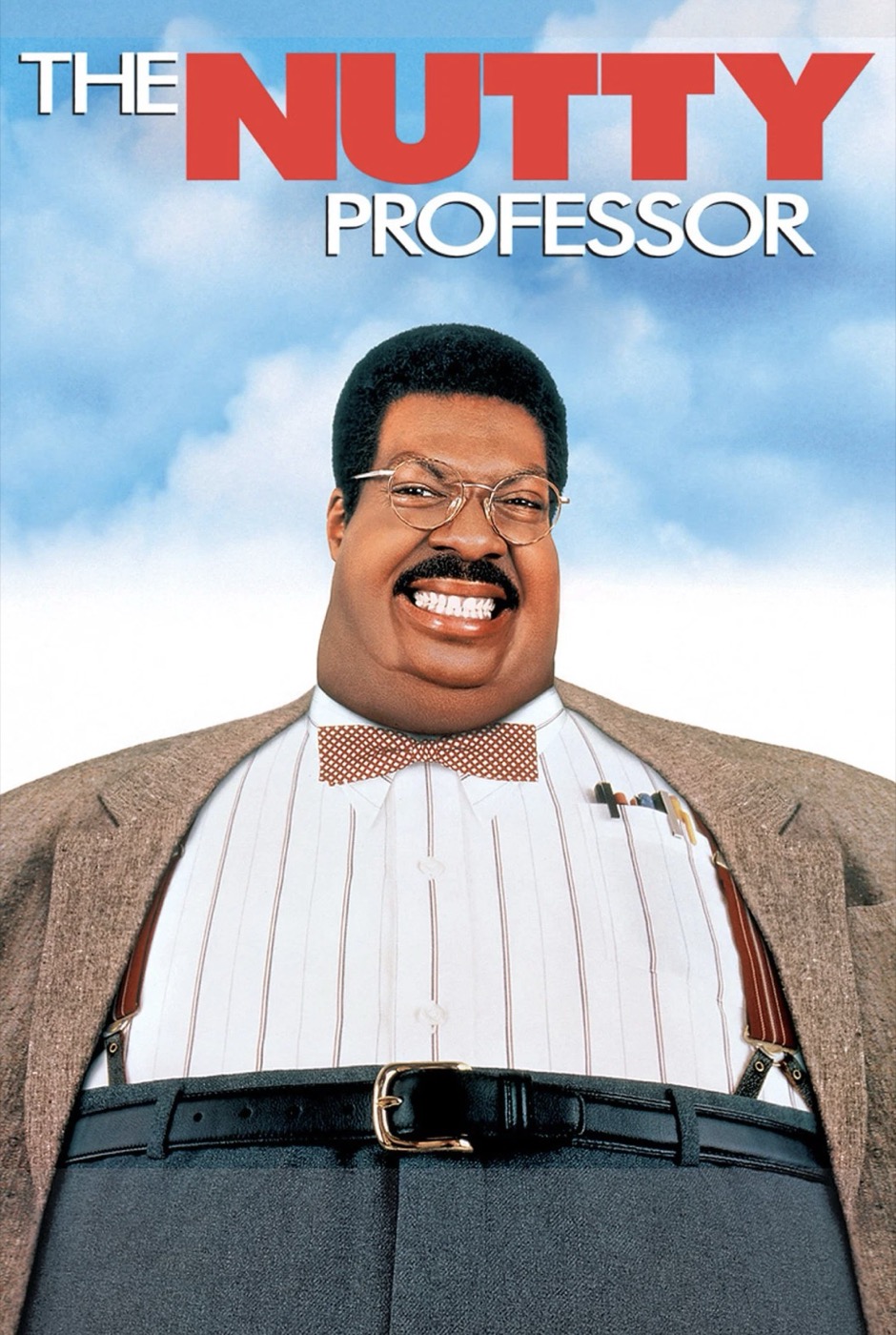
THE NUTTY PROFESSOR (1996)
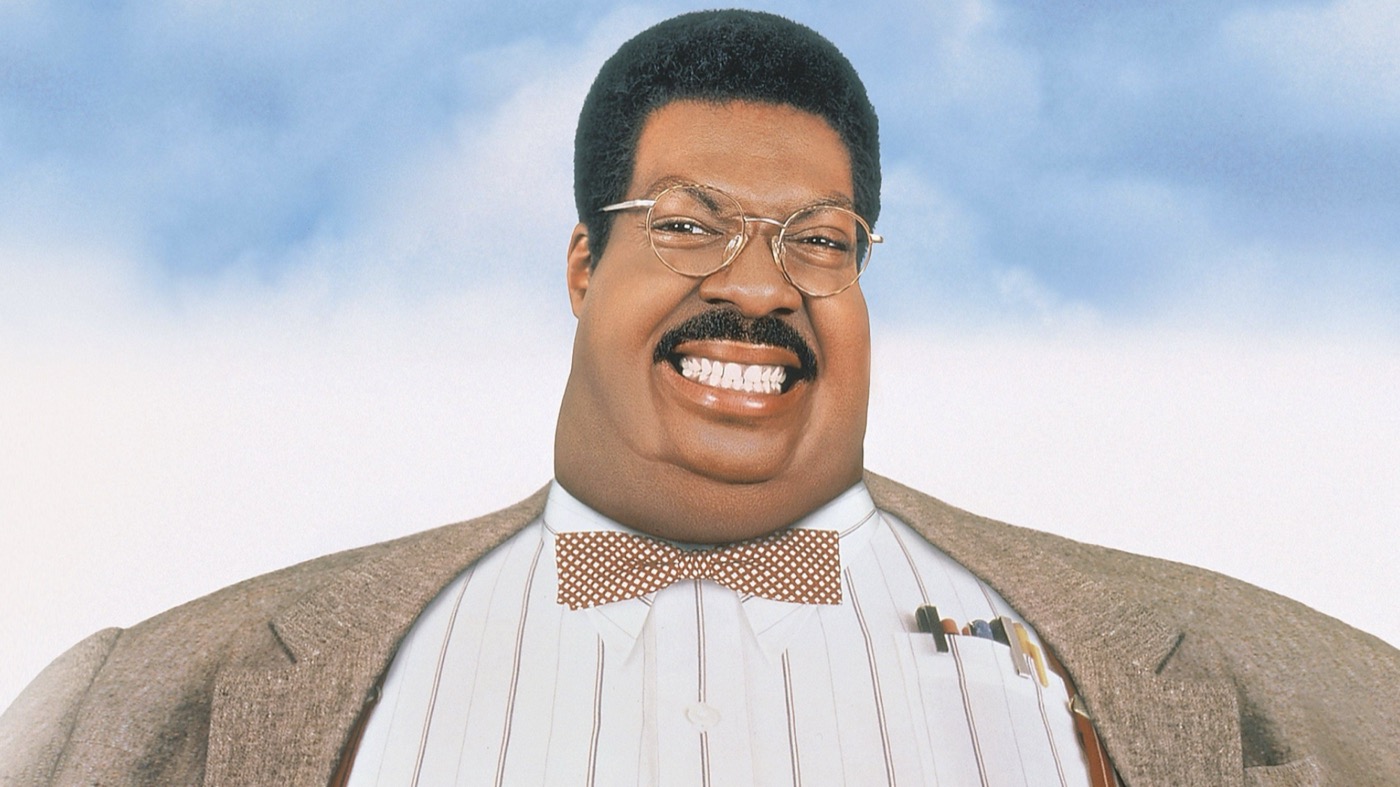
A grossly overweight yet good-hearted professor takes a special chemical that turns him into a slim but obnoxious counterpart.


A grossly overweight yet good-hearted professor takes a special chemical that turns him into a slim but obnoxious counterpart.
Eddie Murphy is huge. His phenomenal two-year streak on; Saturday Night Live, 48 Hrs. (1982), Trading Places (1983), Beverly Hills Cop (1984), and his comedy special Delirious (1983) made the 20-something comic the number one funnyman, black or white. Some early career flab in the middle did nothing to stunt his meteoric rise; The Golden Child (1986), Harlem Nights (1989), and Boomerang (1992) received lukewarm reviews, but two out of the three still turned a profit based on Murphy’s sheer box office draw. It helped that further hits like Raw (1987) and Coming to America (1988) proved audiences hadn’t had their fill just yet.
Yet critics were quick to chew him out. As Claudia Eller noted for the LA Times in 1994, “industry watchers are undoubtedly curious to see whether this movie or Cop III will help boost Murphy’s sagging popularity.” Even producer Brian Grazer offered the backhanded compliment that The Nutty Professor “will allow audiences to rediscover his comic talent.” This was all being said while the initial plan was for Vampire in Brooklyn (1996) to be released first. Audiences ultimately ended up with two colossal duds, and next, he was remaking a 1963 Jerry Lewis classic… but with a heavier twist.
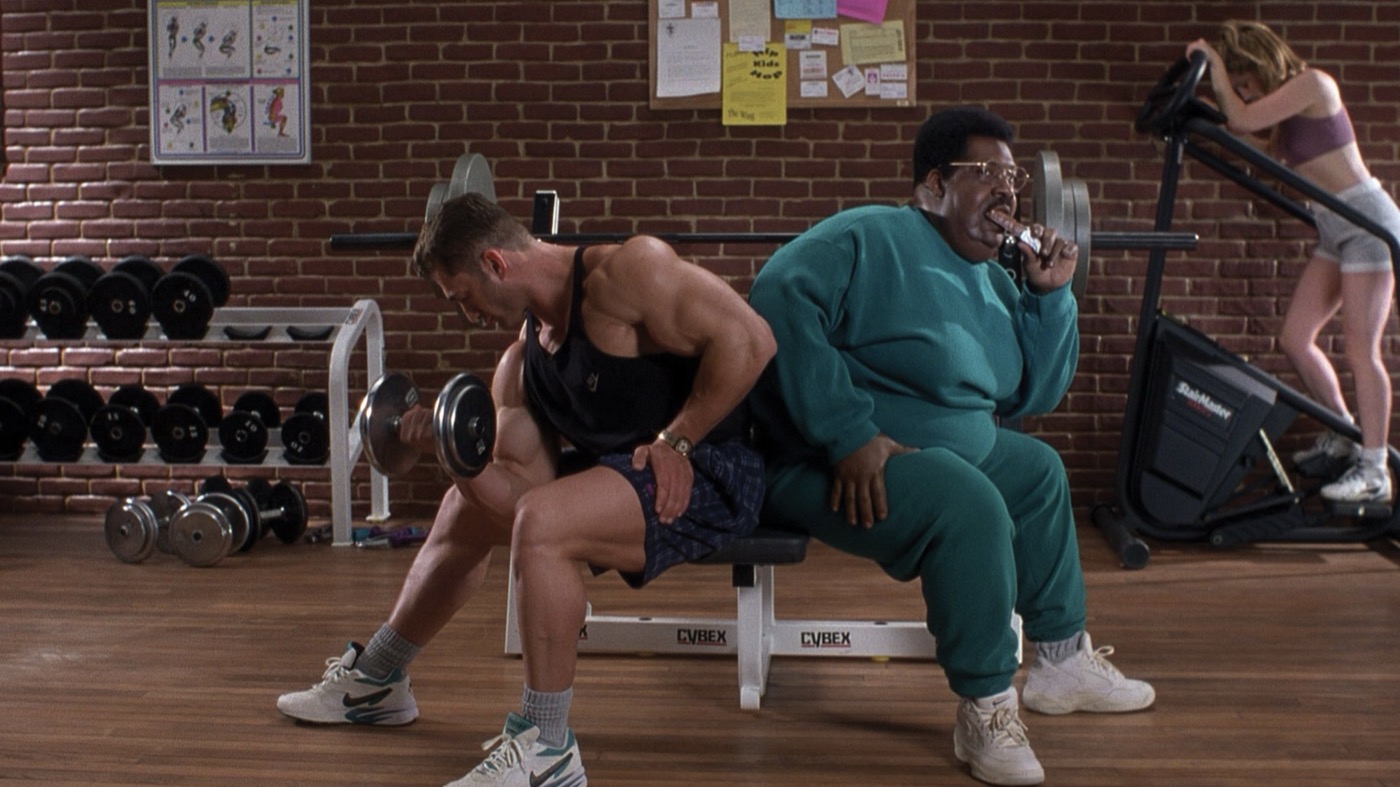
Sherman Klump (Eddie Murphy) is fat, his family is fat, and even his hamster is fat. Scenes open with his big ass struggling up college steps where he conducts his nutty experiments on—take a wild guess—how to be less fat. His boss calls him a “fat tub of goo”, a stand-up comic brands him “King Kong with titties”, and his dad warns him that “the only thing about to breakthrough is your ass about to break through the seat of your pants.” Chunky Butt, blubberbutt, fat ass, Fatzilla—even Sherman stammers, “I’m fatter, er, flattered.” This film is 3XL, wide-load, and bulging at the seams with fat jokes.
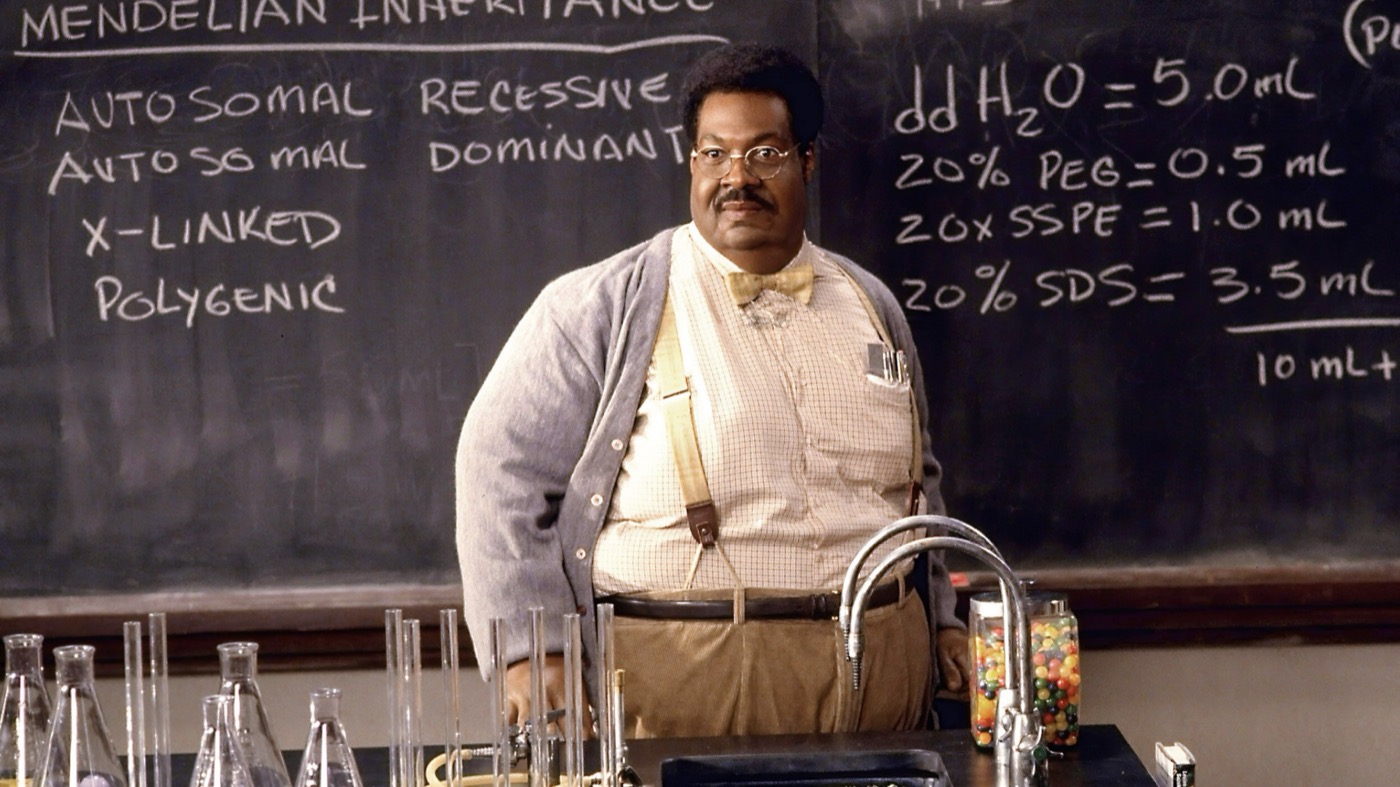
“There will be fat jokes at every turn,” Murphy admitted before emphasising, “our movie is not a put-down of fat people.” Still, there’s fat chance audiences today won’t view The Nutty Professor as a dated product of its time. Perhaps the theme that ‘fat people have feelings’ feels a little quaint by modern standards. But there’s more substance to this remake than skin-deep mockery, as Murphy declared: “Our movie is about obesity; America is obsessed with weight.”
Younger viewers might not fully grasp the concept that television wasn’t always a 24/7 affair. Stations used to shut down for the night, and as To Die For (1995) satirised, the 1990s filled that dead air with endless news and infomercials. Consumers were targeted more than ever by an overwhelming wave of get-rich-quick hucksters selling ways to get thin fast. The Nutty Professor wears its inspiration on its extra-wide sleeve; the first time we see Murphy, he isn’t fat, but white, in a parody of the ubiquitous exercise programmes. This Richard Simmons caricature invades the fridge—plastered onto diet shakes and low-fat microwave meals—proving there was money to be made from fat-shaming. Our protagonist even owns a ‘U-PIG DIET PLAN’ fridge alarm that oinks every time the door opens.
It’s a significant evolution from the original film’s social stigmas, where the only health concern was how hard you got shoved into a locker. The remake capitalises on a cultural shift where everyone was suddenly chewing the fat about weight-loss science. Sherman discusses current breakthroughs over dinner, touching on genetic predispositions to gaining weight and hopes of finding a cure. His family take offence at such casual remarks; they don’t want to be looked down on or pitied, least of all by one of their own. The Klumps counter the weight-loss craze by name-dropping celebrities: “I hope there’s nothing wrong with Oprah, she doesn’t look well.”
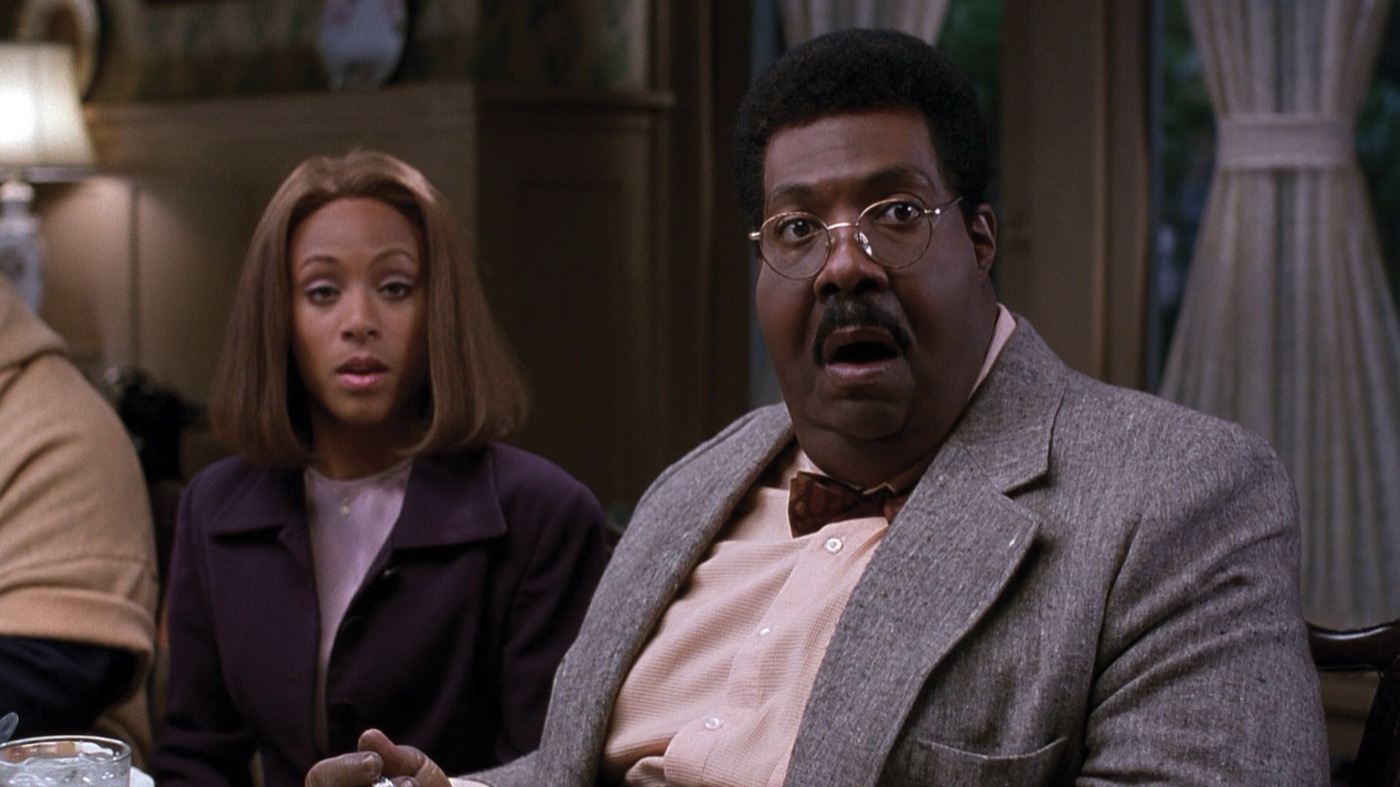
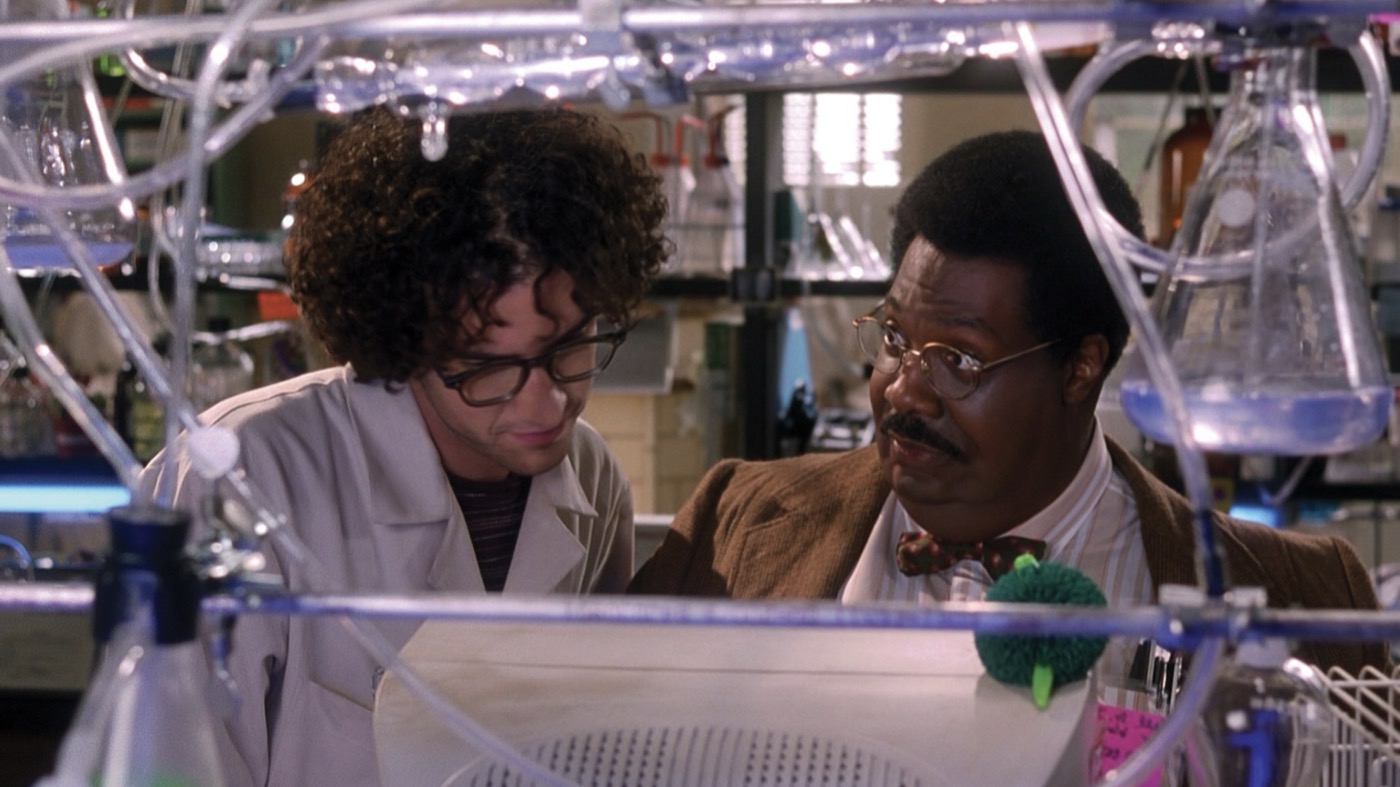
Yet rather than pitying him, we root for the big guy, with sweeping romantic music swelling the moment Carla Purty (Jada Pinkett) arrives. As the love interest, she has little life outside of the main narrative, but as a chemistry graduate, it’s refreshing to see smart characters appreciate each other’s intelligence. Sherman can’t help making self-deprecating comments like “you can’t miss me!”, yet he still musters the courage to ask her out in the first act. Sherman may suffer from low self-esteem, but he’s no incel.
“Being able to lose myself—I’m never Eddie Murphy,” the actor noted, and I’ll confess that as a child, I lost myself in his physical transformation too; I didn’t quite realise Murphy was actually playing Sherman. I don’t recall the same confusion with characters like Fat Bastard, Big Momma, or Murphy’s return to the fat suit in Norbit (2007). Perhaps I was genuinely swayed by the emotive intent that drove Murphy to endure three hours in the makeup chair for 80 days of shooting.
As Grazer noted of the physicality, “it strips away Eddie’s coolness for a while and is a role that allows him not to be in control or powerful.” Sherman has a big heart that beats passionately right through his 400lb. The writing and acting achieve a minor miracle: the usual, high-octane star power of Eddie being Eddie is exactly what the audience doesn’t want to see more of here.
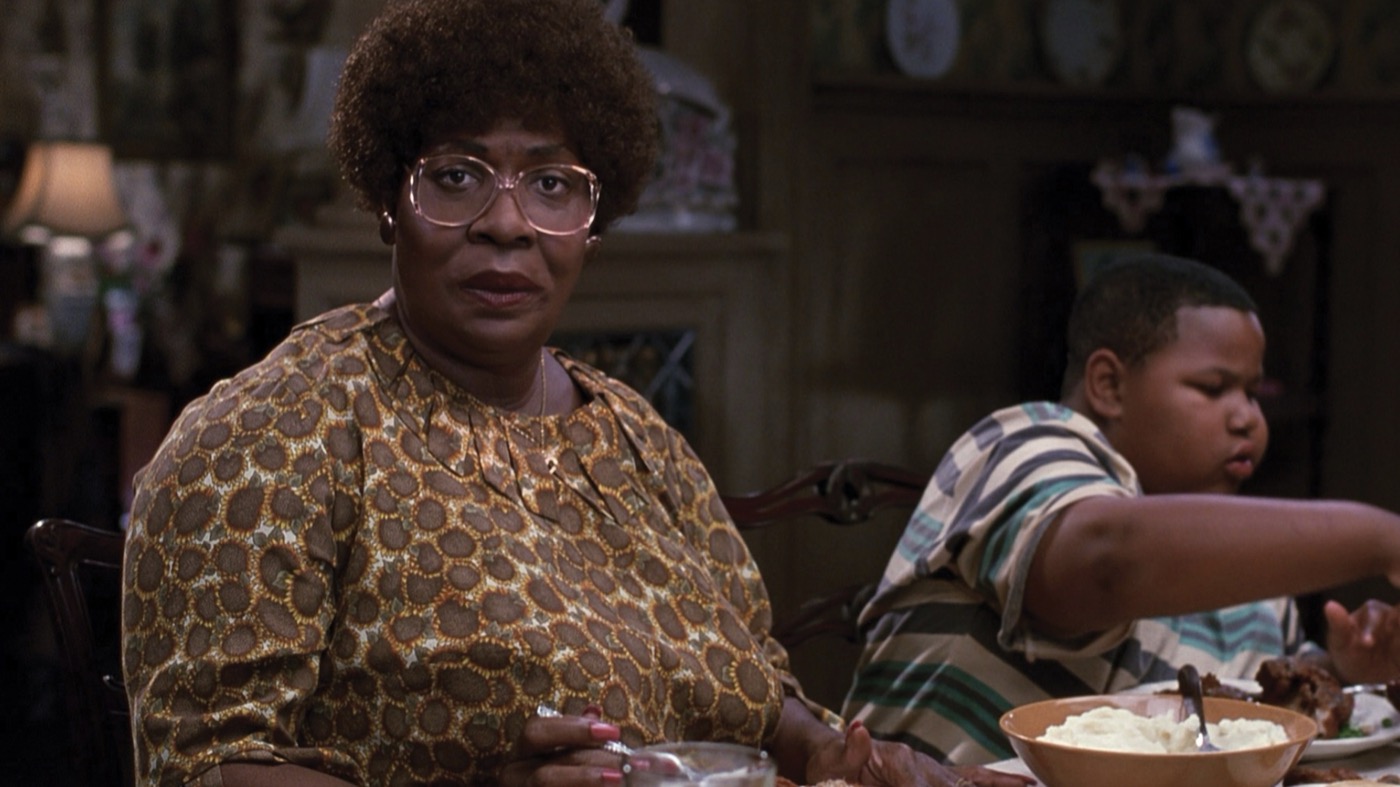
That extensive production schedule covers Murphy’s dedication to playing seven characters in total, and he was game to attempt more. According to LA Times promotional coverage, one omitted role included “a mean-spirited stand-up comic”, which ultimately proved more effective when played by a real comic opposite Murphy. The Klumps—Sherman’s brother, mother, father, grandmother, and Jamal Mixon as the nephew (cast after talks of digital face replacement were dropped)—all manage to feel like a real, interacting family. The distinct faces, voices, and massive personalities represent an underrated achievement in practical effects, seamlessly stitched together by editor Don Zimmerman.
Universal Pictures initially balked at the family gimmick, as the central double-act was more than enough. Were audiences really going to pay to see a table of Eddie Murphys laughing at each other’s farts? Hiring separate actors would have been far cheaper and faster, but the committed star got legendary makeup artist Rick Baker to fashion early versions of Ma and Grandma Klump for a test video. The effort paid off handsomely. As the late critic Roger Ebert noted, “the audience laughed so hard at Papa Klump’s approach to colon cleansing that I missed the next six lines of dialogue.”
Director Tom Shadyac was no stranger to comedy, having hit the big time with Ace Ventura: Pet Detective (1994). This was his next major success, followed by a reunion with Jim Carrey for Liar Liar (1997). Though Patch Adams (1998) with Robin Williams was a critical misfire, it was Shadyac’s fourth consecutive film to clear the $100 million mark. This screenplay, jam-packed with gags, was similarly the work of several comedic heavyweights. Shadyac collaborated with his regular writing partner Steve Oedekerk (Ace Ventura: When Nature Calls, Patch Adams, Bruce Almighty), and they were joined by David Sheffield and Barry W. Blaustein, both of whom knew Murphy’s style inside out from writing for him on SNL, Coming to America, and Boomerang.
The Nutty Professor is more than a one-note joke, treating audiences to some of the classics, like the loose hamster running up a trouser leg to look like a thrashing penis bulge. The entire opening sequence is rife with hamsters shooting out of leaf blowers and into people’s mouths; one even gets revenge on the crusty old Dean (Larry Miller) for insulting Sherman by defecating in his coffee. It’s a crude laugh, but for a 12/PG-13 rated film, it casually drops the N-word so many times it reminds modern audiences that ’90s family comedies were built different.
There is some noticeable padding in the script: a second family dinner invites Purty along for added embarrassment, and two dream sequences permit more fantastical fat jokes. These nightmares spawned some irrational childhood fears from Sherman burying a distraught Purdy under the sand with his heft and absorbing a poor doctor into his ballooning blubber. A lighter moment in that nightmare involves destroying the city with a Godzilla-sized fart, though the film handles Sherman’s internalised fatphobia with all the subtlety of him downing a jar of M&Ms while crying.
There’s also the comical montage of traditional exercise. With how many self-conscious people choose to work out at home, he’s out there in public trying his best. People even cheer him on as he starts to get the hang of it. He only falters when the results aren’t immediate, which drives him to test his untested formula.
His heart rate and blood pressure soar, and he collapses in pain; what he does to himself is self-destructive. In an era where modern cinema demands every superhero ripple with abs, Murphy confessed this was the hardest he ever had to train for a role. The miraculous transformation into Buddy Love is designed to represent the idealised male form. By this point, we’ve sympathised so strongly with Sherman that we vicariously indulge what is factually obnoxious behaviour, and Murphy delivers it all with a big fat grin.
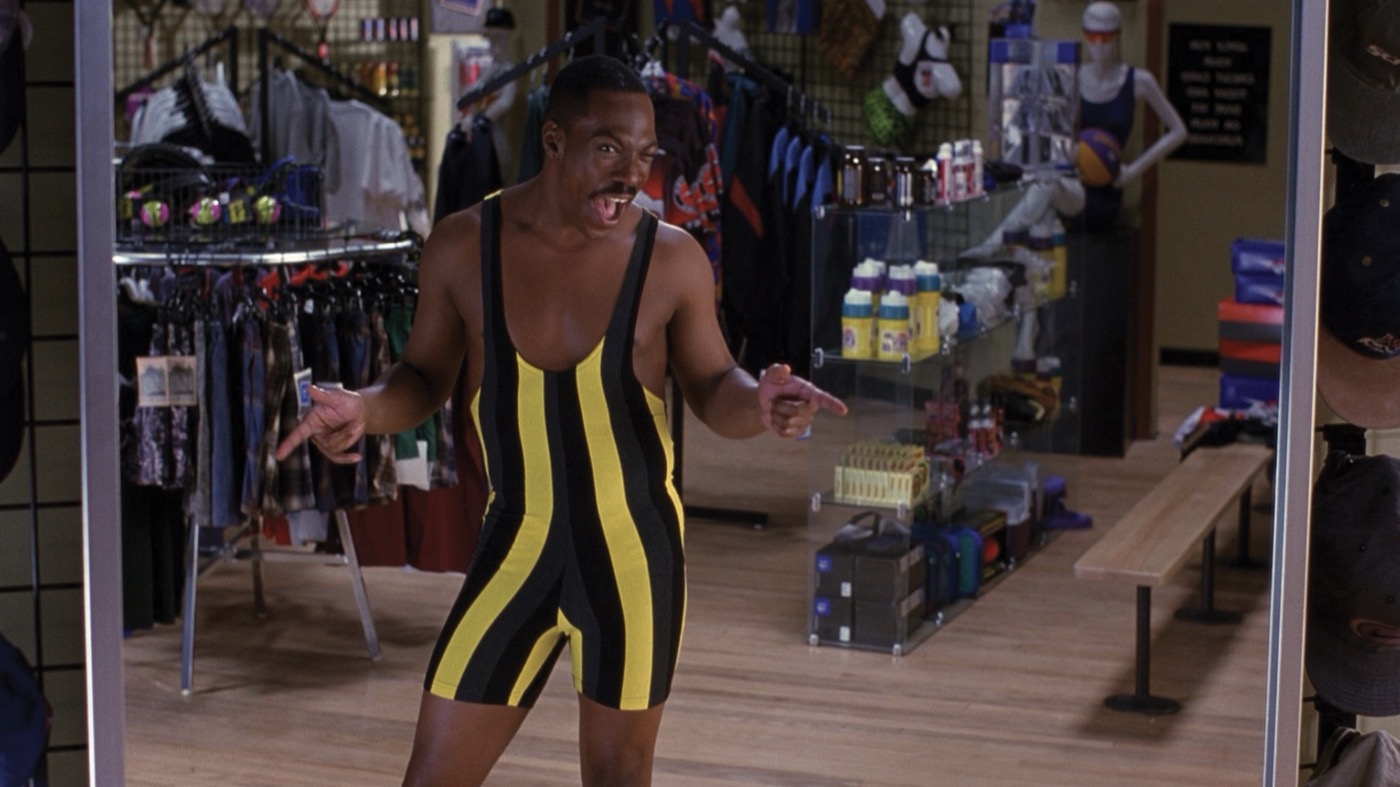
“I’m thin! I’m thin! Look at my cheekbones! I have cheekbones! Look at my cheekbones! Yes! Look at my chest! Look at my breasts! Oh, I don’t have breasts! I’m an A cup! I don’t even need a bra anymore! I’m thin, I’m thin, I’m thin! I’m thin, I’m thin! Well, I’ll be damned. I can see my dick! My dick! My dick, my dick, my dick!”–Buddy Love (Eddie Murphy)
Initially, we still see this character as Sherman, simply thin, and his ecstatic mania feels entirely appropriate for a historic scientific breakthrough. For the sake of the narrative, he cannot reveal his dangerous success just yet, so he creates the alter ego of “Sherman’s confidant”. A Jekyll and Hyde dynamic emerges as Sherman confidently charms Carla as Buddy, before tragically ‘friend-zoning’ her as Sherman, genuinely believing she deserves better. Cue the classic cinematic hijinks of treating the love interest with next to no respect as she is corralled back and forth by his sudden transformations—which she naturally tolerates because she is a nice person.
Inevitably, the conflict is explicitly spelt out: Buddy’s testosterone levels are off the charts, getting it through the fattest heads that Buddy is bad and Sherman is good. Buddy Love puts the confidence in con-man, insulting a restaurant full of big-boned patrons with remarks about “turkey neck” and “tank ass”, yet somehow managing to impress a prospective, fat-cat grant donor. Even Carla falls victim to his overwhelming performance, smiling at the highly questionable compliment, “I bet you got on a thong of licorice, don’t you?”
Reggie Warrington (Dave Chappelle) is presented as a similarly ridiculous individual—all gums and no teeth, sporting “shitlocks” and terrible fashion sense—yet the crowd cheers as he bullies them from the stage. Audiences laugh when the joke is on someone else, and Sherman shared that mob mentality before he was singled out. Their date up to that point is about more than the roast; Students respects his fleeting confidence, he shares a great meal and conversation with Carla, and she gently places her hand on his. A fat lot of good all that does, however, after one cruel stand-up comic destroys Sherman’s sense of self-worth.
Returning to Reggie later in the film provides a phenomenal mix of comedy, catharsis, and conflict. By unleashing every single fat joke Sherman has ever heard in his life on the comic’s poor mother, he is doing it for himself—or perhaps for his alter ego. Then again, maybe Buddy is a different entity entirely: one whose shameless superiority complex is simply intent on out-alphaing another man. The Nutty Professor toys with these psychological ideas whilst delivering riotous entertainment. The laughs never stop, even when verbal self-defence turns ugly, marking the first of two instances where a man physically assaults a stand-up comic on behalf of Jada Pinkett. Plus, who doesn’t want to see Dave Chappelle get thrown into a piano?
Rhythm & Hues worked closely with Cinovation Studios’ practical effects team, seamlessly blending Sherman and Buddy into the same performer using digital morphs and CGI. An inspired action sequence involves Buddy unexpectedly getting a fat lip as his formula wears off, sending him speeding in a runaway Dodge Viper as a swelling foot puts the pedal to the metal. After causing utter mayhem in each other’s lives, the two personas attempt to literally trim the fat and fight. The two effects houses brilliantly bring to life a man losing and gaining 400 pounds in seconds; even after thirty years, only a scant few shots show any signs of age.
On a sizeable budget of $54M, these combined efforts paid off handsomely. It became the first Eddie Murphy film of the 1990s to clear $100M at the domestic box office, ultimately grossing $274M worldwide. There is a certain irony when one thinks of Eddie Murphy and the Academy Awards, given the popular consensus that he torpedoed his legitimate Oscar chances for Dreamgirls (2006) by releasing Norbit. In a way, he had already earned one via a fat suit, as The Nutty Professor took home the 1997 Oscar for ‘Best Makeup’ thanks to the groundbreaking work of Rick Baker and David LeRoy Anderson. Murphy scored big with his own individual nominations too, including the Golden Globes and the Nickelodeon Kids’ Choice Awards—and I don’t think their Blimp Award was intended as a fat joke.
More than the financial windfall, it was the critical consensus where Murphy reclaimed his true success. Owen Gleiberman remarked that “you can feel Murphy rediscovering his joy as a performer. He rediscovers it, too, as Sherman Klump, a fellow who, much like Murphy, is on the bottom rung, desperate to reinvent himself, and—at long last—does.” Peter Travers kept it simple: “Eddie Murphy is funny again.” Meanwhile, Roger Ebert noted the deeply self-reflective nature of the performance: “He delivers a heartfelt speech (‘Buddy’s who I thought I wanted to be—who I thought the world wanted me to be. But I was wrong’). Eddie Murphy looks straight at the camera as he hits the last line, and it occurred to me that maybe he was referring indirectly to some of his recent career miscues.”
Whether Murphy actually learned the right lessons remains open to debate. The family dinner scene was nearly cut from the film entirely, but the Klumps proved so popular they earned the subtitle of the sequel, Nutty Professor II: The Klumps (2000). I heartily recommend that follow-up for an examination of where unexpected success can lead—namely, to bigger budgets, smaller returns, and much harsher reviews. Looking back from recent years, one has to imagine Eddie Murphy reading the news and laughing that science basically invented his miracle drug with Ozempic, before laughing again at the sheer absurdity of a modern legacy threequel.
USA | 1996 | 95 MINUTES | 1.85 : 1 | COLOUR | ENGLISH

director: Tom Shadyac.
writers: David Sheffield, Barry W. Blaustein, Tom Shadyac & Steve Oedekerk (based on the 1963 film ‘The Nutty Professor’ by Jerry Lewis & Bill Richmond.)
starring: Eddie Murphy, Jada Pinkett, Larry Miller, James Coburn, Dave Chappelle, John Ales, Jamal Mixon, Eddie Murphy, Eddie Murphy, Eddie Murphy, Eddie Murphy, Eddie Murphy & Eddie Murphy.