MISERY (1990)
A famous author is rescued from a car crash by a fan who loves his work a little too much

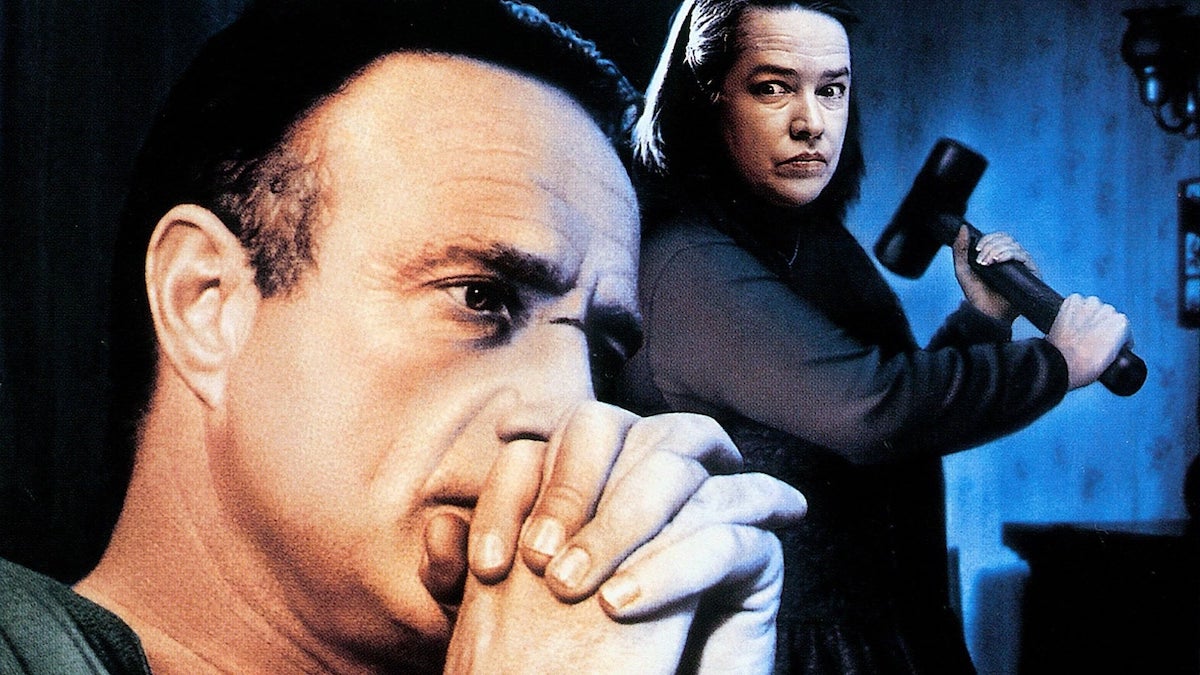

A famous author is rescued from a car crash by a fan who loves his work a little too much
The best Stephen King adaptations are usually the simpler ones—those based on a single strong idea rather than a multi-stranded plot (such as Carrie or Stand By Me, rather than It or The Stand). Misery, directed by Rob Reiner and written by William Goldman, is among the most successful of them all, thanks to the clarity of its central concept: an injured writer is trapped in a remote house with a crazed woman who believes in his fictional characters a bit too much. It could almost be an elevator pitch.
Of course, such a stripped-back plot puts an extra burden on the actors. If we don’t believe in them, the whole thing fails because there are no narrative bells and whistles to distract us. There aren’t many big surprises in Misery, though there are plenty of small ones. This scarcely matters, however, given the power of the central performances by Kathy Bates and James Caan. The latter occupies a less obviously flamboyant role than Bates, but one that contributes every bit as much to Misery‘s success.
Misery opens with Paul Sheldon (Caan) typing away. The camera reveals a bottle of champagne and an empty glass beside him. He handwrites “THE END” on his typescript, pours a drink, and lights a cigarette. It’s clearly an end-of-writing ritual, presented with the extreme economy and clarity that characterises the whole film, with each shot showing a single detail.
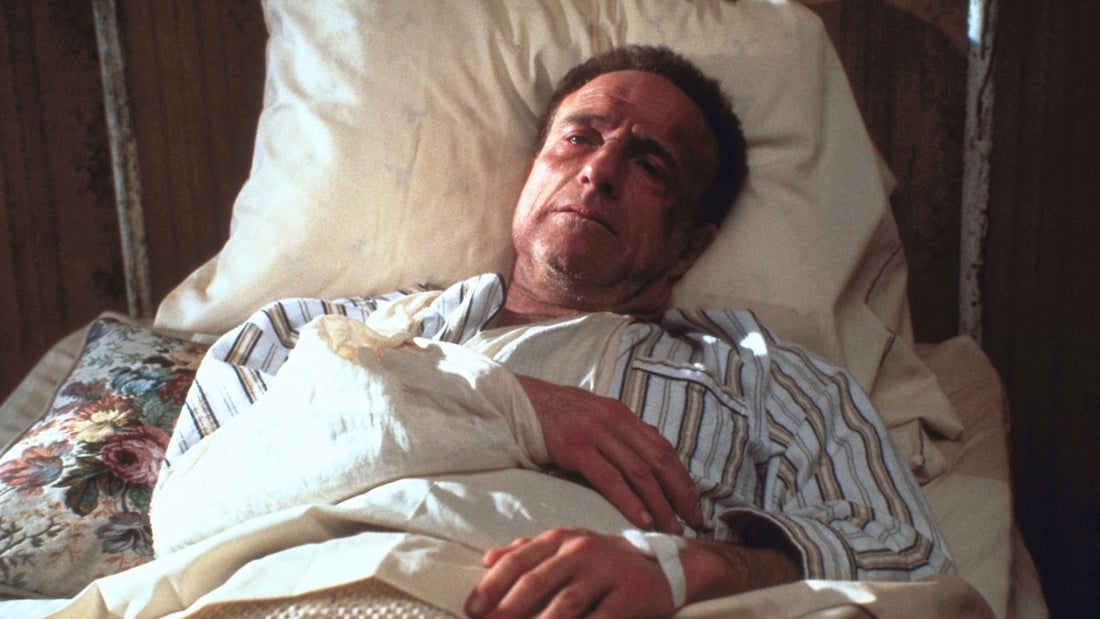
We learn from this that Paul is a writer celebrating the completion of a new book. We soon discover he’s been staying at an isolated hotel to finish it, and we see him drive off towards the big city—and into a steadily worsening storm. This is a blatant weather metaphor, but it’s also a crucial plot element on a literal level: it’s this storm that causes yet another of the car accidents that repeatedly crop up in King’s work, after which Paul is rescued from his wrecked vehicle by Annie Wilkes (Kathy Bates).
Annie, a former nurse, takes Paul to her isolated home and cares for him. She seems solicitous and efficient enough at first, but Paul soon discovers she’s more than an average Good Samaritan; she’s a massive fan of his Misery Chastain novels, a series of bodice-ripping Victorian romances. She’s his self-proclaimed “number one fan”, so besotted by the character Paul created that she’s even named her pet pig Misery. We hear her speak the famous line, “I’m your number one fan”, before we ever see her face.
She isn’t pleased to discover among Paul’s possessions the manuscript he’s just finished—a much grittier, more foul-mouthed novel set in the modern world. Then something else tips her over the edge: his newly published Misery book arrives at the local store. Annie settles down to read it with eager anticipation, only to discover that Paul kills off her beloved heroine. Hell hath no fury like a number-one fan spurned. With Paul now at her mercy, she decides it’s time for him to start writing what she wants…
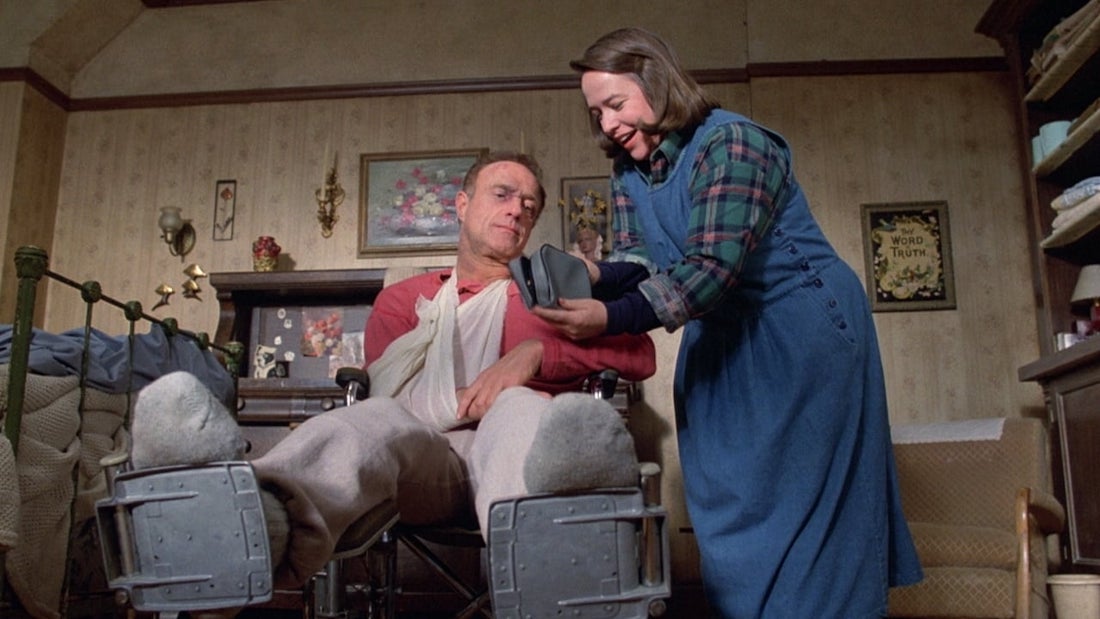
Thanks to Bates’s performance, Annie dominates attention whenever she enters the single room—Paul’s bedroom—where much of the film is set. The character’s reputation may be rather over-the-top, but it’s a performance of great subtlety. Annie is clearly severely unbalanced, yet she’s also cunning, and rage coexists alongside a kind of genuine love. Bates cycles through her moods (coquettish, matter-of-fact, irritated, crazed) without letting any become a caricature. The way she gradually elevates Annie from calmness, through ordinary anger, into an unhinged fury is masterful. Subtle shifts in her voice and eyes signal the precise moment reason departs.
Goldman, Reiner, and King deserve substantial credit for the character. Annie’s strangely folksy vocabulary (“you dirty bird”, “oogy”, “cock-a-doodie”) and her pockets of ignorance (“what’s the ceiling that dago painted?”, referring to the Sistine Chapel) lend her a memorable realism. The scene where she absent-mindedly (or perhaps intentionally) sprinkles fuel over Paul’s bedclothes is chilling.
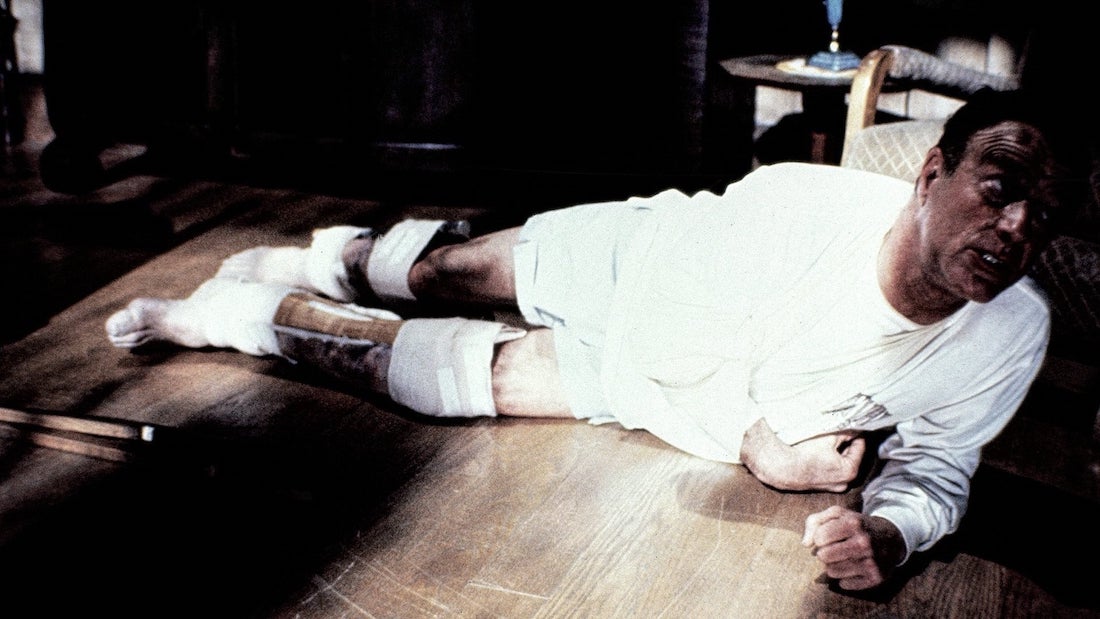
While Bates delivers the performance most viewers remember, Caan provides sterling, understated support in a difficult reactive role that requires him to remain bedridden for most of the film. He’s completely believable as a popular yet frustrated writer who longs to be recognised for serious literature. He’s an unpretentious professional used to dealing with fans, though unprepared for one this intense. As in so much of King’s work, Misery offers plenty of meta-commentary on the nature of writing and the author–reader relationship. Paul’s feigned affability towards Annie is tinged with just the right degree of apprehension. Like Bates, Caan conveys vast emotion through simple facial expressions: his eyes wide with worry when she spills soup, or his subtle gulp when she says, “I love you, Paul.”
Excellent support is provided by Richard Farnsworth as the local sheriff (a far more prominent character in the film than in the novel) and Frances Sternhagen as his wife, whose search for Paul provides a tension-building counterpoint to the ordeal inside Annie’s house. In some films, this sub-plot might diminish the sense of claustrophobia, but Reiner and Goldman achieve the opposite, heightening our empathy with the trapped protagonist. Salvation is tantalisingly close, yet just out of reach.
Their parallel storyline also allows Goldman and Reiner to inject some humour, which might otherwise have felt incongruous within the core Annie–Paul dynamic. (Not that humour is entirely absent there: when Paul taps out “fuckfuckfuckfuckfuck” on the typewriter Annie provides, it’s a clear nod to Jack Nicholson’s unhinged repetitive typing in The Shining.) Lauren Bacall, meanwhile, contributes an enjoyable cameo as Paul’s agent.
For the most part, precise and uncomplicated direction from Reiner (who previously adapted King to great acclaim in 1986’s Stand By Me) and a masterful script from Goldman blend plot and performance into a gripping narrative. Indeed, perhaps the only weak notes in Misery are Mark Shaiman’s score (which becomes somewhat intrusive during peak moments) and a mildly unsatisfying ending. A coda is certainly necessary, yet this one fails to convince us that Paul has been either transformed or permanently damaged by his ordeal.

These are minor flaws, and Misery was rightly praised by critics upon release as a thoroughly enjoyable thriller. As Derek Malcolm wrote in The Guardian, “you’d have to be churlish not to be entertained”. Many singled out Bates’s performance, which earned her the Academy Award for Best Actress alongside several other major honours.
Misery hasn’t dated and remains one of the finest King film adaptations. It serves as an impressive showcase for Caan’s versatility in a role unusual for him (Paul remains a passive victim for much of the runtime). Above all, this is Bates’s film. While the script and direction lay the foundation for her character, it’s the scowling face of Kathy Bates as Annie Wilkes, poised to commit monstrous acts as a “number one fan”, that remains the enduring image of the film.
USA | 1990 | 107 MINUTES | 1.85:1 | COLOUR | ENGLISH




director: Rob Reiner.
writer: William Goldman (based on the novel by Stephen King).
starring: James Caan, Kathy Bates, Richard Farnsworth, Frances Sternhagen, Lauren Bacall, Graham Jarvis & J.T Walsh.