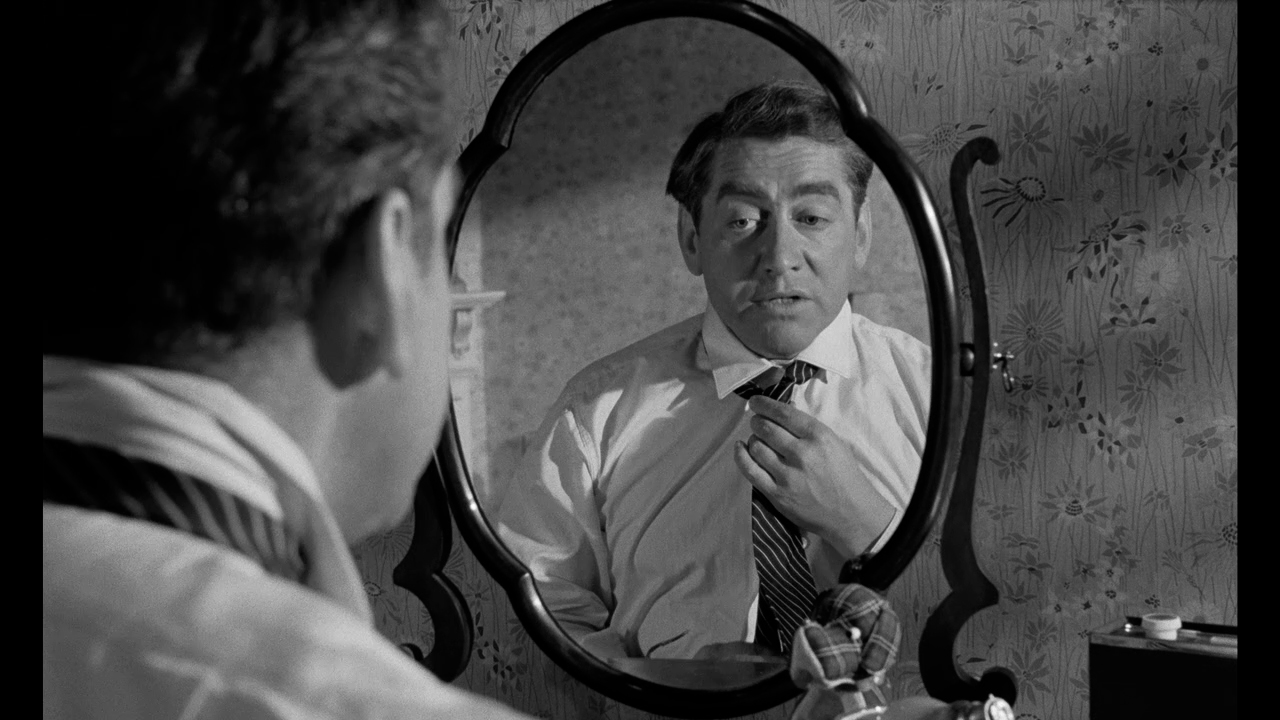
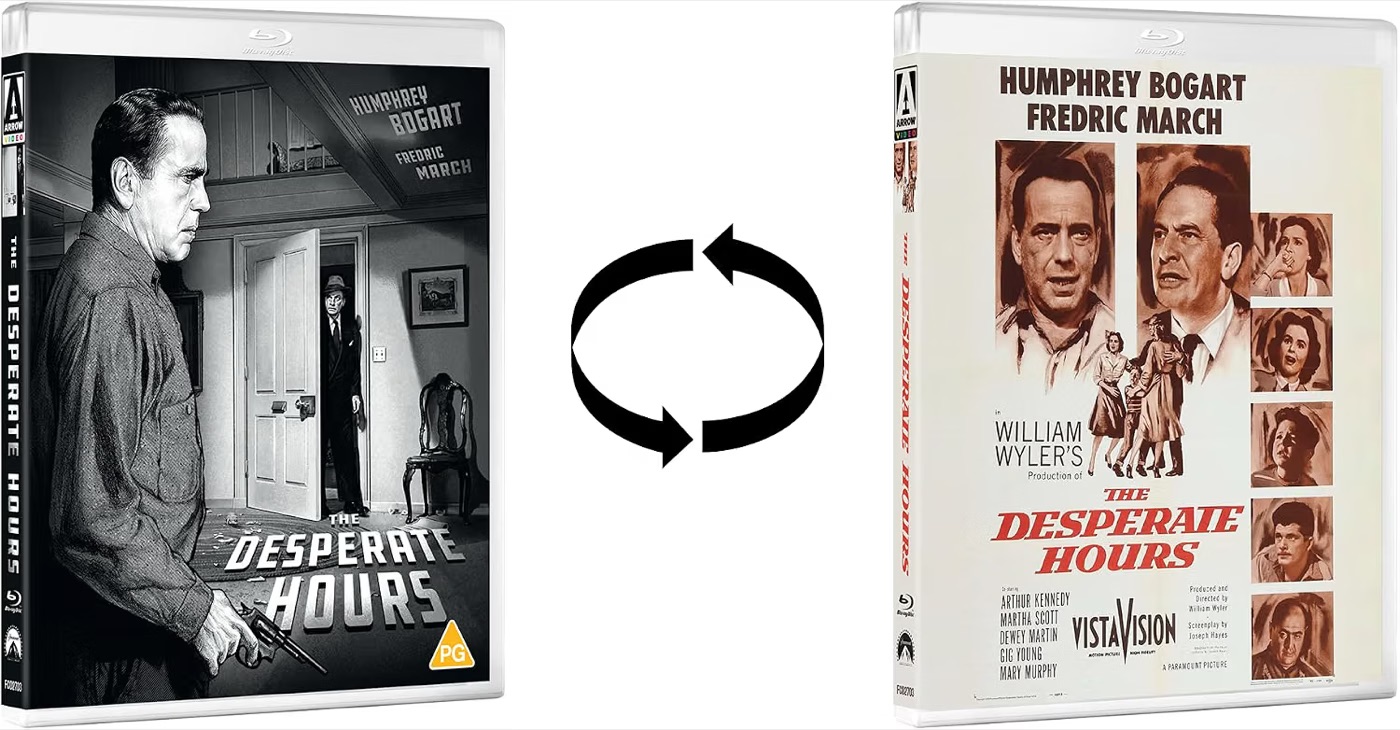
THE DESPERATE HOURS (1955)
A conventional 1950s family faces difficult dilemmas when three escaped prisoners invade their suburban home.

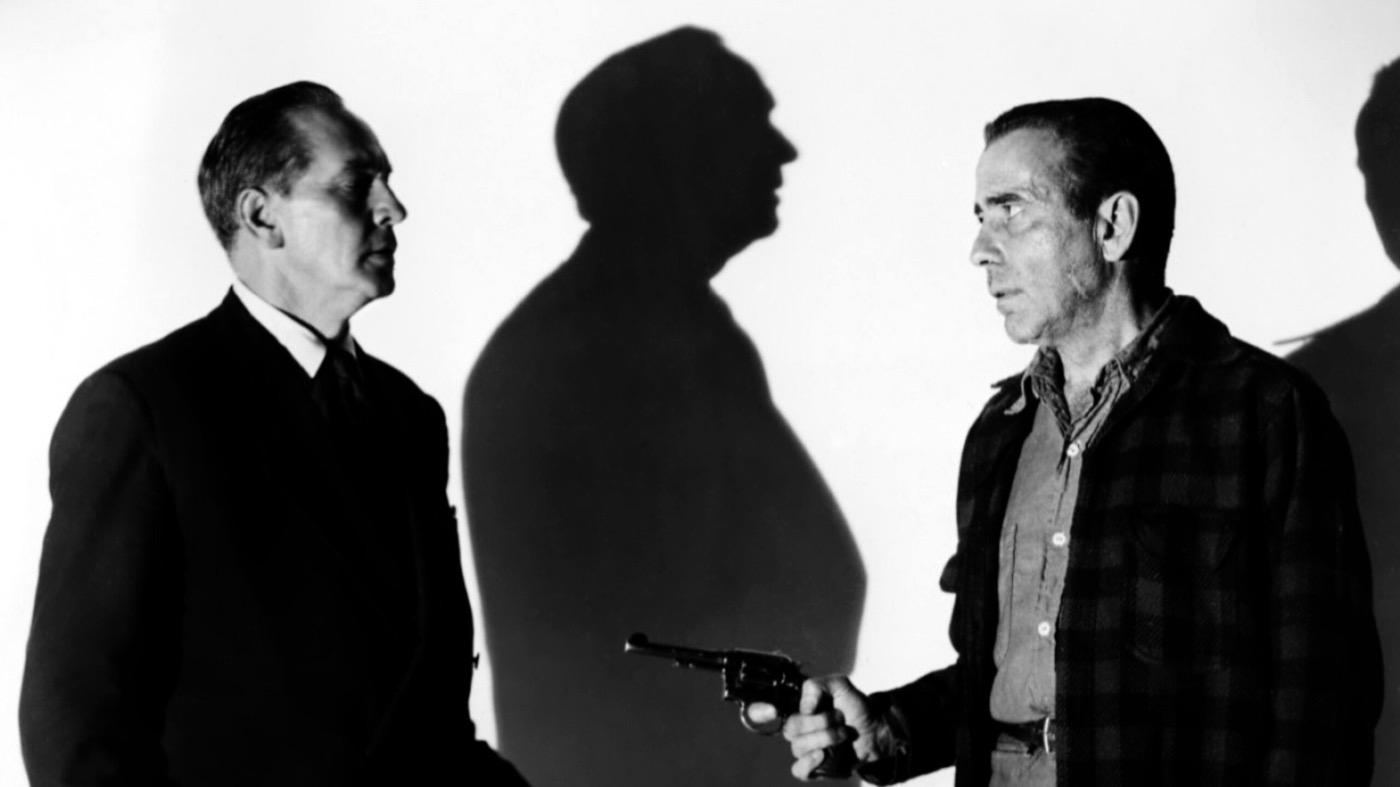

A conventional 1950s family faces difficult dilemmas when three escaped prisoners invade their suburban home.
Overshadowed by uncontested classics in the filmographies of its director and leading man, The Desperate Hours is rarely heard of these days. Yet it deserves to be, and not only for the contributions of Humphrey Bogart (nearing the end of his career) and William Wyler (at the peak of his). Fredric March and Martha Scott also deliver fine performances, Lee Garmes’s cinematography stylishly supports the narrative, and the screenplay by Joseph Hayes—who wrote the source novel and play—is constructed with great skill.
The film is not perfect, but these qualities are refreshing in a movie that could easily have descended into melodrama and cheap sensationalism, given its subject matter: The Desperate Hours is a relatively early example of the home-invasion genre. The phrase itself was hardly used in the 1950s, only becoming common in the 1980s, but Hollywood writers hadn’t ignored the idea’s potency. The nearly contemporary Beware, My Lovely (1952) is one example, as is Key Largo (1948)—a much better-known Bogart vehicle than The Desperate Hours—though in that case it’s technically a hotel invasion.
The premise had grown more popular in the post-war years, perhaps owing to an increased awareness of threats close to home in the form of Communist subversives: The Desperate Hours was released just after the end of Joseph McCarthy’s reign of terror. More broadly, it falls into a category of films about peaceful men forced to act in defence of their families or communities, alongside legendary titles such as High Noon (1952), Shane (1953), and Cape Fear (1962). Again, this may well connect to the idea that protecting the country was now down to ordinary people as much as the authorities.
Hayes based his novel and subsequent play loosely on a real incident in Philadelphia, but set The Desperate Hours in Indianapolis—a city rarely featured prominently on screen and lacking a strong image in the public imagination: a place that could easily stand for anywhere in the United States. The very first shot sets that scene by showing an ordinary suburban street, comfortable without being conspicuously wealthy—whistling children, a small dog running across the road, a boy delivering newspapers—before getting straight down to business.
A radio announcer broadcasts news of the escape of three convicts from a nearby prison, led by Griff (played by Bogart, though we don’t meet him yet). Without delay, The Desperate Hours moves to the local sheriff’s office, where we meet Deputy Bard (Arthur Kennedy), the man who previously captured Griff, breaking the criminal’s jaw in the process. Then it’s back to suburbia for a view of a house framed from inside a car—the car of the three fugitives,though cleverly we aren’t allowed to see them yet.
Soon enough we do: Bogart’s Griff, his much younger brother Hal (Dewey Martin), and Kobish (Robert Middleton), a large, apparently rather slow-witted man (“He’s only got half a brain, if that,” says Griff). They enter the house and hold the resident family at gunpoint: Mr Hilliard (March), Mrs Hilliard (Scott), their strong-willed, near-adult daughter Cindy (Mary Murphy), and their young son Ralphy (Richard Eyer). The rest of the film switches back and forth between the family and the police, focusing far more on the former, and frequently surprises the viewer by stepping outside the domestic setting. Mr Hilliard is sent on errands; Cindy is also allowed out with her boyfriend (Gig Young) so as not to raise suspicion.
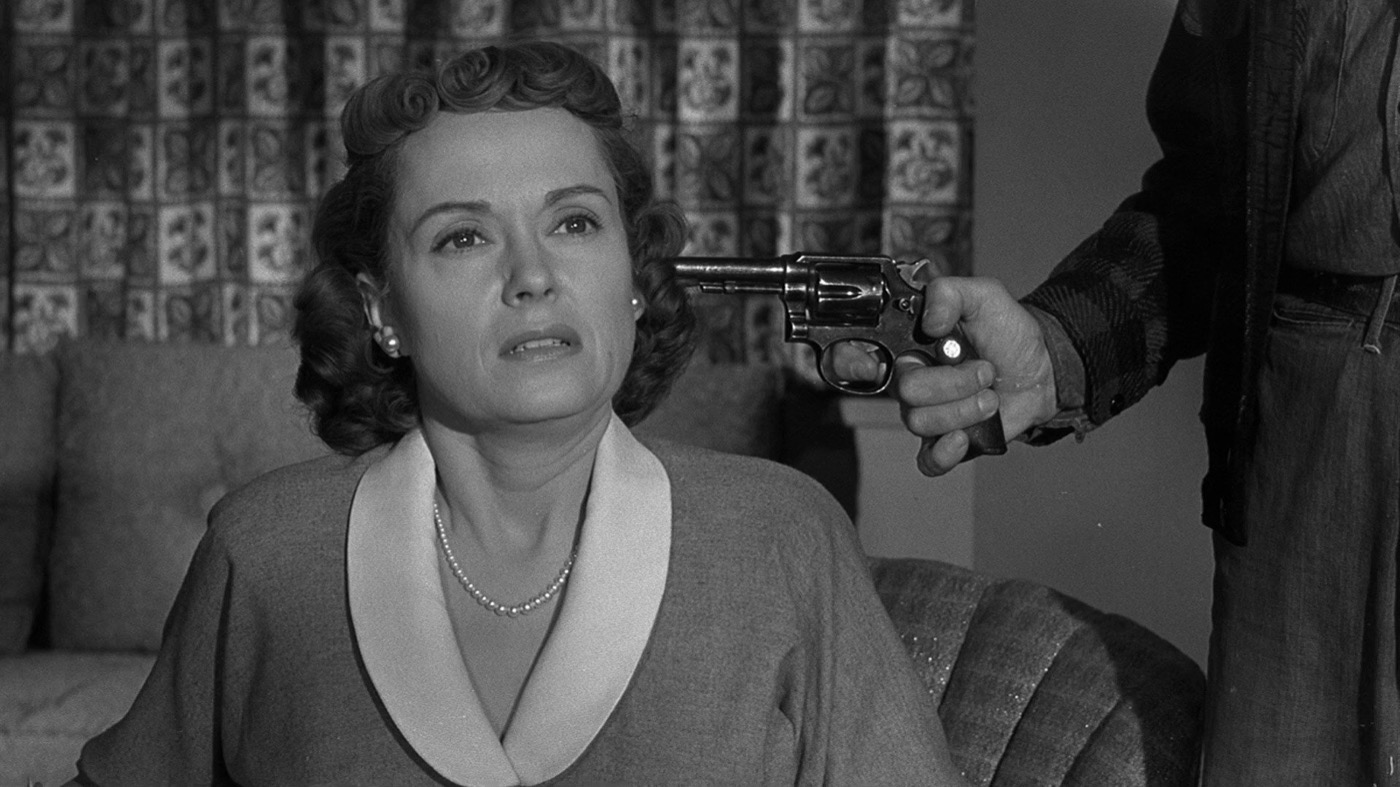
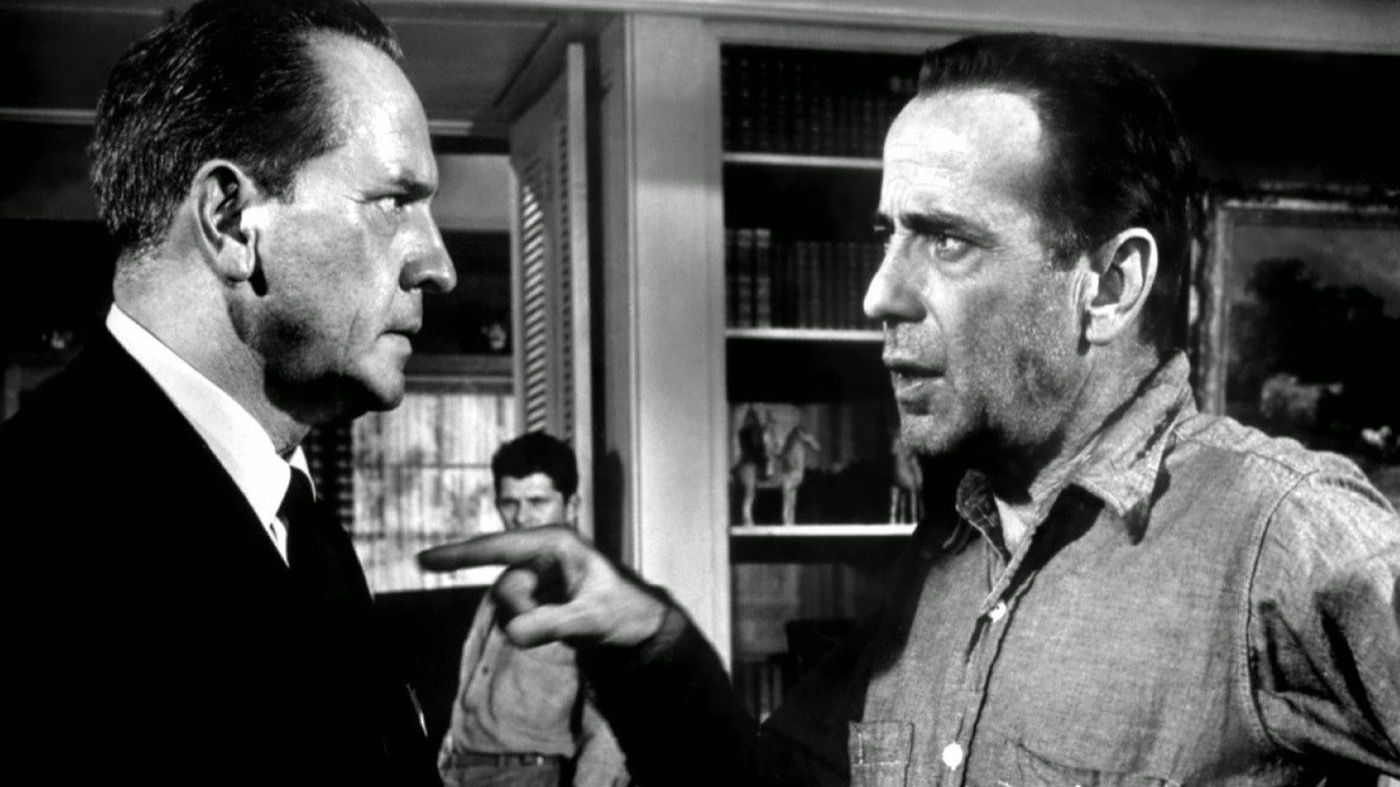
This may not be entirely plausible, and the whole story is a bit far-fetched if looked at objectively, but it’s a mark of Hayes’s smart writing. Throughout The Desperate Hours, Hayes takes great care to extract as much tension and variety as possible from his characters’ predicament. The three fugitives are waiting for a female accomplice to bring them money, providing the narrative with a ticking clock. Griff’s desire for revenge against Deputy Bard heightens the stakes for both of them and opens up divisions among the crooks, even if this theme sometimes gets lost as other plot developments come to the fore.
Above all, forcing the family to work with the fugitives rather than against them—trying to avoid police involvement in the hope that the intruders will leave without resorting to violence—adds complexity to all the main characters’ relationships. Although The Desperate Hours is frequently considered a film noir, and even features a late shot of Bogart in classic noir chiaroscuro style (half-lit and half in darkness), the movie isn’t in the slightest morally ambiguous—though it often feels as though it’s about to head that way.
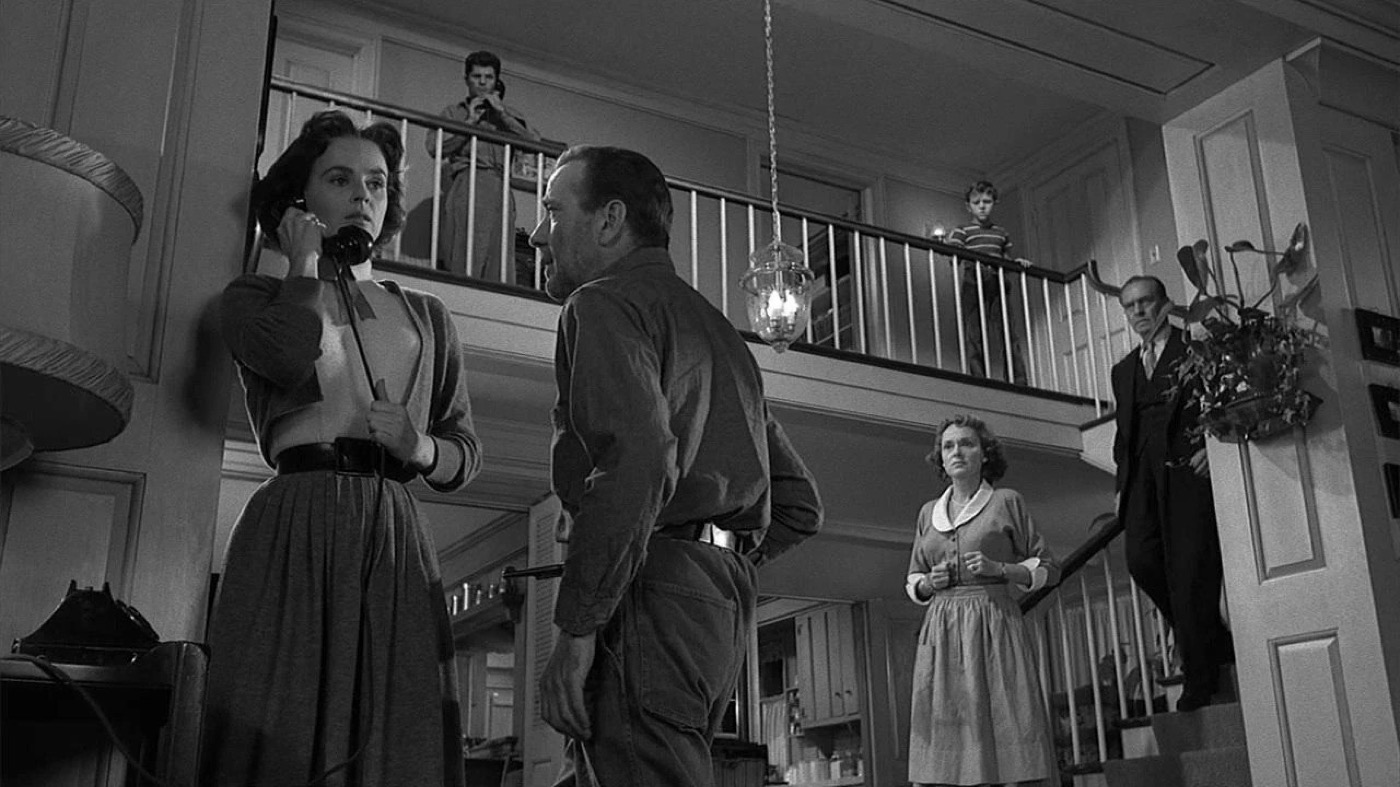
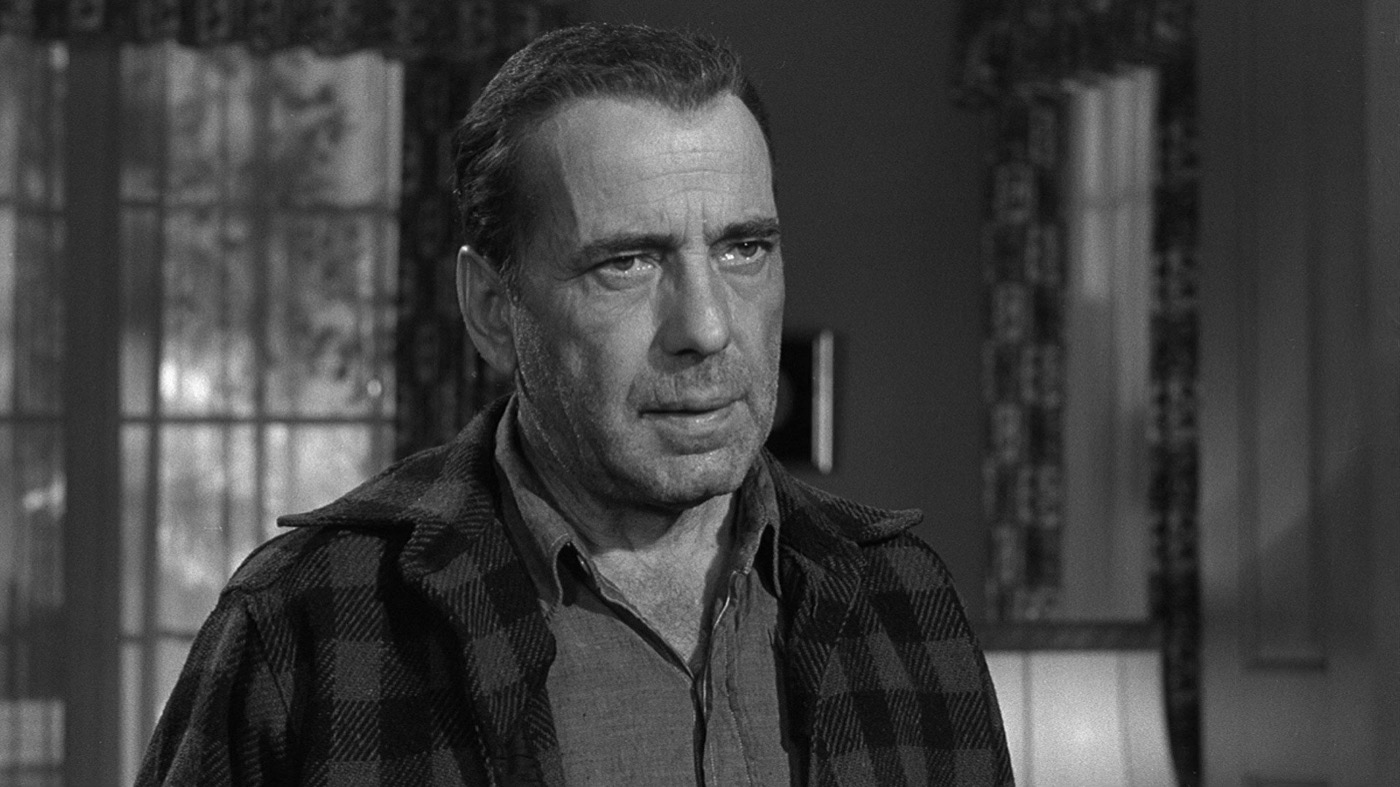
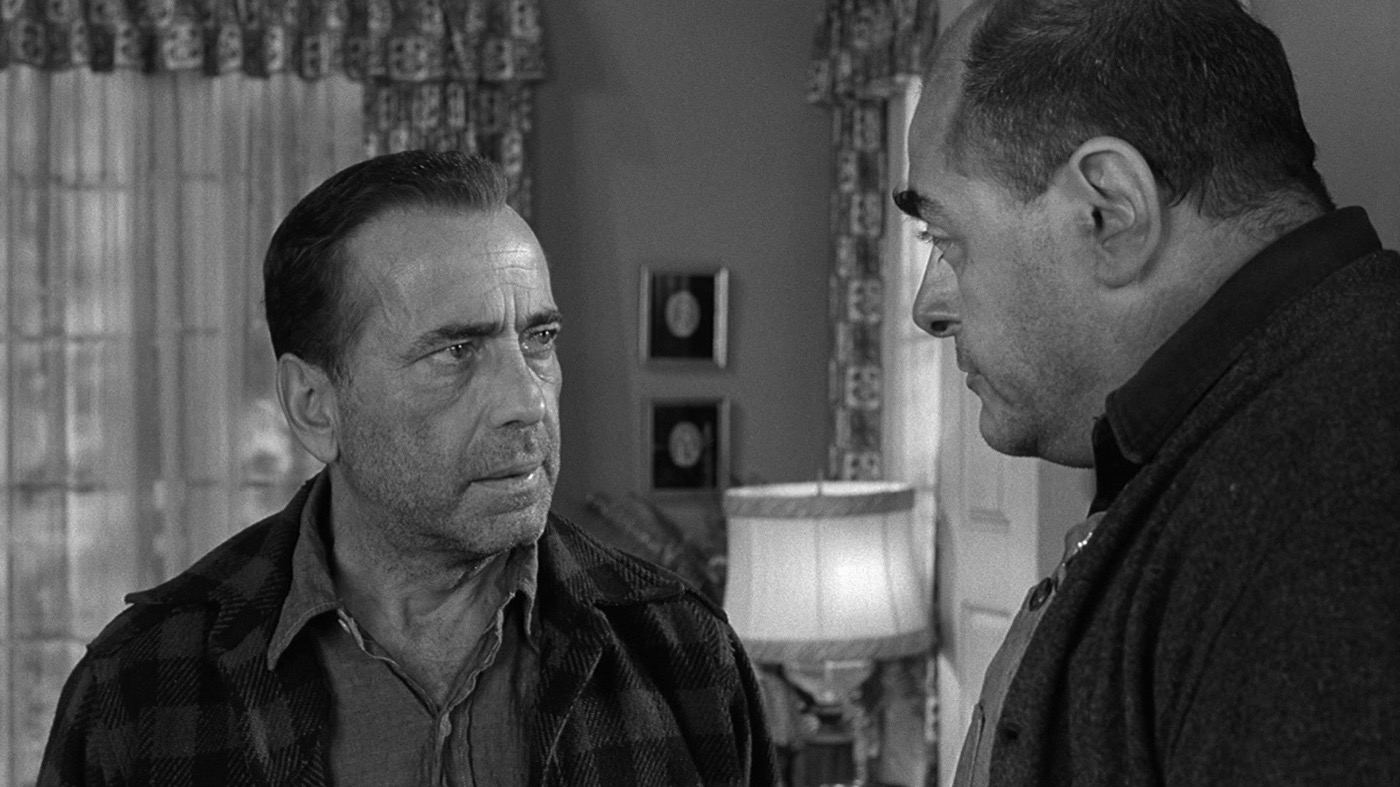
Bogart’s Griff is an intriguing character. Mrs Hilliard calls him a “cruel, inhuman, filthy” game-player—but is he?Most of the time he seems reasonable, but at others he struggles with the stress of the situation, and there are hints that his resentment of pillar-of-society figures like Mr Hilliard—as well as Bard—might get the better of his undoubted intelligence. The part could have been written for Bogart, and to some extent was; Paul Newman, a quarter of a century younger, played Griff on stage, but the character was aged for the screen so Bogart could take the role. Bogart compared Griff to his Duke Mantee in The Petrified Forest (1936), but his performance also recalls his Fred C. Dobbs in The Treasure of the Sierra Madre (1948), both in his initial geniality and in the way the cracks later show. It may have been a familiar role for Bogart, but here, in his penultimate film (his health was already failing, and he died little more than a year after its release), he shows why he was such a compelling villain.
The other fugitives are less captivating: Martin’s Hal is bland, and while Middleton’s Kobish is satisfyingly threatening, he carries something of the unintentionally comic feel of a silent-movie baddie. But the Hilliard family is more believable, their interpersonal bonds feel realistic, and all the actors playing them excel—especially March as the father (a role played by Karl Malden on stage) and Scott as the mother. Mr Hilliard acts tough with the intruders (“Get out of my house”), but he’s mild enough with his family, and until the end we’re never quite sure whether his defiance toward Griff is an empty sham or an indicator of hidden strength. His wife’s resolve in dealing with the intruders is quieter, but if anything, that makes it feel more solid.
Wyler’s production team contributes as much as the cast to making The Desperate Hours so gripping. Camera movement and editing subtly maintain tension, contrasts of diegetic light and shadow heighten the climax, and busy,cluttered sets add to the realism. Gail Kubik, a celebrated classical composer at the time though barely remembered today, wrote the score—and adapted a standalone orchestral piece from it—though it was heavily cut for the theatrical release.
Michael Cimino’s 1990 remake, Desperate Hours, was a disaster both critically and commercially, but Wyler’s film has stood the test of time well. It falls squarely into the mainstream of the era—it isn’t a groundbreaking movie (except in its use of the VistaVision process), and its noirish elements are far from extravagant or mannered. But it’s exceptionally well-made in every respect, and thoroughly engrossing from start to finish.
USA | 1955 | 112 MINUTES | 1.37:1 | BLACK & WHITE | ENGLISH

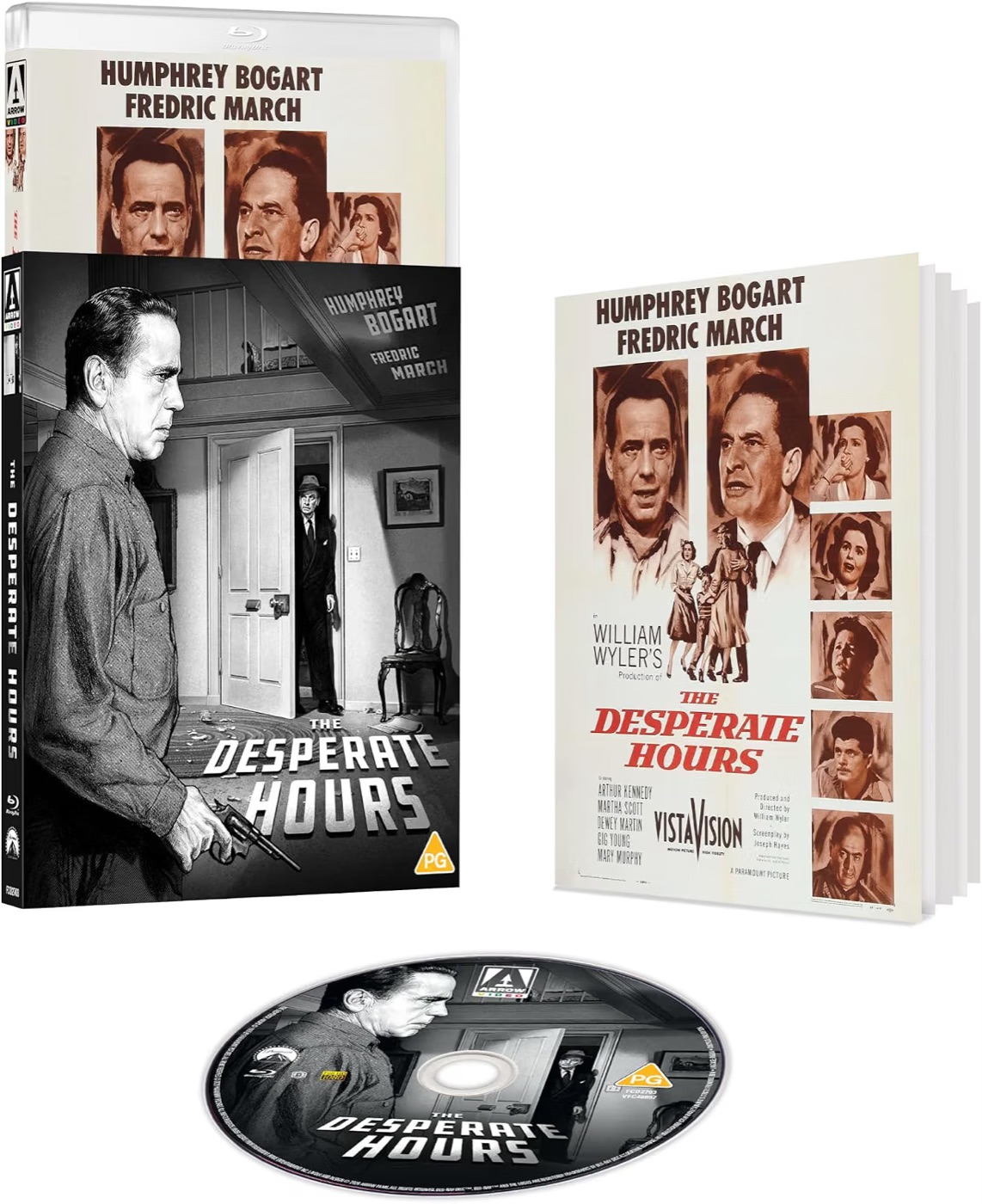

director: William Wyler.
writer: Joseph Hayes & Jay Dratler (uncredited) (based on Joseph Hayes’s 1954 novel & 1955 play).
starring: Humphrey Bogart, Fredric March, Arthur Kennedy, Martha Scott & Dewey Martin.