BUGSY MALONE (1976)
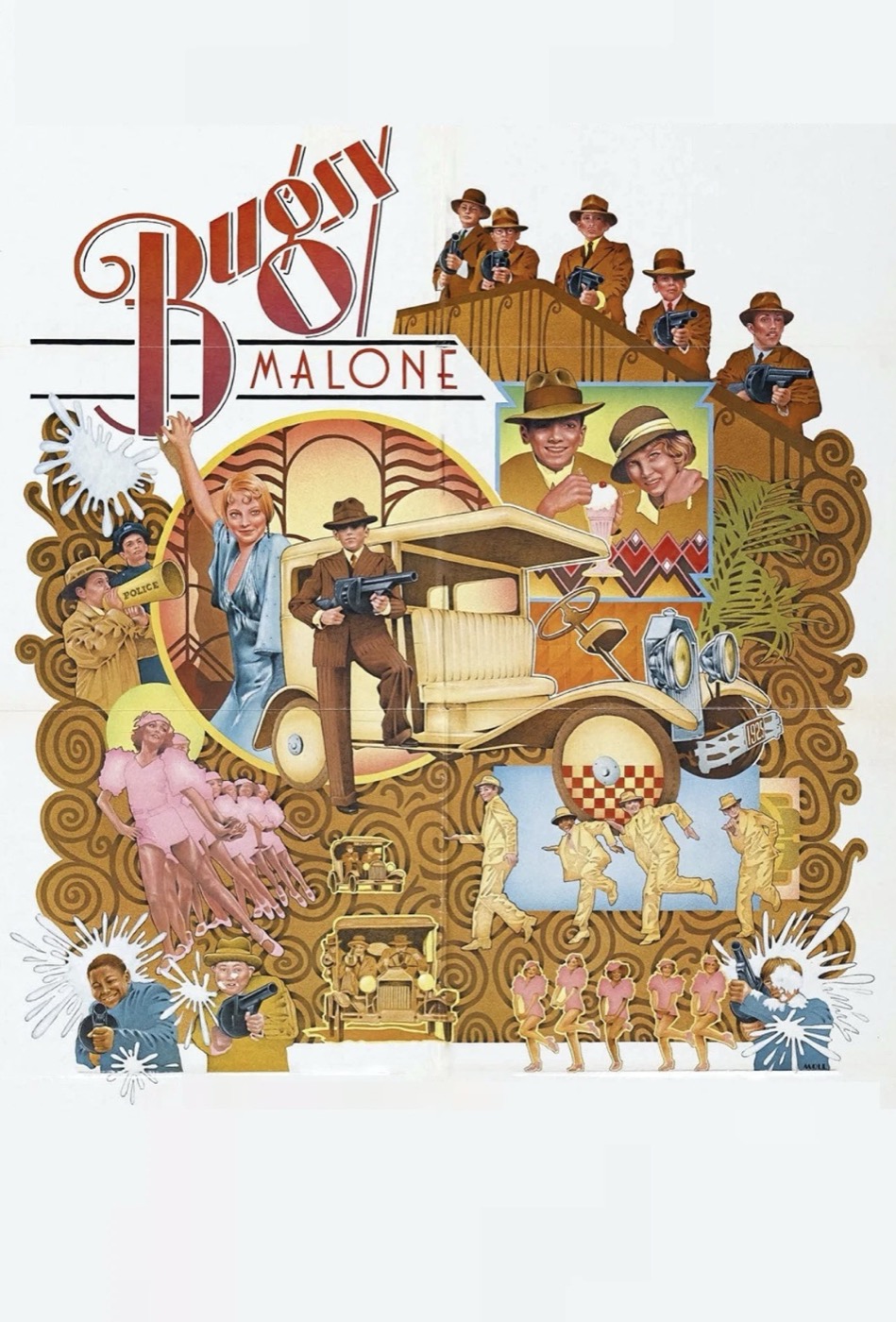
The classic gangster story of Bugsy Malone told with an all-child cast. The rise of Bugsy Malone and the battle for power between gangsters Fat Sam and Dandy Dan.

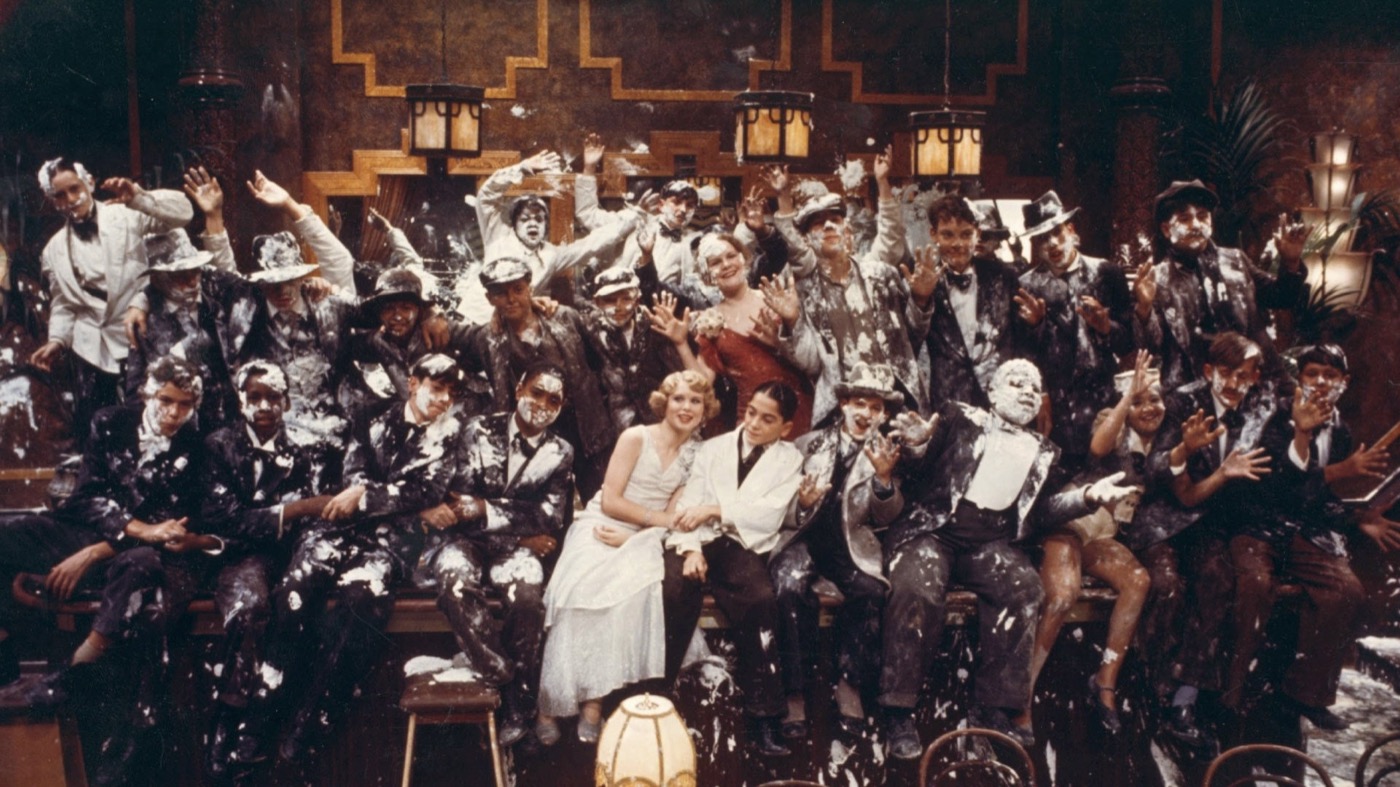

The classic gangster story of Bugsy Malone told with an all-child cast. The rise of Bugsy Malone and the battle for power between gangsters Fat Sam and Dandy Dan.
There is an obvious way to misunderstand Bugsy Malone: to treat its central conceit as the film itself. Children play gangsters, cars are pedal-powered, machine guns fire cream, and nightclubs are populated by junior molls, singers and hoodlums. The premise is so immediately legible that it risks reducing the film to a novelty before it’s even begun. Alan Parker’s achievement is to refuse that reduction. He doesn’t direct Bugsy Malone as a joke about children pretending to be adults. For the most part, he directs it as though its world were entirely coherent, and that distinction is what allows the film to survive its own absurdity.
The plot itself is hardly exceptional. Fat Sam’s criminal empire is under attack from rival gangster Dandy Dan, whose men possess a new weapon: the splurge gun. Bugsy becomes involved in the conflict whilst pursuing Blousey Brown and negotiating the attentions of Tallulah. Territory is lost, retaliation planned, alliances assembled, and the whole affair proceeds towards an inevitable confrontation. As a gangster narrative, this is elementary. Bugsy himself is charming, mobile, resourceful and fundamentally decent, but rarely contradictory. Fat Sam is funnier, Tallulah more vivid, and the gang war never develops the dramatic complexity of the films whose surfaces Parker is borrowing.
Yet that simplicity isn’t merely a weakness. Bugsy Malone is less interested in deepening the psychology of the gangster film than in reproducing its grammar under altered physical conditions. Parker preserves the adult system and changes its substance. Guns remain guns, but they fire cream. Cars remain cars, but they’re pedal-powered. Nightclubs retain their codes of glamour and performance without becoming genuinely sexualised spaces. Violence retains narrative consequence whilst losing most of its bodily force. Alcohol becomes brightly coloured liquid whose precise contents scarcely matter, and death itself is transformed into something closer to temporary exclusion from a game.
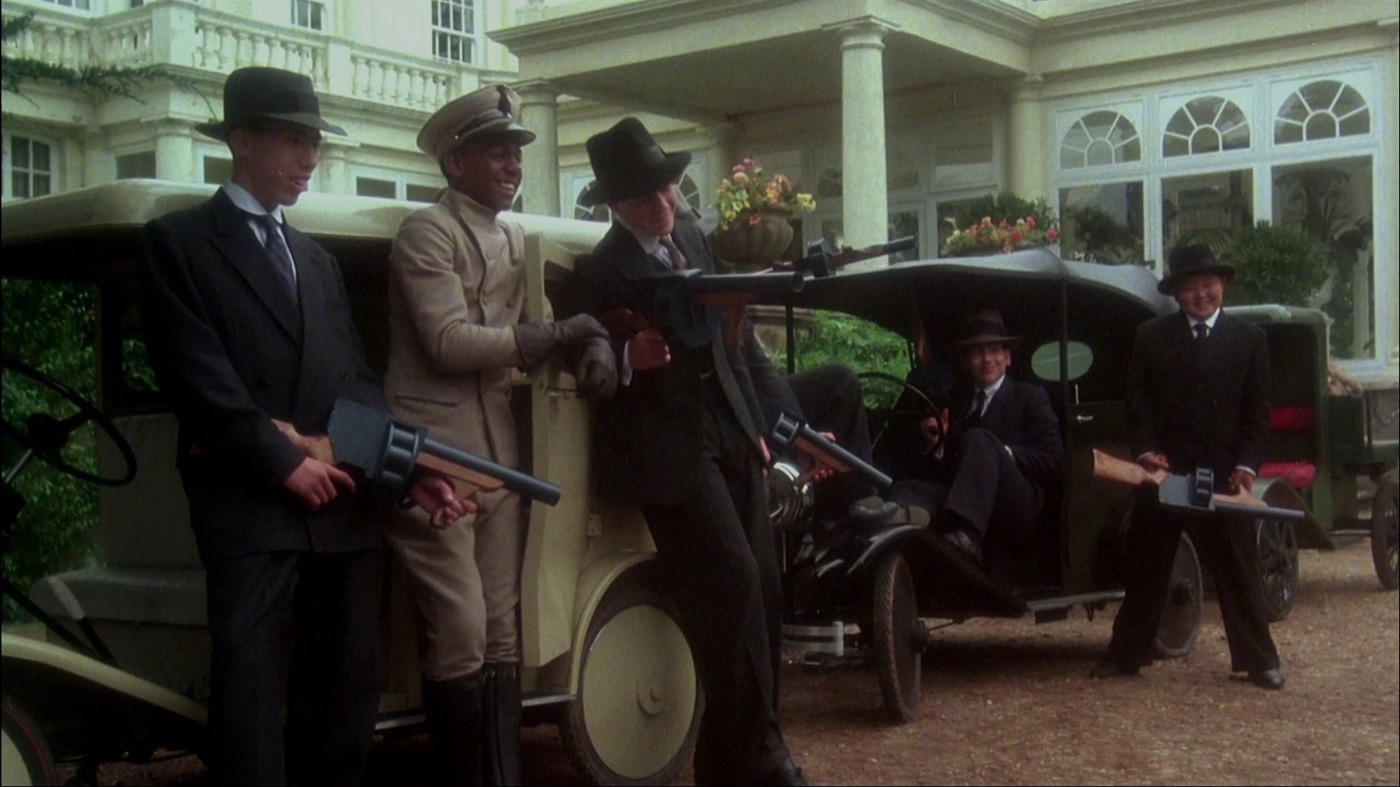
The remarkable thing is how little attention Parker calls to any of this. The cars aren’t repeatedly presented as comic props; within the film, they simply function as transport. The splurge guns aren’t treated as amusing substitutes for weapons: they possess tactical importance, confer power and alter the balance between rival gangs. The children don’t continually signal that they’re pretending. This is why the tone holds. Children at play rarely maintain an ironic distance from the worlds they invent. Once the rules have been established, those rules become temporarily absolute. A chair isn’t “like” a horse; it’s a horse. A corner of the garden becomes enemy territory. A stick acquires the authority of a weapon because everyone participating in the game accepts that it does. Bugsy Malone operates according to much the same principle: its world is ridiculous from the outside and serious from within.
That contradiction depends on considerably more technical discipline than the premise might suggest. The film was shot on 35mm with spherical lenses and composed for 1.85:1, photographed first by Peter Biziou and then principally by Michael Seresin. Precise focal-length records aren’t readily available, and there’s little value in retrospectively assigning millimetres to shots without evidence. What can be observed is the effect. The lensing rarely announces itself. There’s little aggressive wide-angle distortion and little conspicuous telephoto abstraction. Faces, groups and sets remain spatially intelligible. Parker is interested less in optical virtuosity than in placing bodies exactly where they need to be.
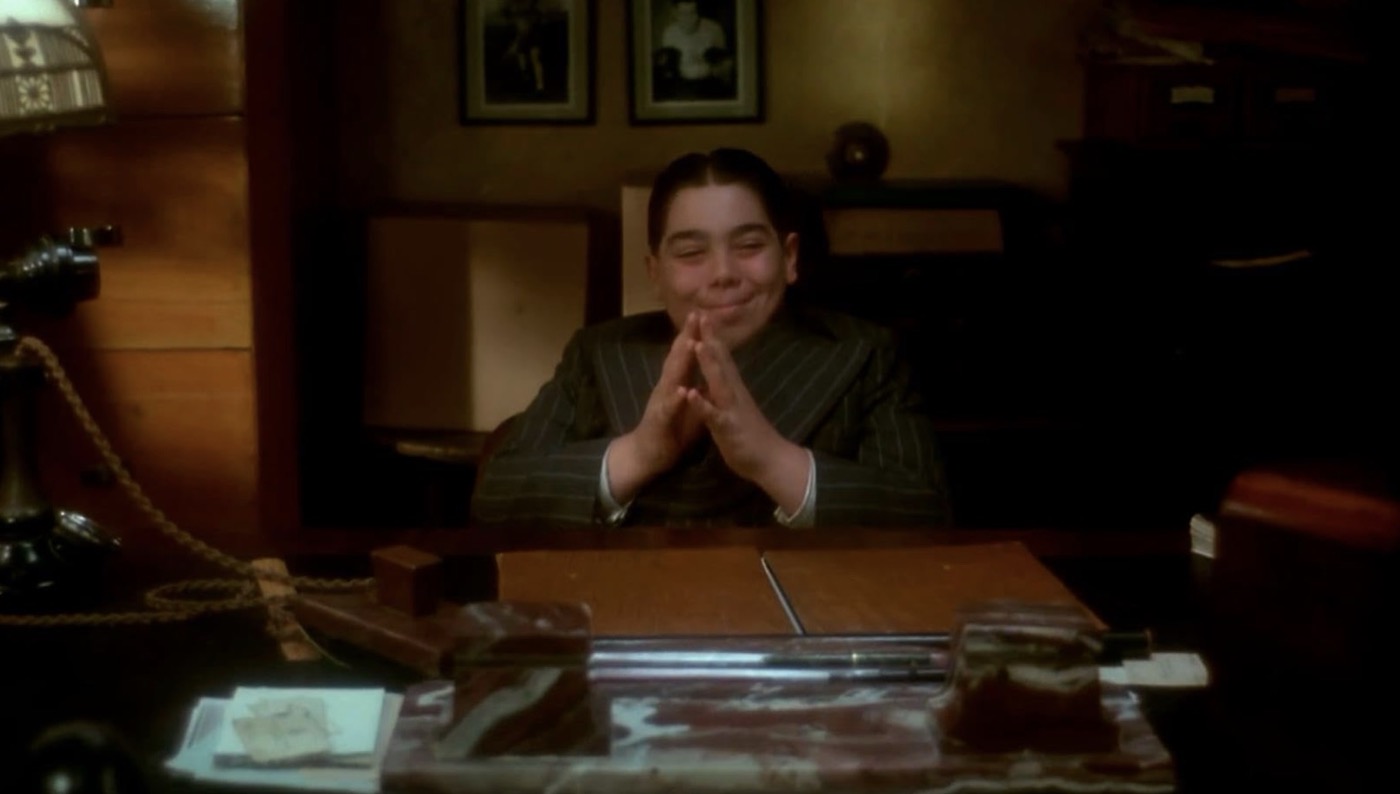
His framing is unusually controlled for a film whose premise could easily have encouraged exaggeration. Parker repeatedly knows when to isolate a face, when to hold several figures together and when the geography of a room must remain visible. Fat Sam’s office has hierarchy because people occupy it hierarchically. The speakeasy works because performers, tables, entrances and spectators are organised into a legible social space. The artificial New York street becomes convincing not because Parker attempts documentary realism, but because everybody knows how to move through it.
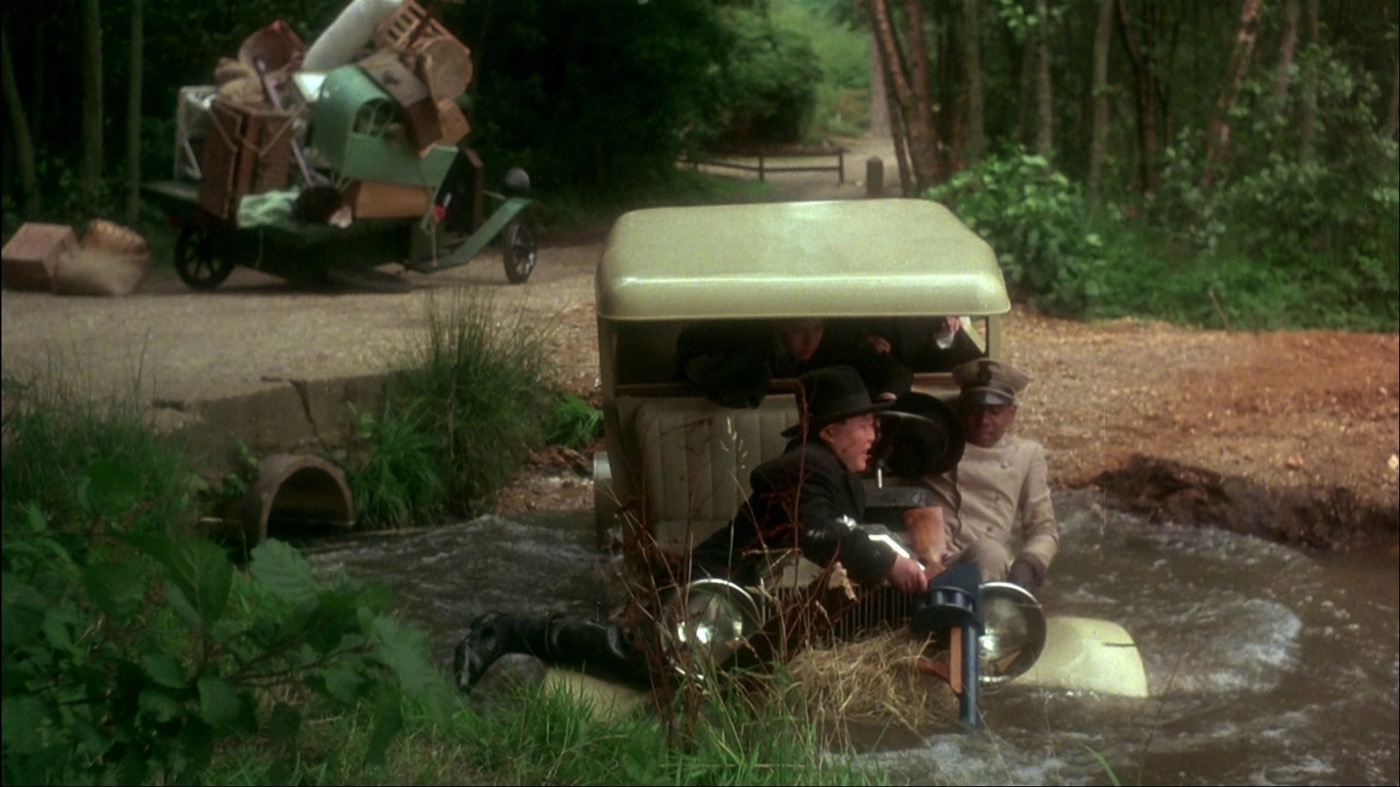
The sets reinforce that effect. Geoffrey Kirkland’s main street was built indoors at Pinewood and slightly reduced in scale, allowing the young cast to inhabit a recognisably adult urban environment without simply being swallowed by it. The result occasionally recalls the polished period artificiality of The Sting (1973): America remembered through cinema rather than recovered through historical realism. Suits, cars, offices, alleyways, nightclubs, gangsters and slang arrive already mediated by decades of Hollywood mythology.
Parker knew that mythology better than he knew America. Bugsy Malone is therefore not an attempt to reconstruct the US of the 1920s with historical rigour; it reconstructs an America already filtered through Cagney, Astaire, Kelly, Brando and Welles. What matters isn’t realism, but internal consistency. The visual discipline protects the premise. Had Parker filmed the children with exaggerated lenses, frantic camera movement or constant comic emphasis, every scene would have reminded us of the joke. Instead, the camera grants them the spatial authority of adults.
The same restraint is present in Gerry Hambling’s editing. Bugsy Malone rarely feels anxious about keeping a young audience’s attention. Shots are allowed to complete their dramatic function, reactions are isolated cleanly and action remains legible. The rhythm is brisk without becoming frantic, and Parker trusts the clarity of the staging rather than compensating for weak material through over-cutting.
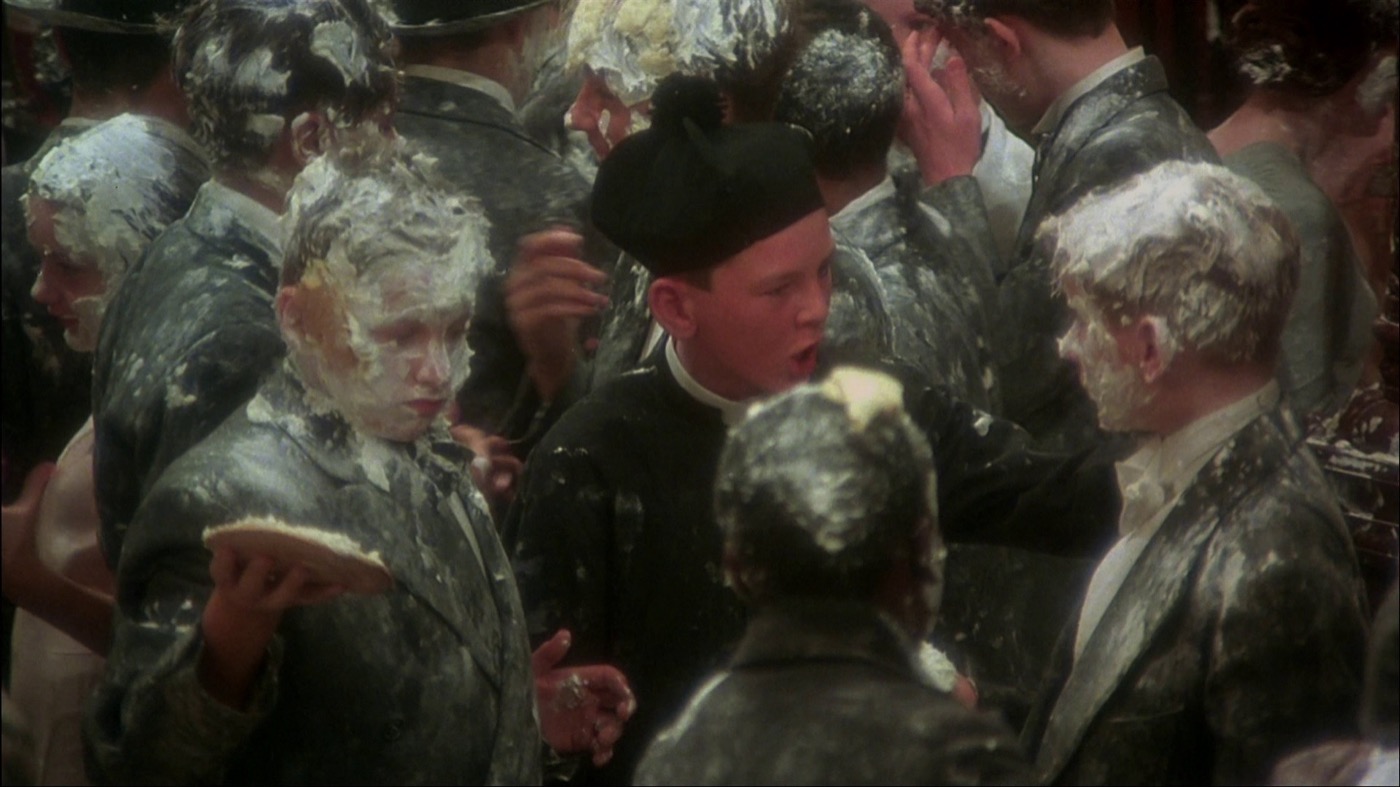
One of the film’s central inventions also exists partly because of editing. The splurge guns didn’t actually fire cream successfully. The practical weapons fired ping-pong balls, while the impact was created separately by throwing cream at the victim. The cut joins cause to effect, and the spectator constructs the impossible weapon in the interval between the two shots. In miniature, this is the logic of the entire film: Parker provides two incompatible realities and cinema fuses them into a functioning one.
The treatment of violence follows the same principle. When Bugsy is beaten, we understand exactly what is happening, yet Parker avoids presenting the body as the site of violence. Figures descend upon him, he disappears beneath them, and the event remains comprehensible without fists repeatedly striking flesh. Violence is preserved as a relationship between aggressor and victim, threat and submission, power and defeat, while its material horror is removed.
Sexuality is handled with comparable precision. Tallulah is unmistakably assembled from the signs of an adult femme fatale: costume, posture, confidence, make-up and theatrical self-possession. Jodie Foster plays her with an assurance that gives the character more weight than the screenplay alone might suggest. Yet Parker stops before those signs become literal eroticisation. Tallulah performs the code of seduction without the camera asking us to consume her sexually. The nightclub dancers reproduce the choreography and visual vocabulary of adult entertainment whilst remaining inside the protected artificiality of the film’s world.
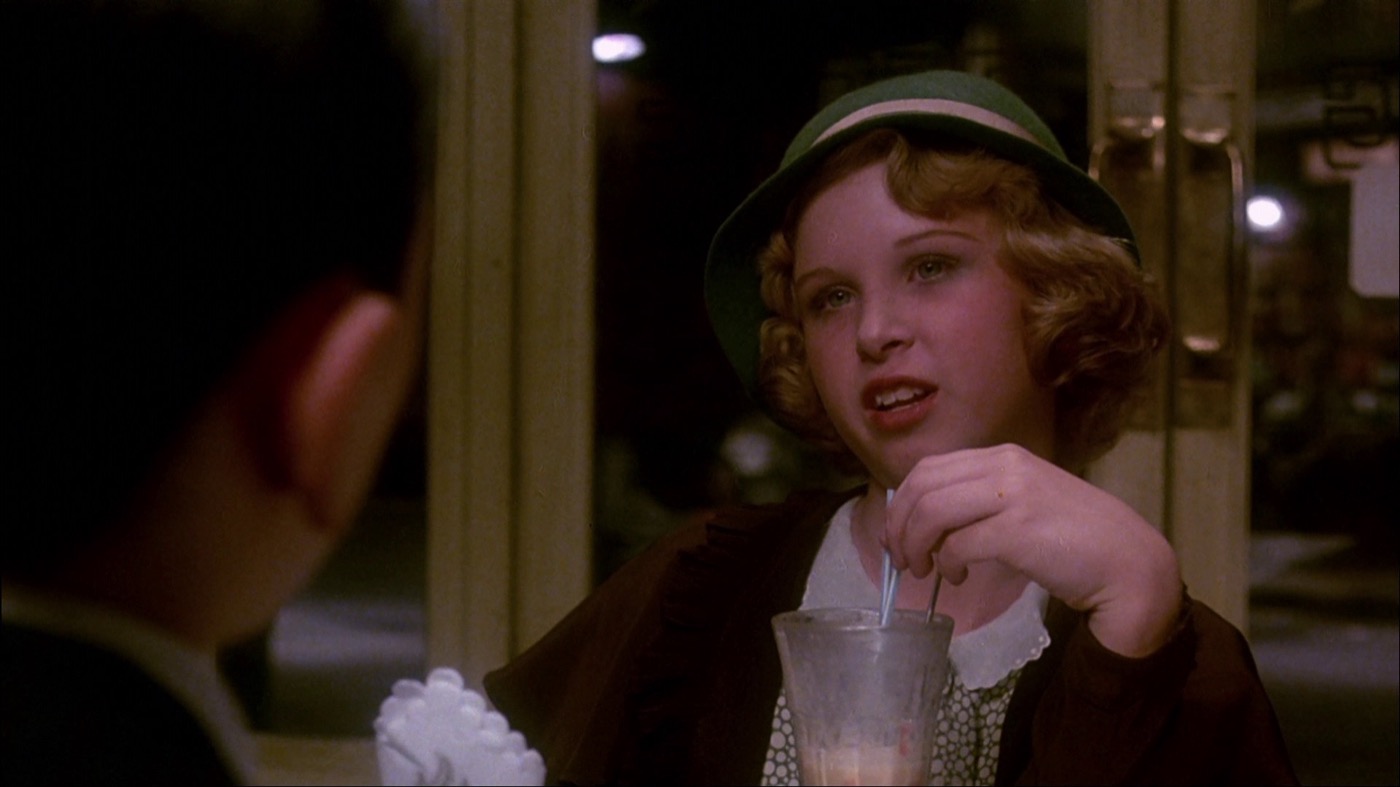
This principle extends across the entire film. Parker retains the adult structure but replaces the irreversible physical content. Blood becomes cream, alcohol becomes coloured drink, sexual availability becomes glamour, cars become toys and death becomes exclusion. The adult world remains recognisable because its grammar is intact, but its material consequences have been translated into forms compatible with play.
Maintaining that balance would be impressive with any cast. With approximately two hundred children and teenagers, many of them inexperienced, it becomes one of Parker’s clearest achievements. His personal history matters here. Bugsy Malone began as a story invented for his four young children during long car journeys, and he’d already spent years directing children in television commercials. By the time he made his first feature, he wasn’t approaching children as exotic performers requiring some sentimental or specialised technique. He already understood how they behaved and how directly they needed to be addressed.
More importantly, he appears to have understood what not to ask from them. The cast rehearsed for six weeks. Parker used that period not simply to drill performances, but to discover individual strengths and weaknesses, shifting roles where necessary and allowing the young actors to become familiar with the material before filming began. He encouraged spontaneity and improvisation whilst protecting the written dialogue, and he treated the performers as actors rather than as children being indulged by adults.
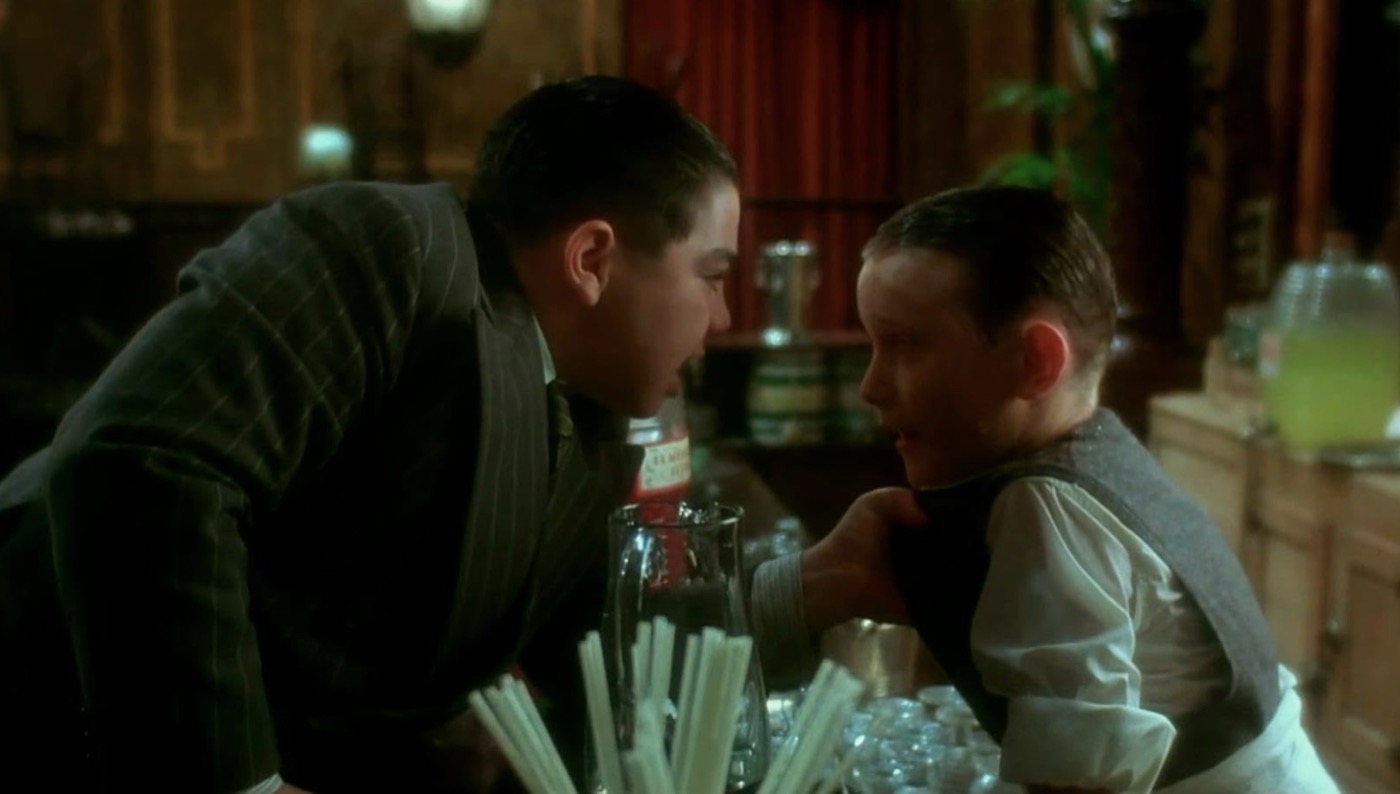
Accounts from the cast suggest a method based on clarity rather than psychological explanation. Instead of asking a child to analyse a complicated emotional state, Parker could simply ask for sadness, fear or happiness and allow the performer to embody it. This isn’t a lesser form of direction. It’s often better direction, because the note is playable. The performer is given a condition rather than an interpretation.
Parker also cast for presence rather than conventional technique. John Cassisi, the extraordinary Fat Sam, had never acted before Parker found him in a Brooklyn school. What Parker recognised wasn’t polish, but behaviour: a voice, a rhythm, an attitude that could become a character. At the opposite extreme stood Jodie Foster, already extraordinarily experienced at twelve and technically far more advanced than most of the cast. Yet both belong to the same film because Parker doesn’t force the children into a uniform style of “child acting”. He builds the frame, establishes the rules and allows different kinds of presence to function inside them.
That may be one reason the performances retain so much freshness. Natural behaviour is placed inside an artificial form. The children aren’t asked to parody adulthood, but neither are they forced into grotesque imitations of adult psychology. They inhabit clear roles: boss, singer, rival, lover, hero. The form around them is controlled enough to give those roles weight.
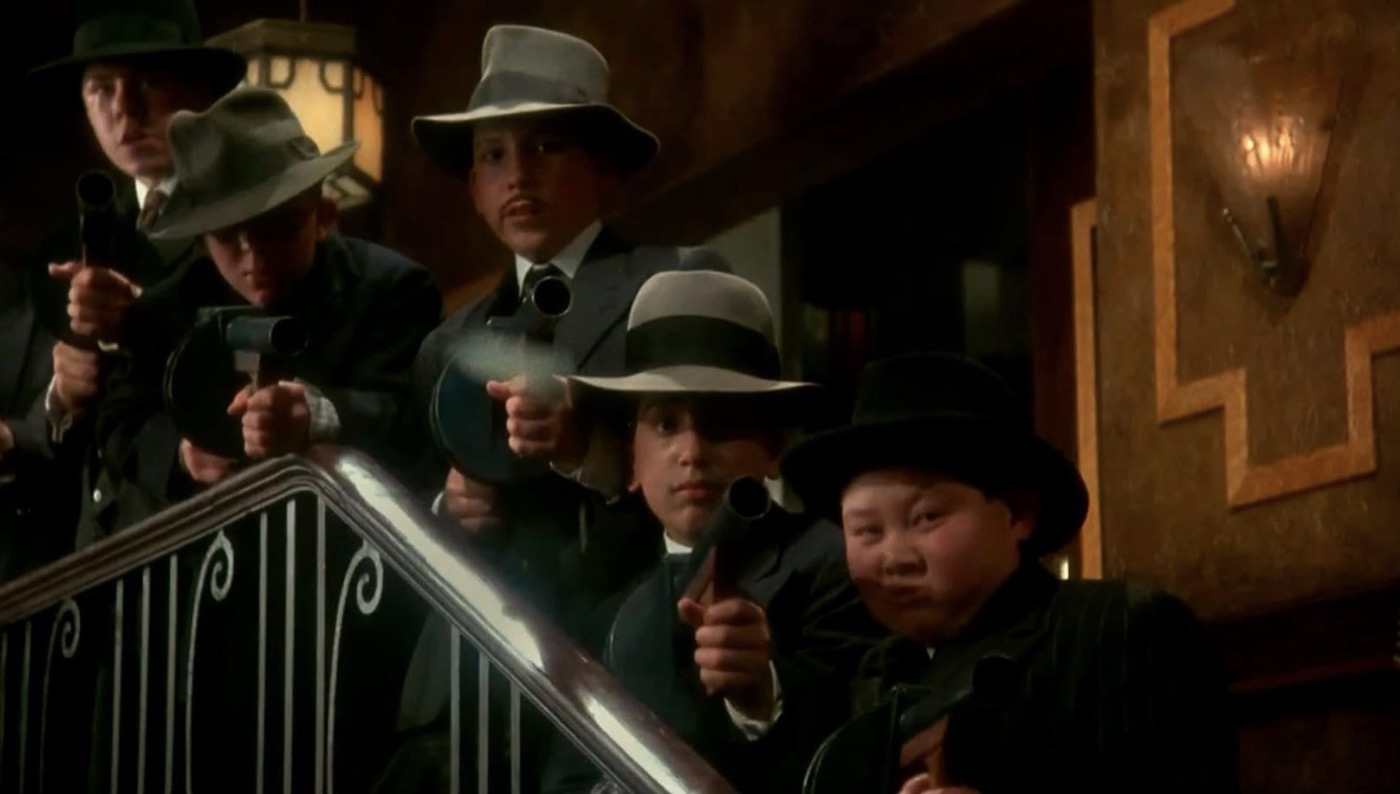
This is where Bugsy Malone becomes more interesting than its premise. The film doesn’t simply infantilise the adult world. It exposes how much of that world already consists of roles, conventions, costumes, gestures and collectively maintained rules. A gangster is powerful because other people recognise the signs of his power. Territory matters because everybody behaves as though it matters. Reputation produces consequences because a community agrees that reputation must be defended. Hierarchy becomes real through repeated acts of recognition.
The children make that mechanism unusually visible because their bodies never quite disappear into the roles they perform. However seriously Fat Sam behaves as a crime boss, the spectator retains a simultaneous awareness that this is a child enacting the form of a crime boss. That gap between role and body is the film’s most productive space.
Seen through this arrangement, adult institutions can begin to look like systems that have forgotten their own contingency. “This is how things work” replaces “this is how we have decided things should work”, and the children make that shift unusually visible. Their seriousness reveals the strength of the system, while their childhood reveals that the system need not be mistaken for nature.
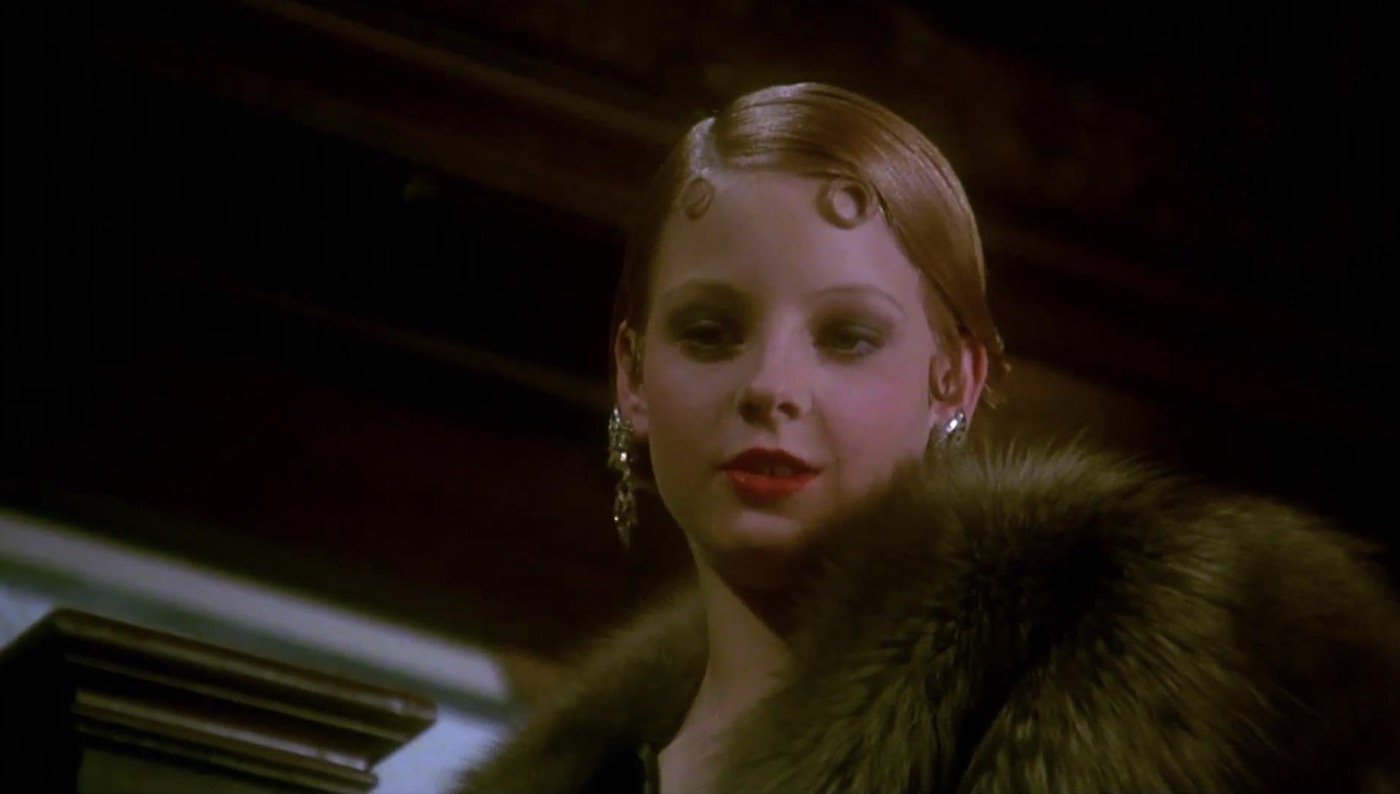
This doesn’t mean Bugsy Malone should be inflated into a conscious political allegory. There’s no need to attribute a systematic philosophy of institutions to Parker. The film’s intelligence lies in following its formal premise rigorously enough for these implications to emerge without being announced. Parker builds a functioning world first and allows meaning to follow from the way that world operates.
The adult singing voices are perhaps the most conspicuous rupture in this coherence. Unlike the cars or the splurge guns, they don’t belong seamlessly to the material rules of the world. They introduce an overt split between body and voice, child and adult, image and sound. The effect remains bizarre, but it’s also strangely appropriate. An adult voice emerges from a child’s body in a film already devoted to children inhabiting adult forms. Even an awkward production choice ends up reinforcing the film’s central division between role and body.
The weaknesses of the screenplay nevertheless remain real. Once the rules of the world have been grasped, the narrative itself rarely surprises, and some relationships might have sustained greater tension without sacrificing clarity. The gang war works efficiently enough as a structure, but not as a particularly gripping dramatic engine.
There’s also a structural limit to how far Parker could have gone. A psychologically dense gangster tragedy performed by children would have altered the nature of the game. The roles need to remain sufficiently clear for the world to remain reversible. Once genuine trauma, irreversible betrayal or death entered the film, its governing contract would collapse.
That reversibility is what makes the ending possible. For most of the film, cream means violence. It’s ammunition, it marks defeat and it belongs to the rules of conflict. Then the final confrontation dissolves. Cream ceases to signify death and becomes cream again. Everybody throws it at everybody else, enemy distinctions collapse, and the war loses its seriousness because the agreement sustaining that seriousness has been withdrawn.
Nothing material has changed; what changes is the shared meaning attached to the object. This shift transforms the final song, “You Give a Little Love”, from merely cheerful sentiment into something structurally necessary. Its message is deliberately simple: hostility can end, divisions can be abandoned and people can choose to behave differently. In another film such a conclusion might feel naïve. Here, naivety belongs to the architecture because children possess a freedom adults often lose: they can take a game completely seriously and then simply stop playing it.
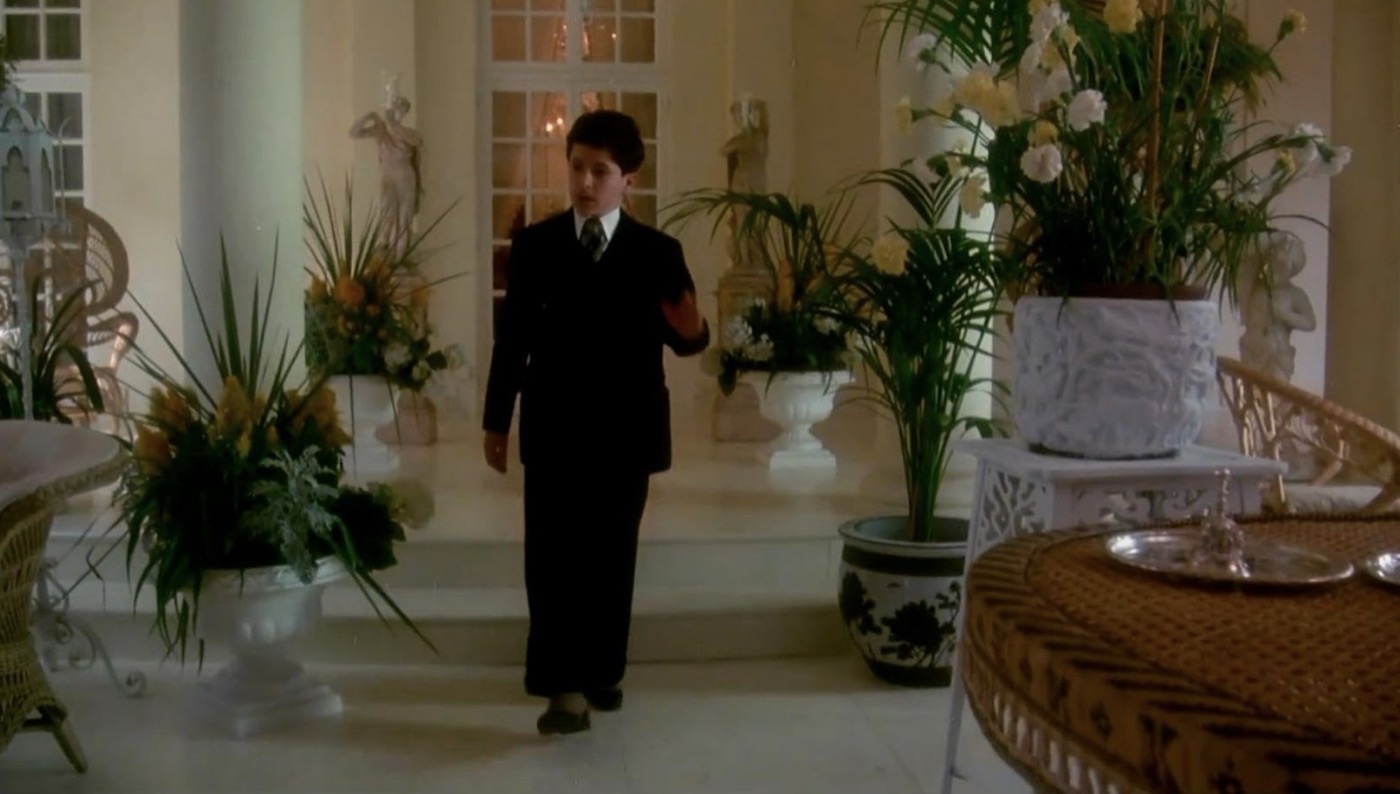
Nobody has truly died. No wound is irreversible. No trauma has accumulated to the point at which reconciliation would become dishonest. The world has been constructed precisely so that violence can remain serious within the game without becoming permanent outside it. The possibility of exit has been present from the beginning.
That may be the most quietly radical thing about this extraordinarily cheerful film. The children spend ninety minutes reproducing an adult world of hierarchy, competition, violence, ambition and seduction with complete conviction. Yet once the game ends, its structures lose their authority almost instantly. Adults are much less inclined to remember that the systems they inhabit were constructed at all.
Bugsy Malone is therefore more successful than its novelty initially suggests. It’s not a great narrative, but its achievement is configurational: direction, performance, production design, cinematography and editing all maintain the same precarious boundary between reality and play.
Parker’s first feature demonstrates something his later career would confirm. He was not merely an image-maker, but a director capable of organising performers, space, rhythm and technical departments around a single tonal law. The children take the game seriously, Parker takes the children seriously, and because he does, Bugsy Malone can suggest that some of the things adults regard as permanent, natural and inescapable may simply be games whose rules we have forgotten we invented — and, unlike children, forgotten that we can stop playing.
UK • USA | 1976 | 93 MINUTES | 1.85:1 | COLOUR | ENGLISH • ITALIAN • FRENCH

writer & director: Alan Parker.
starring: Scott Baio, Florrie Dugger, Jodie Foster, John Cassisi & Martin Lev.