FORBIDDEN PLANET (1956)
A starship crew in the 23rd-century investigate the silence of a distant planet's colony, only to find just two survivors, a powerful robot, and the deadly secret of a lost civilisation.

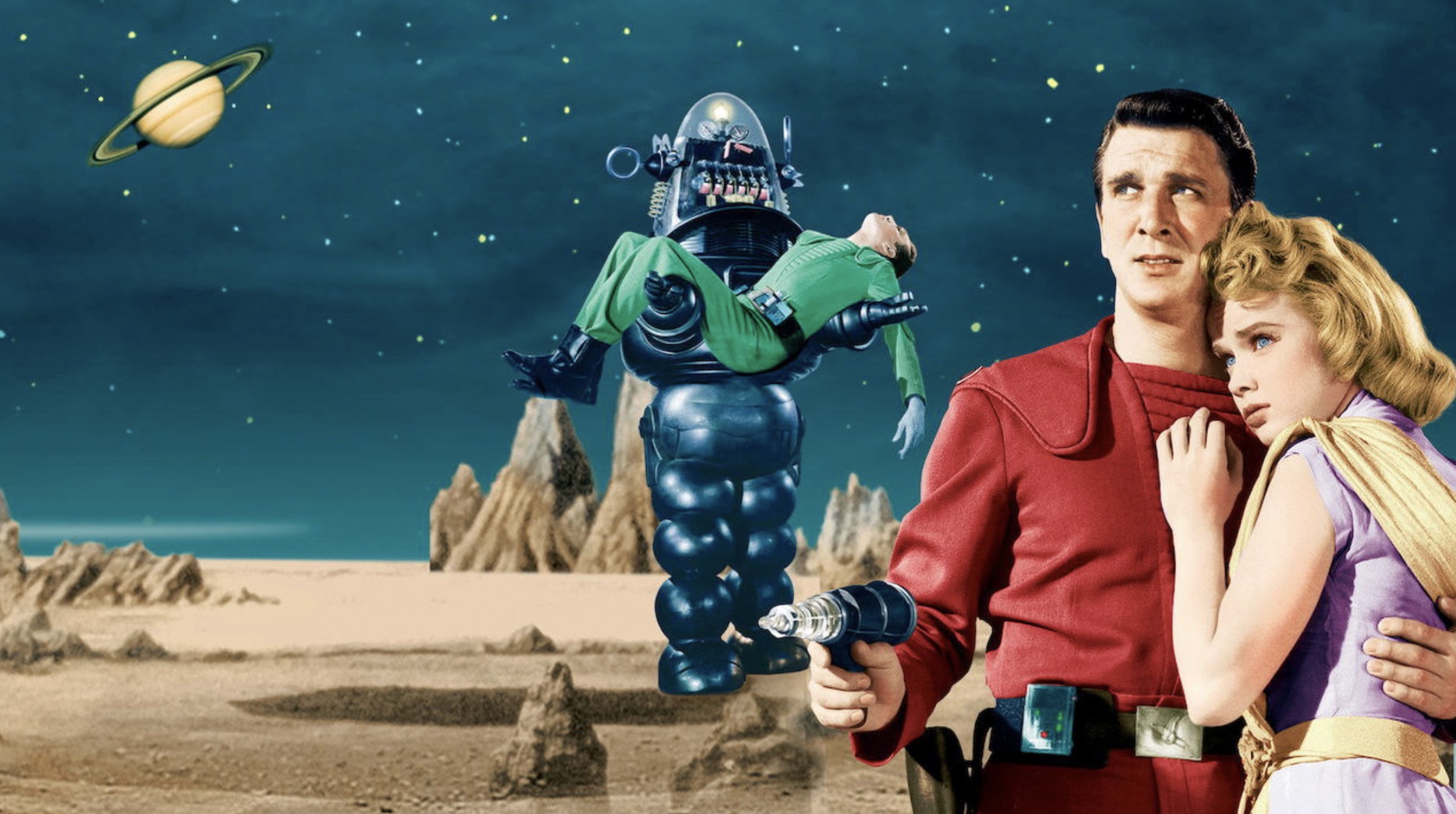

A starship crew in the 23rd-century investigate the silence of a distant planet's colony, only to find just two survivors, a powerful robot, and the deadly secret of a lost civilisation.
Very much of its time and yet in many respects far ahead of it, Forbidden Planet changed the trajectory of sci-fi by combining a gorgeous Golden Age aesthetic with intelligent storytelling and elements of psychological horror. Nothing quite like it had been seen before. It was the first film to be set in a future where humans have become a spaceborne, interplanetary civilisation with faster-than-light ships, and where none of the action occurs on Earth. Its legacy echoes through the classic television shows and movies that followed—-from The Twilight Zone (1959-1964) to Star Trek (1966-69), and from 2001: A Space Odyssey (1968) to Star Wars (1977).
Made in 1950s America, the film reflects the societal values of that time and place: the cast is entirely white and subject to gendered stereotyping, particularly the sole female character. However, this creates an interesting dichotomy for today’s audiences; it reflects negative aspects that persist in many cultures while presenting an optimistic model of a possible future. It also delivers a caveat that’s even more pertinent now than it was then regarding rapid technological advancement without matching philosophical development. Such conflict only adds an extra layer to what remains one of the finest works of cinematic art in both aesthetics and themes.
No one can deny that, halfway through the 20th century, science fiction movies finally caught up with the level of intelligence already asserting itself in the genre’s literature. Perhaps Robert Wise’s The Day the Earth Stood Still (1951) can be counted as one of the earlier examples, arriving a few years ahead of The War of the Worlds (1953), The Quatermass Xperiment (1955), and This Island Earth (1955)—the only notable precursors to Forbidden Planet.
After the lofty aspirations of pioneering fin de siècle novelists like Mary Shelley, Edgar Allan Poe, Jules Verne, and H.G Wells, science fiction’s popularity took it along the path to “pulp”. Seminal stories such as the Skylark series, by E.E ‘Doc’ Smith with Lee Hawkins Garby, and Buck Rogers, by Philip Francis Nowlan, were among those published in 1928 by Amazing Stories. The colourful cover art of the first periodical dedicated to thrilling tales of speculative science also established how sci-fi should look. Among the plethora of similar magazines that followed was the equally influential Astounding Stories which, under the editorial stewardship of John W. Campbell, is said to have heralded the Golden Age of science fiction. This era, defining the genre through the 1940s and 1950s, was typified by ambitious, space-spanning stories with profound, philosophically challenging content.
By contrast, monstrous metaphors for atomic-age paranoia had infested the world’s screens with massive mutants. The majority of these relied on a “look at the size of that thing” spectacle that invariably failed due to budgetary and technical shortcomings. Yet the post-war public loved them, so the studios churned out B-movies and drive-in fodder. There were a couple of notable exceptions from opposite sides of the globe. From those delivering the nuclear nightmare, we have the superior creature-feature Them! (1954), and from those suffering its legacy, Godzilla (1954)—both surprisingly sophisticated responses to a weighty issue.
Just as the genre was rooted in literary beginnings, Irving Block saw untapped potential in pulp periodicals and the proven popularity of the intellectual stories he’d read in print. As a special effects technician and scenic matte painter, he understood the cinematic possibilities and technical limitations of such fantastical world-building.
Block was already making a name for himself, despite his first notable job being buried under a lawsuit. He’d been art director, working with stop-frame animator Lou Bunin, on Alice in Wonderland (1949), which was pulled from US distribution following pressure from Disney, who feared it would pre-empt their own version. It was also refused distribution in Britain because the Queen of Hearts was thought to be an unpatriotic pastiche of Queen Victoria.
More relevantly, Irving Block was the matte artist for Kurt Neumann’s Rocket-Ship XM (1950), which claimed to be the first serious feature film about “man’s conquest of space.” The following year, he contributed special visual effects for B-movies of varied quality, including Flight to Mars (1951) and Invaders from Mars (1951). He then graduated to producer for Unknown World (1951), about a mission to explore the Earth’s depths to escape nuclear annihilation. After bemoaning the lack of sophistication in such films to colleague Allen Adler, the pair set themselves the challenge of writing a high-concept sci-fi story to redress the problem before audiences lost interest in the genre.
By 1954, they were pitching Fatal Planet to producer Nicholas Nayfack at Metro-Goldwyn-Mayer. They must have been unsure of their chances, as MGM had never made a science fiction film, but they also knew the studio offered the best hope of raising a sufficient budget. Block also had insider knowledge, having already worked with the studio’s matte painting crew.
Nayfack was expecting another monster movie he could easily dismiss but was immediately intrigued by the idea of an invisible monster. For one thing, he thought it would be cheap to shoot—and that was enough of a hook to seal the deal. He was aware of recent prestige productions like War of the Worlds for Paramount and This Island Earth for Universal, which had been critically well-received but still struggled to recoup their large budgets.
Irving Block was offered the role of associate producer but declined to accept unless it was shared with Allen Adler. Instead, he was re-hired as a concept artist and uncredited production designer, collaborating with art director Arthur Lonergan. He also had input into the story development, working with Cyril Hume, who was tasked with the screenplay.
Hume was a seasoned writer who’d entered the industry when his 1923 debut novel, The Wife of the Centaur, was filmed by King Vidor. His early draft was retitled Forbidden Planet to emphasise the mystery. This, alongside Block’s plentiful concept art and additional storyboarding by Mentor Huebner, secured the production.
Fred McLeod Wilcox was assigned as director. Though he had no sci-fi experience, he was considered a safe pair of hands, having directed three successful Lassie movies. Perhaps over-compensating for his lack of genre experience, he spent three months planning the shoot and consulting with physicists and engineers at Harvard and MIT to ensure the science sounded feasible.
Initially, Block envisaged something with the gravitas of a Wellsian classic. Apparently, it was Adler who suggested that instead of looking to “The Shakespeare of Science Fiction”, they go back further and borrow from the Bard himself. Thus, they decided to use The Tempest as their template.
Although some critics argue the connection is tenuous, there are enough blatant Shakespearean parallels for the movie to be considered an adaptation. In turn, Gene Roddenberry never openly admitted that Forbidden Planet directly influenced Star Trek, citing instead E.E ‘Doc’ Smith’s Skylark stories and NBC’s Wagon Train. However, Roddenberry’s biographer, David Alexander, noted a production memo acknowledging the film’s influence and advising the crew to avoid directly copying the film’s “mechanics”. He may not have been entirely successful; many view it as an unofficial pilot or a prequel set in the same universe.
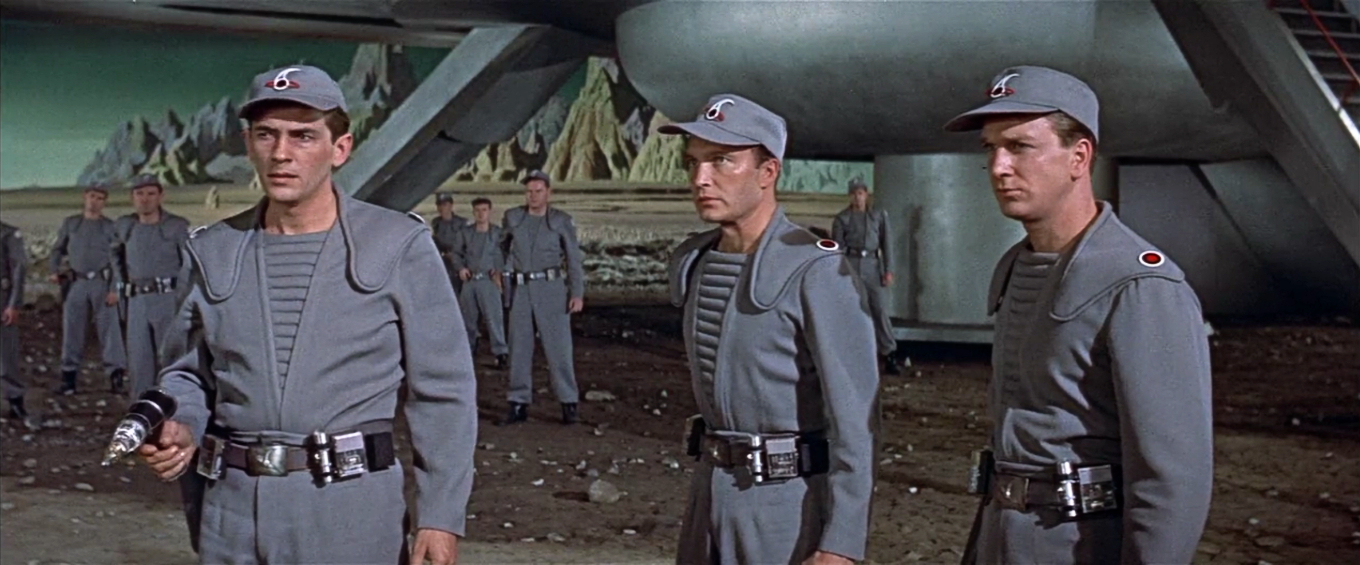
The film opens on board the United Planets Starship C-57D, which seems to comply with the numbering convention later employed by Star Trek’s United Federation of Planets. Not only that, but in the first few lines of dialogue, the mark for their ship to drop out of faster-than-light (FTL) speed is “1701”. Coincidental? Probably. But it’s certainly noteworthy that this was the first time the concept of FTL travel appeared on screen with an awareness of the physical toll of acceleration. To overcome this, the crew steps into beams of green energy that look remarkably like Trek’s transporters.
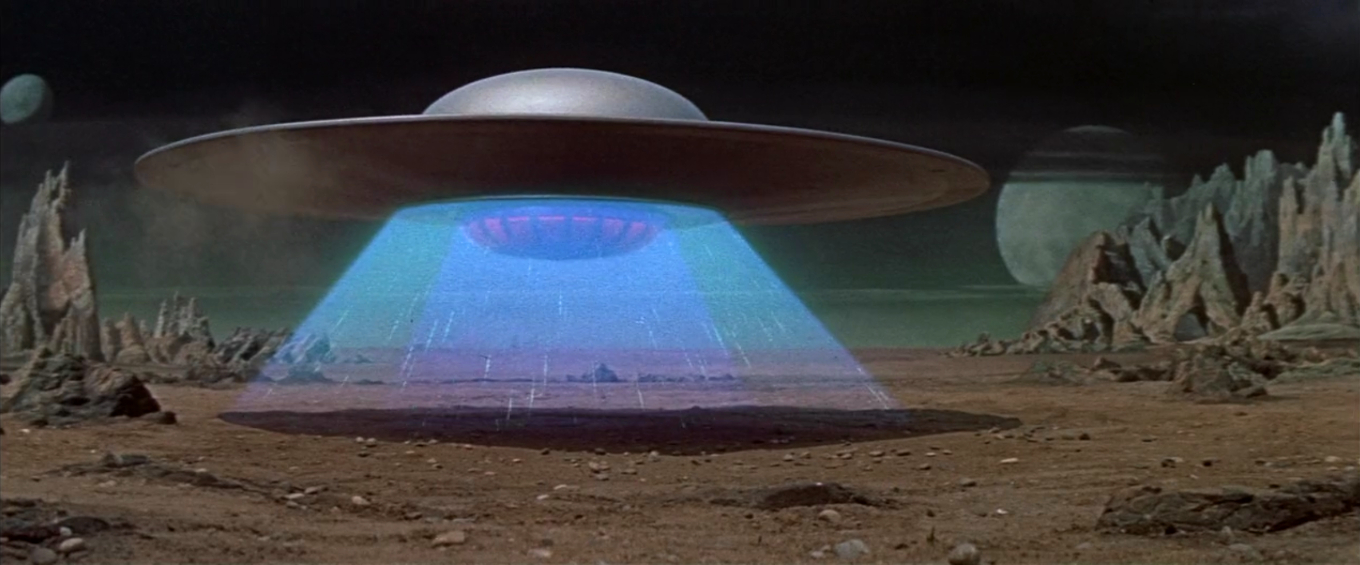
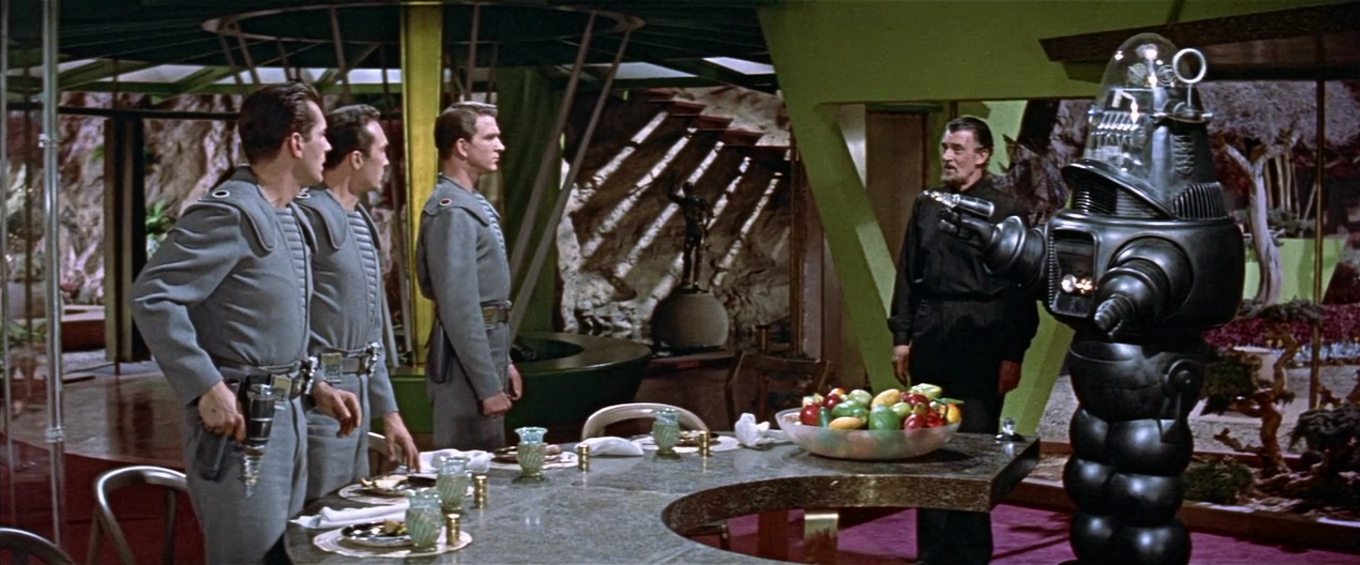
The C-57D has arrived at Altair IV, where a scientific survey went missing 20 years prior. Commander Adams (Leslie Nielsen) is warned to stay away by Dr Morbius (Walter Pidgeon), but Adams continues his mission regardless. On landing, they’re greeted by the iconic Robby the Robot, who escorts the Commander and his lieutenants to the well-appointed home of Dr Morbius. Arthur Lonergan wanted a plush design inspired by the modernist architecture of Frank Lloyd Wright—a decision that looks very cool, even if it raises questions about the Doctor’s priorities.
Robby is arguably the star here. Beyond the beautiful design, he demonstrates Block’s familiarity with Isaac Asimov’s “three laws of robotics”. Dr Morbius demonstrates the robot’s compliance by ordering it to shoot the Commander; Robby, unable to harm a human, is locked in a logic loop that would destroy him if the order weren’t countermanded.

Robby was the result of a long design process costing around $125,000, making him one of the most expensive props ever created. Based on Block’s sketches, he was developed by Robert Kinoshita. The finished seven-foot-tall prop was so close to the wooden maquette Kinoshita carved that the model was used in the miniature sequences.
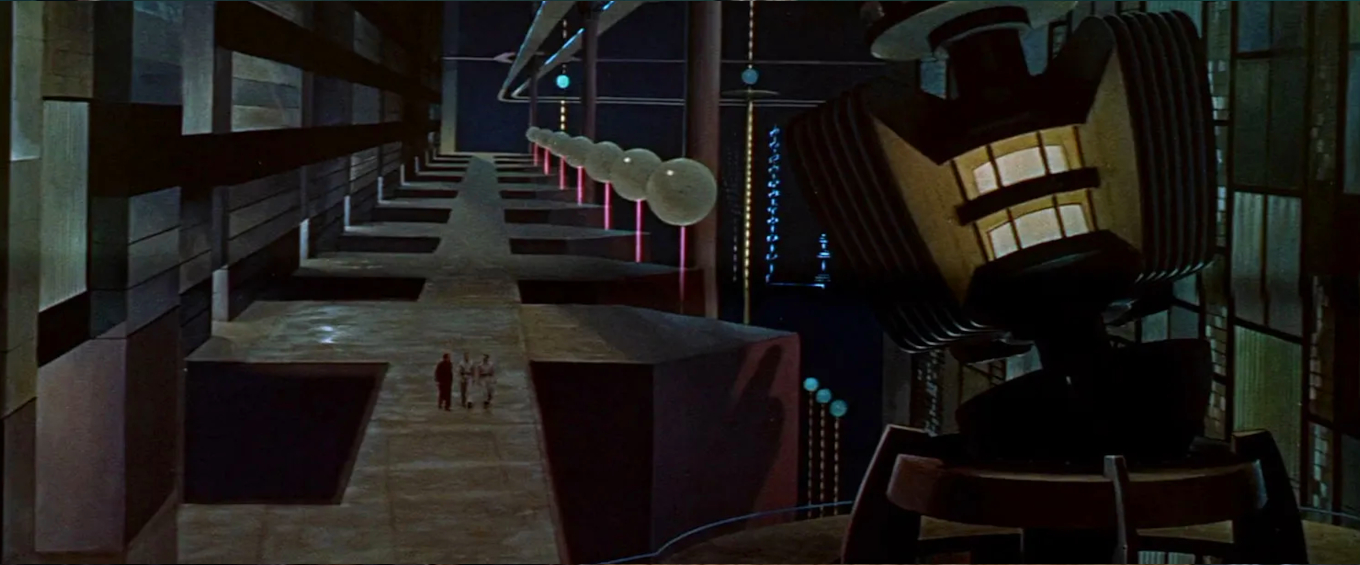
The seamless combination of full-size sets, miniatures, and superb scenic paintings gives the film its unique visual identity. Today, it still looks fantastic. The organic skill of the model makers and painters lends a richness that “look development” in today’s CG-dominated industry often lacks. Records from the era don’t explicitly credit all the crew, but it is assumed veteran matte artist Henri Hillinck created much of the illusion regarding the barren surface and the 20-mile-wide subterranean Krell machines.
Of course, these visuals are sold by the accompanying sound design by Bebe and Louis Barron, who composed the first-ever entirely electronic score. They avoided calling it music, preferring the term “electronic tonalities”.
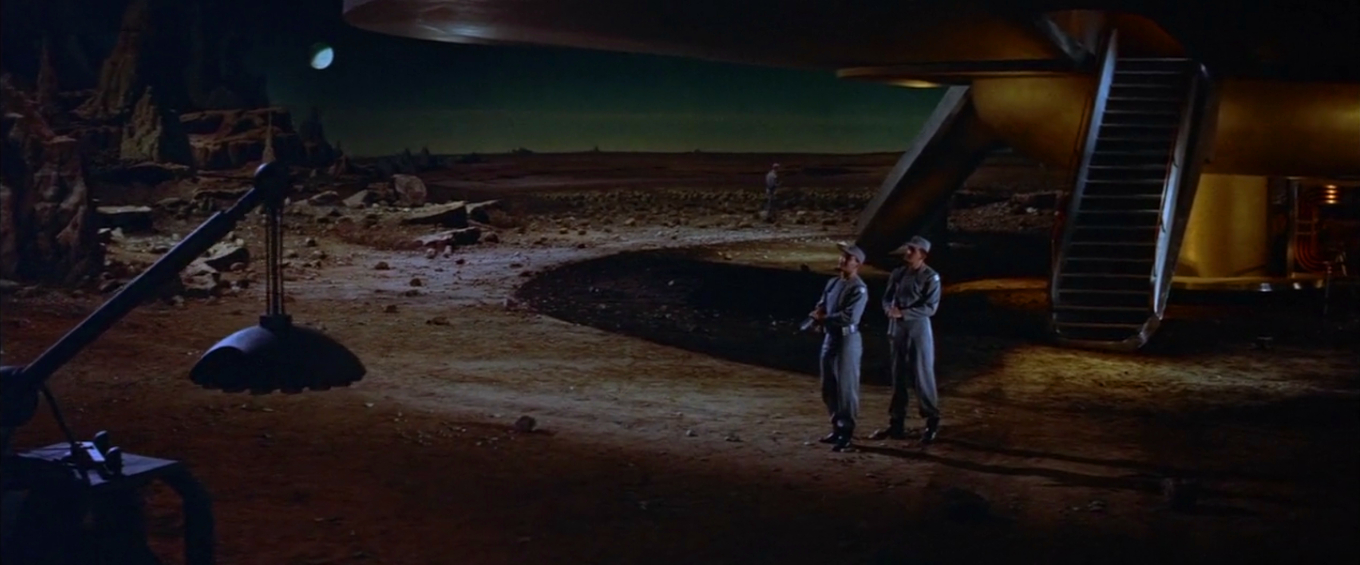
Dr Morbius explains that the rest of his team were killed by a formless planetary force. He strongly suggests the newcomers leave before they fall victim to the same fate. However, he neglects to tell them about the vast machines abandoned by the ancient, long-vanished Krell.
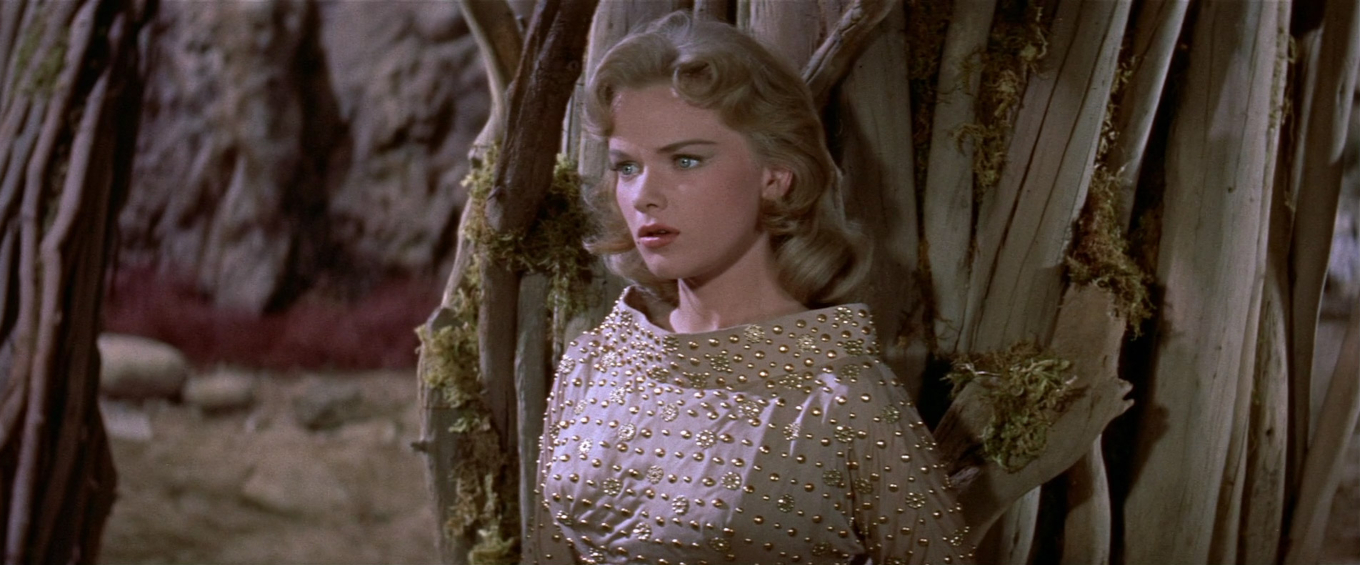
The three men are readying to depart when they’re surprised by the entrance of the Doctor’s daughter, Altaira (Anne Francis). Comedic sexist interactions litter the second act as the officers compete for her affections. The Commander berates her for showing too much skin, telling her to cover up because it would be her fault if anything “untoward” happened. Nevertheless, a romance blossoms—a necessity for 1950s audiences. This also explains the “comedy drunk” character of the Cook (Earl Holliman), who convinces Robby to produce gallons of bourbon.
The swimming pool was added to the set to facilitate a scene where Altaira’s skinny-dipping flusters Commander Adams. She is portrayed as an innocent with a rapport with wild animals. The presence of Earth fauna—deer, monkeys, and a tiger—lends the home a “Garden of Eden” appearance. The tiger was a deliberate nod to the “unicorn” of myth, which can only be tamed by an unsullied maiden.
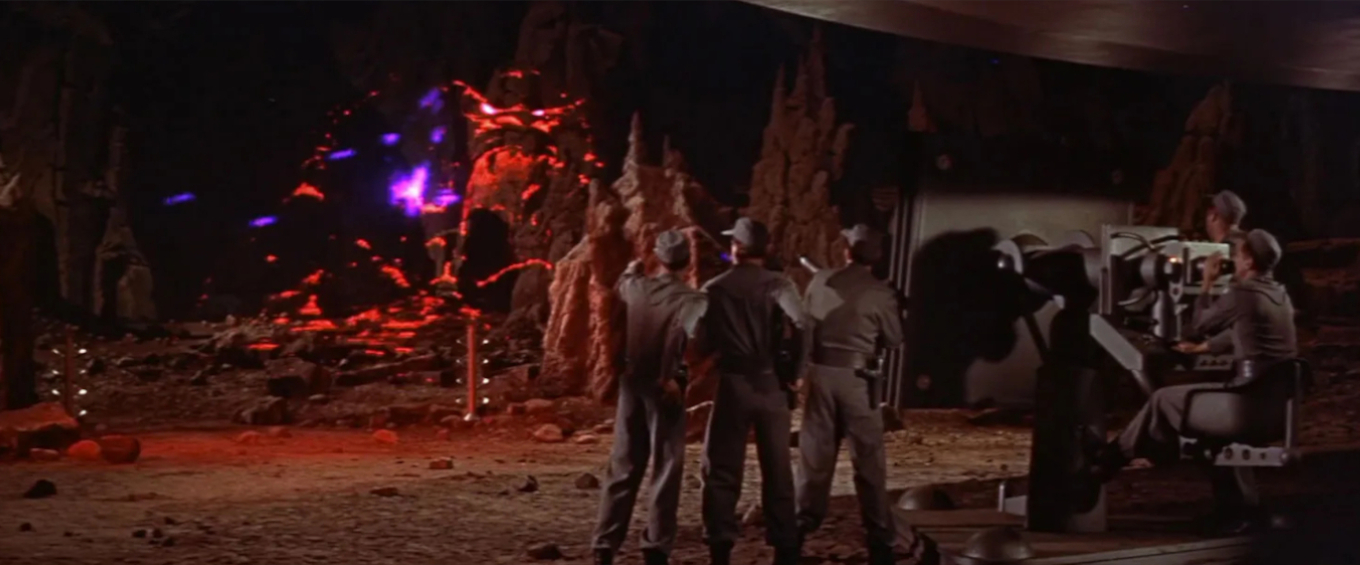
This was a nod to Jungian and Freudian psychoanalysis, which was enjoying a renaissance as Americans processed post-war trauma. Block and Adler decided that instead of an alien threat, the monsters we carry in our subconscious are the scariest. This is the core element taken from The Tempest.
In Shakespeare’s play, the magician Prospero flees to an island with his daughter, Miranda. There, he discovers the magic of the witch Sycorax and her monstrous son, Caliban. When a ship arrives from Italy, the crew interferes with Prospero’s isolation and competes for Miranda’s affections. In Forbidden Planet, Morbius lives on a planet with his daughter, Altaira. He discovers a Krell machine that can alter reality, but his primal urges manifest as a “Monster from the Id”. The film reshuffles and recasts all the key elements from the original play.
Forbidden Planet was a moderate success, earning back its $1.9M budget. Its influence on subsequent science fiction is undeniable. Robby went on to have a life beyond the movie, making more than 20 cameos in television shows including Columbo. In 2017, the original Robby prop sold at auction for more than $5.3M. Author George R.R Martin owns a full-size replica; I own a 22 cm tinplate wind-up one.
“I’ll break my staff, Bury it certain fathoms in the earth, And deeper than did ever plummet sound I’ll drown my book.”—Prospero
USA | 1956 | 98 MINUTES | 2.55:1 | COLOUR | ENGLISH

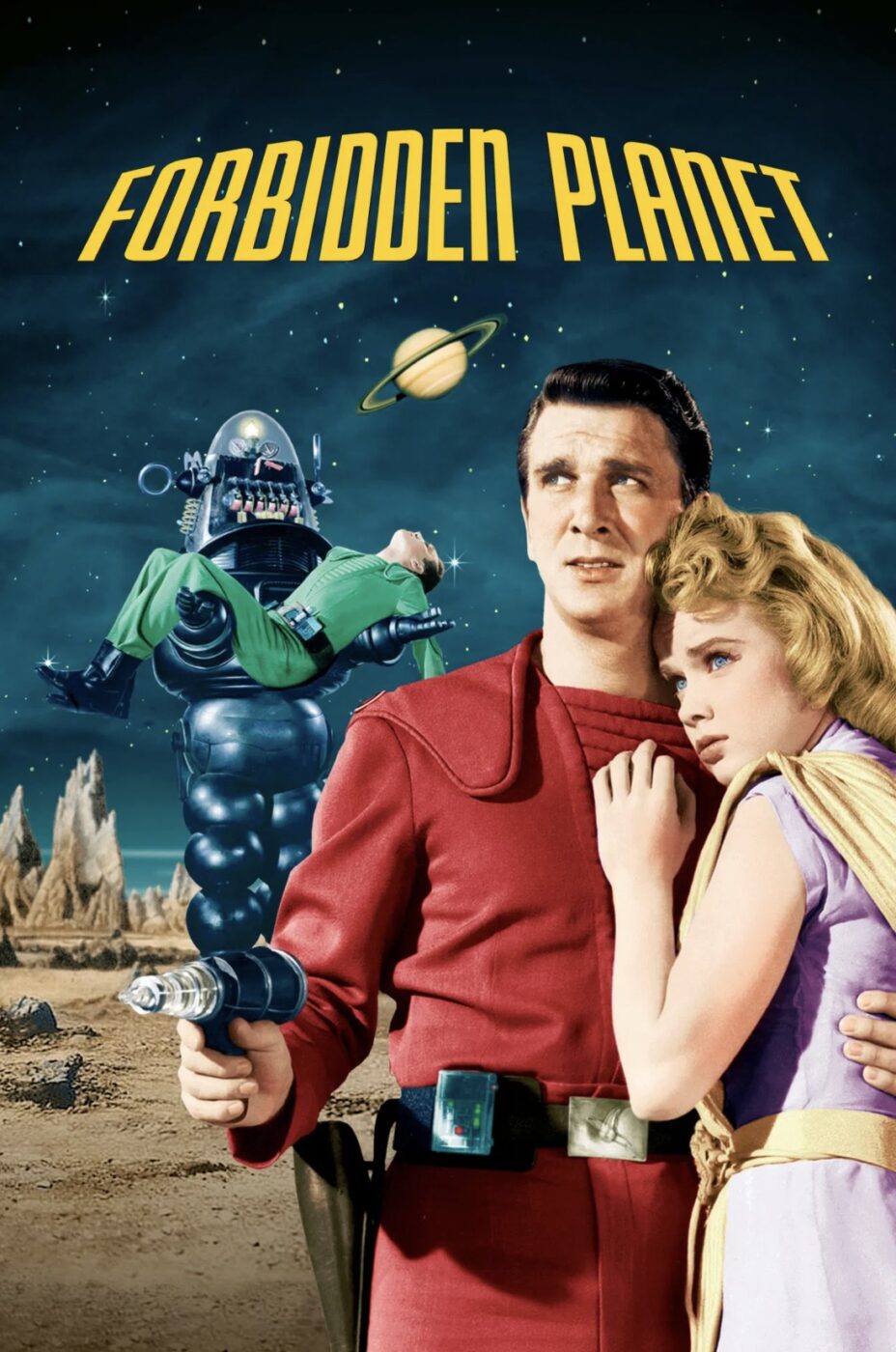
director: Fred M. Wilcox.
writer: Cyril Hume (based on a story by Irving Block & Allen Adler).
starring: Walter Pidgeon, Anne Francis, Leslie Nielsen & Warren Stevens.