WAKING LIFE (2001)
A man shuffles through a dream meeting various people and discussing the meanings and purposes of the universe.



A man shuffles through a dream meeting various people and discussing the meanings and purposes of the universe.
A little over 10 years on from his unclassifiable but undeniable indie landmark, Slacker (1990), writer-director Richard Linklater returned to its specific vein of sketch-like daydreams set across Austin, Texas. But, as has become a defining feature of the director’s films, this was a project he’d been trying to wrangle for decades.
It started when Linklater experienced a series of lucid dreams—those in which the dreamer awakens inside the dream, recognises it as such, and can then (some claim) control the elements of the dream itself. It offers total nocturnal freedom under the cloak of darkness and fallen eyelids. In Linklater’s case, however, he experienced a series of false awakenings.
We’ve seen the moment a thousand times in a thousand films: a character bolts upright in bed, typically drenched in sweat and gulping for air, relieved momentarily to be out of the nightmare. Then—surprise!—the camera pans to a dead body lying next to our beleaguered hero, or perhaps to a dark corner from which a ghoul emerges. The dream isn’t really over.
In Linklater’s dreams, the dread appears to come not from the content, but from the mere fact of recognising your own dream state and being helpless to break out of it. “It seemed to go on for weeks and weeks,” the director told PopMatters in 2001, “and got creepy near the end.” It’s the disintegration of the line between dreams and reality that disturbs and fascinates—the ceding of our control to firing synapses and subconscious machinations in a realm in which we spend half our lives, yet have no conscious say. Did you decide what you dreamt about last night? Did you decide when to wake up?

Eventually, these ideas took the form of Waking Life, a surrealist animated feature in which an unnamed twenty-something Austinite (Wiley Wiggins) floats between self-contained but thematically linked dreams. Our dreamer doesn’t speak much, but he listens. He listens to lecturers in philosophy, scientists, musicians, roving street gangs of existentialists, maniacs, and self-immolators.
Some proselytise on the inevitable downward trajectory of humanity; others say we never stop learning and growing. There’s no consensus; rather, it’s as if our dreamer is receiving prospectuses from a dozen different schools of thought. To reflect this range of ideas, the animation is ever-changing.
Linklater shot Waking Life on a low-spec mini-DV camera and employed a roster of artists to rotoscope the resulting footage. Traditionally, rotoscoping involved artists tracing over filmed images frame by frame, resulting in something more fluid than traditional animation and closer to real human movement.
You can see the technique in abundance in Snow White and the Seven Dwarfs (1937), yet the effect here is less “realism” and more hyperreality—a shifting, uncanny point at which an image we know to be false moves in a way unnatural to its form. Seeing an animated character move like a person can feel as off-putting as seeing a real person take on the properties of a cartoon.
That the effect works in Snow White is a testament to the brilliance of its artists. But Linklater may have picked up on the slightly queasy, dreamlike feeling of these images—of recognising head tilts and pirouettes, of glimpsing something human behind the permanent lines etched onto film.
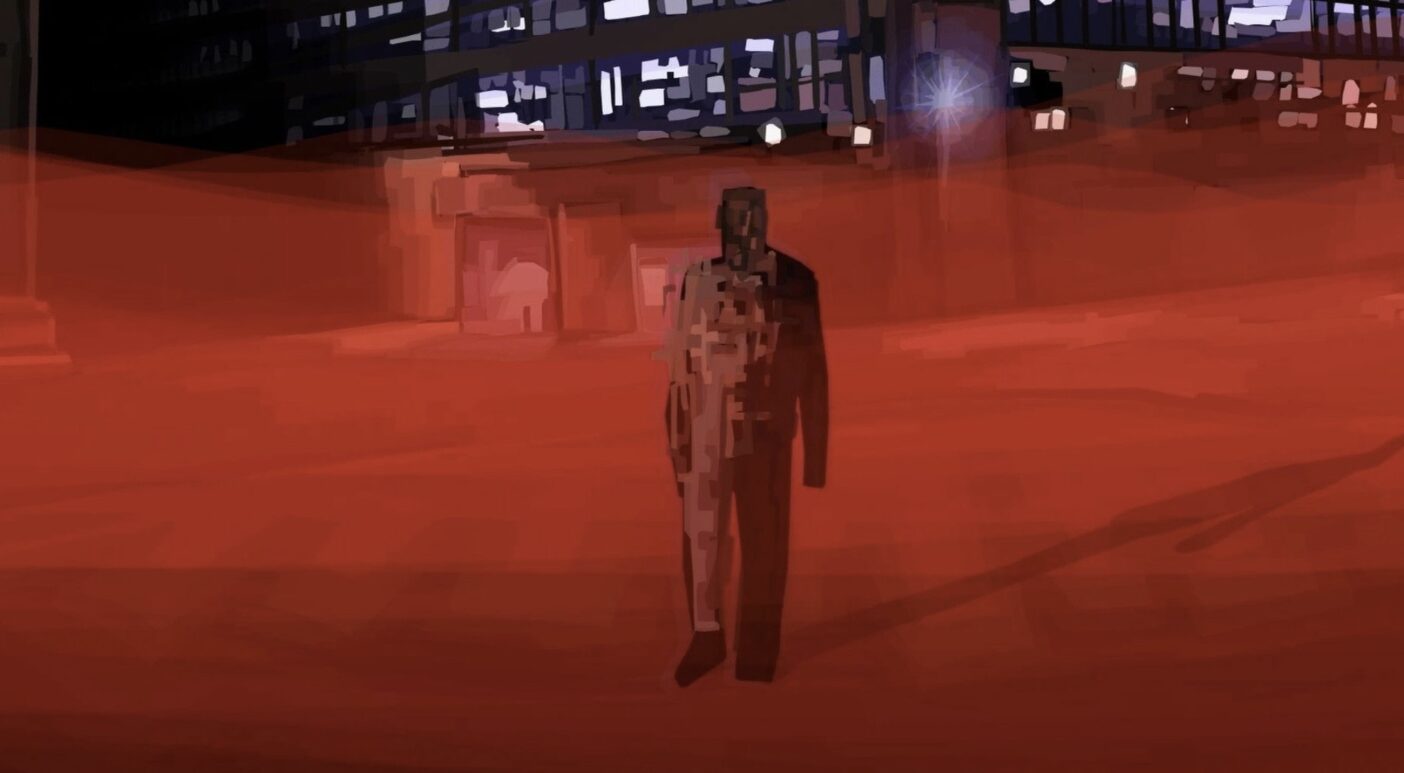
Waking Life’s rotoscoping was done digitally using “Rotoshop” software. 12 frames per second were animated, resulting in a twitchy style that’s anything but slick. The fact that Linklater shot all his footage handheld only adds to the effect of an animation that could break apart at any time.
Each animator was assigned a segment and given free rein to put their personal stamp on it. Similarly, much of the dialogue was written by the actors—many of whom were real people “playing” themselves. The result is disorienting; we feel a sense of seasickness when a tunnel sways and bends as the dreamer walks, like the gangway between train carriages rounding a track.
One character, driving a taxi shaped like a boat, is defined by solid lines and expressive, bulging eyes. Later, a woman who invites Wiggins to retry a social cue presents as something more two-dimensional and abstract. Some characters have eyes that float from their faces. A biologist’s head expands and shrinks as he talks, his hands elongating as he illustrates his points.
Much of Waking Life—its animation and the concepts it grapples with—is in a constant state of flux. It is a world actively reacting to the people within it—or is it the other way around? The shifting perspective and vibrant animation comprise a bold style of filmmaking that gives the impression of life, dreams, and memory. It isn’t literal or exact, but it’s astonishingly familiar.
Familiarity is a recurring theme. The ideas our dreamer is introduced to are incredible, he says, but could he have possibly come up with them himself? Our subconscious minds hoard information—capitals of countries, phone numbers of old friends, concepts of relativism or determinism. It’s how we hear a song we haven’t heard in 20 years and find we still know all the words.
Here, Linklater captures both wonder and frustration: we’re as limited as we are curious. We’ll never have enough time to read every great novel, and there’s a churning suspicion that every question has already been asked and answered. Linklater even reunites us with Jesse and Céline, the lovesick couple from his Before trilogy (1995-2013), with Ethan Hawke and Julie Delpy reprising their roles. They lie in an unmade bed while Céline’s hair shifts through shades of gold, yellow, and green.
Jesse mentions a study: a control group completed a crossword puzzle that hadn’t yet been published. Later, another group completed a puzzle published the previous week. The scores for the latter were significantly higher. “We’re all telepathically sharing our experiences,” Jesse suggests. Once the answers are out in the cosmos, they’re there for anyone to absorb.
It’s a beautiful, connective thought, and it’s familiar. It’s exactly what the Jesse of Before Sunrise (1995) would pontificate on. So, is our dreamer a fan of Richard Linklater? Did he see the film a decade earlier, forget it, and absorb it into his dreams? Linklater pivots from the comfort of familiarity to the maddening nature of the mind: what is truly ours, and what have we simply heard others say? How do we tell the difference between a real memory, a scene from a film, or something we’ve invented whole-cloth in the deepest hours of slumber?
Later, the dreamer looks at a digital alarm clock; the numbers are rearranged into abstract lines—a sign he’s still dreaming. “Small print is tricky,” one man suggests, as the pin on his lapel shifts from a clown face to a skull. And you can’t control the lighting in a dream, he adds.
Our dreamer flips through TV channels, which appear as condensed, packaged transmissions of experience. We see Kurt Cobain on stage and a woman hawking products on a shopping channel. There are shots from art films and an intellectual speaking on the nature of the mind. Steven Soderbergh appears. All these ideas sit on the equal footing of a square screen: so what is wheat and what is chaff?

Linklater, an eternally curious filmmaker, doesn’t draw lines between high and low thought. “I wanted it to be light and dark, positive and negative,” he said. “Mostly positive and not cynical, but I liked that it would have both.” It certainly does.
The information overload we face daily might lead to crystalline moments of epiphany—like the woman who tells our dreamer that although words are inert, when we truly communicate, we experience “spiritual communion.” Later, a film theorist wells up with tears as he experiences what André Bazin called a “holy moment” in real life—the act of sitting and sharing a moment with someone, absorbing their beauty and the “nowness” of the present.
We also meet a bright red man in a dingy jail cell. Heavy lines cross his forehead as he growls and threatens anyone within earshot. “All you pukes are gonna die the day I get out of this shithole,” he bellows. In another scene, two men accidentally shoot each other dead in a bar.
Later, a pre-fame Alex Jones drives through Texan streets, screaming through a speaker system on his roof. He is furious and vague. “The 21st-century is going to be a new century!” he blares. “The age of humankind standing up for something pure!” As his rage intensifies, he turns completely red.
His words are meaningless bluster—slogans that serve only his ego. Some ideas catch on more than they should; Linklater questions whether our ideas are helpful ones designed for connection, or egomaniacal expressions born from too much noise and too little introspection.

Some characters would argue that Jones’s trajectory was inevitable—that free will is an illusion and we’re at the whim of what’s inside us. Indeed, the 21st-century is a new century, one in which we’re more exposed than ever to crackpot theories and 24/7 news via devices we carry every minute. Our poor dreamer has no idea how “filled up” his brain will be in 25 years’ time.
Waking Life opens with him as a boy, floating outside his suburban home. A girl with a paper fortune teller tells him: “Dream is destiny.” The film ends with the dreamer, now an adult, floating away again. He tries to grab a car door handle but can’t get a grip. He slips silently and resignedly into the blue sky.
The constant whirring of the mind, now trained to be whipped into a frenzy by a TV or phone, can make us long for terra firma. We crave routine, then get bored of it. We want our memories secured, but we also want them to be perfectly true. We want to wake from a bad dream, but we also long for the deep sleep that allows us to reunite with memories in their most abstract forms. We long for a version of enlightenment where we can eradicate the vulnerabilities of our thoughts. We want to know, not to think—but only one is possible.
We want our memories to be incorruptible, yet each time we remember something, the gulf between the moment and the present grows wider. We begin to remember the memory, not the moment itself—a copy of a copy. Perhaps, then, there is comfort in the inevitability of change.

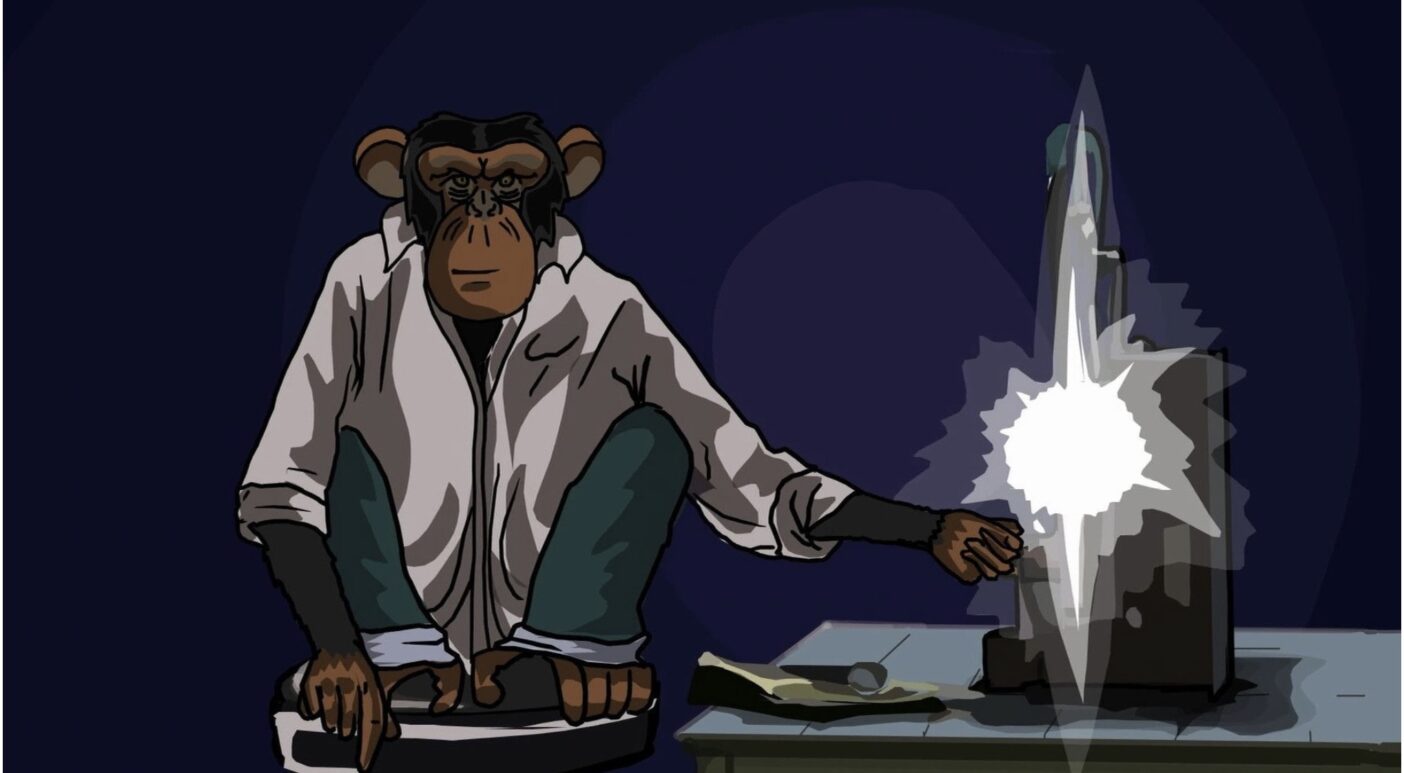
In one segment, two women sit at lunch. One relates her fear that her thirties would be a plateau. Instead, she takes comfort in the idea that she’ll never stop growing. Later, a monkey projecting a science reel says: “We knew that anything was still possible, and given the right circumstances, a new world was just as likely as an old one.”
Waking Life doesn’t decide for us whether that “new world” is the one around us or the one within. Linklater’s film is one of genuine beauty and rare insight—100 minutes of filmmaking that speaks to its audience as equals.
The freewheeling dreamscape is pierced by moments of sublime poignancy. Linklater has done something borderline miraculous: he has turned the act of dreaming into complex art. It’s a film that implores us not to stop daydreaming, and not to let our inner lives be snatched away by a brutal external world. We’re only here for a few decades; the answers won’t be sent down in flashes of lightning. It’s up to each of us to make sense of what this life is about. But take this strange morsel of comfort from the film: we’re all sharing this same dream.
USA | 2001 | 101 MINUTES | 1.85:1 | COLOUR | ENGLISH

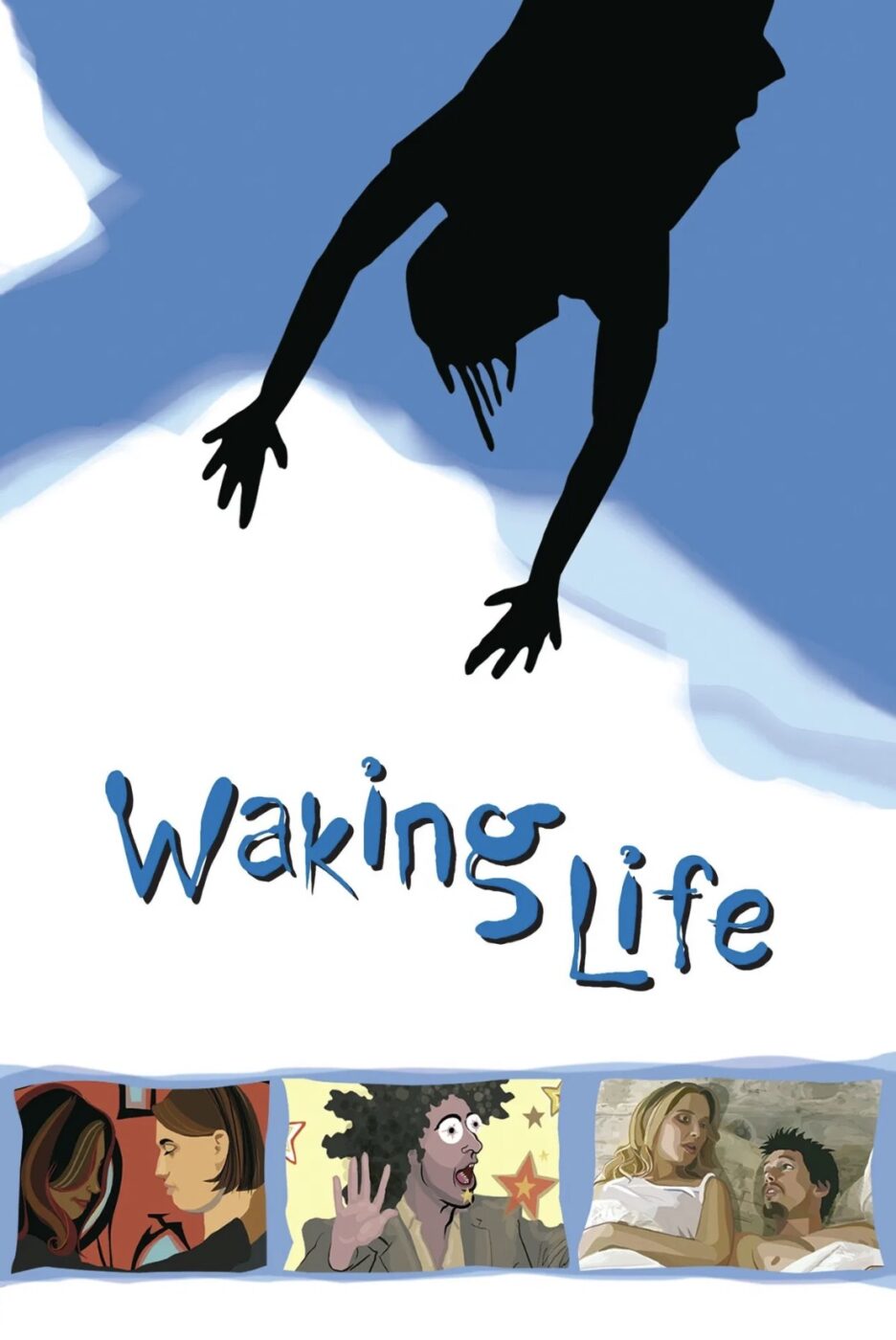
writer & director: Richard Linklater.
starring: Wiley Wiggins, Eamonn Healy, Timothy “Speed” Levitch, Adam Goldberg, Nicky Katt, Ethan Hawke, Julie Delpy, Caveh Zahedi, Otto Hofmann, Richard Linklater & Alex Jones.