SPACEBALLS (1987)
A mercenary and his trusty half-dog sidekick come to the rescue of a spoiled princess to save her planet from the clutches of the evil Spaceballs.



A mercenary and his trusty half-dog sidekick come to the rescue of a spoiled princess to save her planet from the clutches of the evil Spaceballs.
Mel Brooks is a legendary filmmaker whose mastery of the spoof sub-genre defined the 1970s. His classic pastiches of Hollywood Westerns and Universal horror films — Blazing Saddles (1974) and Young Frankenstein (1974) — remain unrivalled even 50 years later. But by the 1980s, Brooks had pivoted toward producing serious fare like The Elephant Man (1980) and The Fly (1986). However, he returned to the director’s chair in 1987 for Spaceballs, a $22M sci-fi comedy that set its laser sights on the likes of Star Trek (1966–69), Star Wars (1977), and Alien (1979).
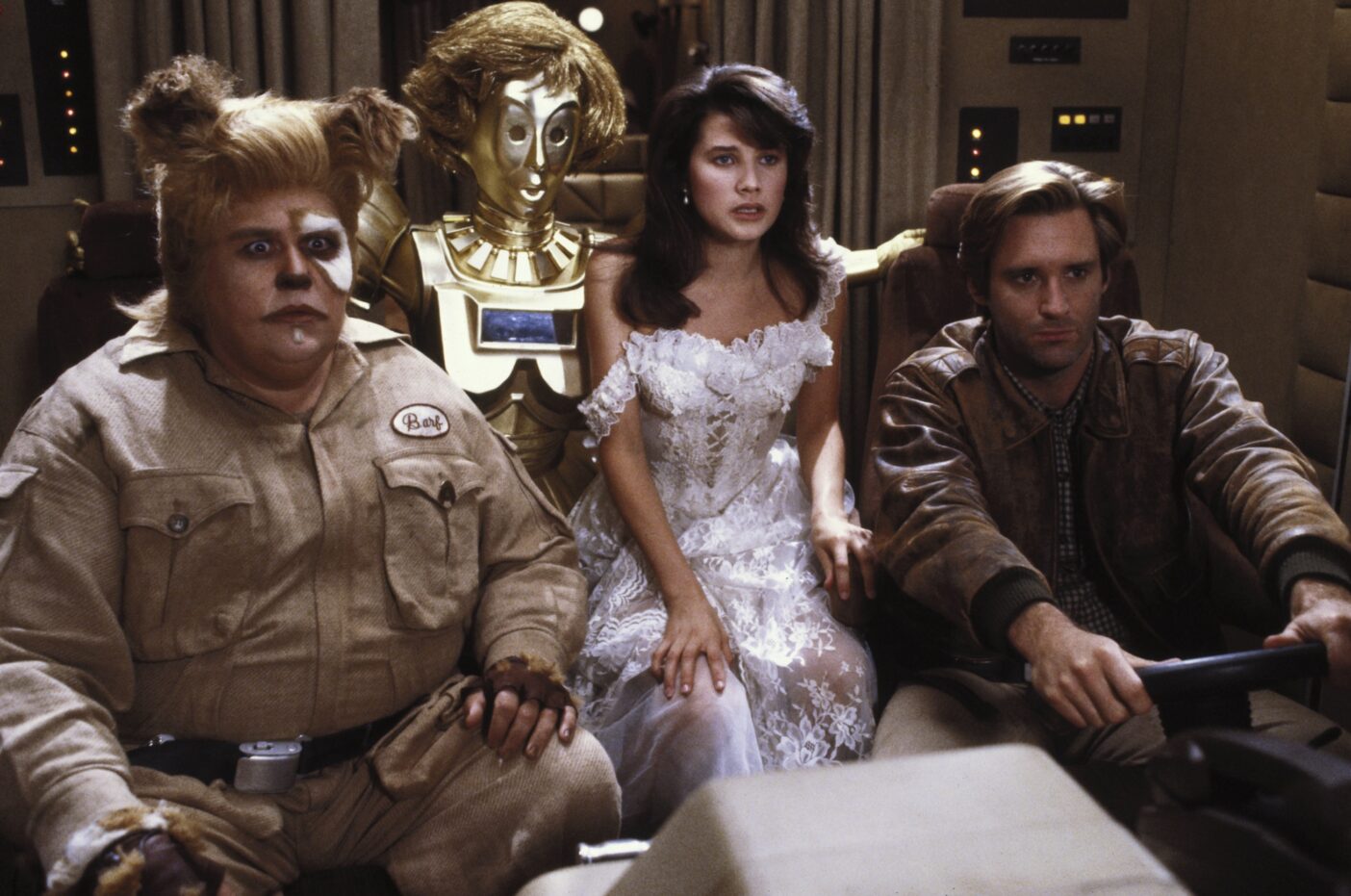
In a galaxy “very, very, very, very far away”, the spoiled Princess Vespa (Daphne Zuniga) flees an arranged marriage alongside her “Droid of Honour”, Dot Matrix (Lorene Yarnell, voiced by Joan Rivers). Her father, King Roland (Dick Van Patten), offers mercenary Lone Starr (Bill Pullman) and his “half-man, half-dog” best friend, Barf (John Candy), a million “space bucks” to find her. Meanwhile, President Skroob (Mel Brooks), leader of the tyrannical Spaceball race, hatches a plan to steal Druidia’s oxygen to replenish his own planet’s dwindling supply, aided by his enforcer, Dark Helmet (Rick Moranis), and Colonel Sandurz (George Wyner).
As you can tell, it’s all very silly. The film leans heavily on the iconic Star Wars ensemble and storyline: Lone Starr’s a hybrid of Han Solo and Luke Skywalker, Barf is an intelligible Chewbacca, Vespa’s a Princess Leia lookalike, and Dot Matrix a female C-3PO. The most obvious analog is Dark Helmet, a ridiculous take on Darth Vader defined by his diminutive stature and oversized headgear. Brooks even takes on a dual role, later playing the gold-skinned Yogurt — a Jewish riff on Yoda from Star Wars: The Empire Strikes Back (1980).
Spaceballs was met with mixed reviews at the time, which came as a surprise to me later in life. I first saw the film when I was eight or nine — the perfect age for its brand of goofy silliness and naughty-boy humour. For me, the gags about Star Wars and Star Trek hit their marks, while others flew over my head and only made sense years later. This is probably the movie where I first saw a chest-burster erupt from John Hurt, and the excellent nod to Planet of the Apes (1968) in the climax only worked because the image of the Statue of Liberty half-buried on a beach was so famous; yet I hadn’t seen the original film yet.
However, the fact it was deemed a misfire at the time (grossing only $44M) makes sense in hindsight. Mel Brooks was still seen as the pre-eminent spoof-maker, yet the likes of Airplane! (1980) and Top Secret! (1984) had pushed the art of parody further, establishing a gag-a-second pace that Spaceballs couldn’t rival. It perhaps felt a bit slow and old-fashioned to 1987 audiences, but the likely issue is that Brooks’s love for science fiction just didn’t run as deep as his affection for Westerns, horror, or the Hitchcock films utilised in High Anxiety (1977). Star Wars, in particular, was only a decade old at the time, and The Empire Strikes Back only seven. A man in his fifties and sixties when these films were released simply wouldn’t have had the necessary insight or affection to dig deeper than superficial ridicule.
This is perhaps why Spaceballs feels cartoonish and immature when mocking its main sci-fi targets. It only finds a richer source of humour in its take-down of George Lucas’s lucrative toy deals (“merchandising, merchandising, where the real money from the movie is made!”), or the medium of video — specifically when Dark Helmet uses a VHS copy of the movie we’re watching to fast-forward events and locate Princess Vespa. When Moranis breaks the fourth wall — or a camera bumps into him during a close-up — it feels as though Brooks is relishing the meta-comedy of the film industry more than he is lazily rhyming “The Force” with “The Schwartz”.

The limitations of the parody are also curious, as many potential targets are missed. While there are more franchises to target today, it seems odd that Brooks focused so heavily on Star Wars in 1987. Star Trek only receives two real references — Skroob getting “beamed up” with his head on backwards, and Lone Starr’s Vulcan neck pinch. Furthermore, the culture of the Druidians is strangely rooted in a fantasy setting, complete with fairy-tale castles and medieval garb. Again, is that simply a backdrop Brooks was more comfortable playing in over the more appropriate “used future” aesthetics connected to 1980s sci-fi? Whatever the reason, today it seems strange the targets are so limited and there aren’t even any throwaway lines nodding to Blade Runner (1982) and suchlike. Even the mighty 2001: A Space Odyssey (1968) only gets a subtle callout with a similar ‘Stargate’ sequence, when it seems so obvious to poke fun at HAL 9000.
Like many spoofs, it’s primarily a gag-machine built on recognition and familiarity, plus affection for the talented cast assembled. But the best examples of such comedies always have actors you’re genuinely happy to watch, with Gene Wilder’s performance in Young Frankenstein or Leslie Nielsen’s turn in The Naked Gun (1988) the gold standard. Otherwise, the stream of jokes can become deadening if that’s all a film has in its arsenal.
Luckily, Spaceballs benefits from having Rick Moranis as the villainous Dark Helmet — the heavy lifting is done through the inherently amusing sight of him moving around in a bin-sized helmet, but his clueless gurning and childish behaviour make him appealing. He’s a little boy playing dress-up (even seen playing with “dolls” at one point), his ego inflated by the extraordinary power he wields, yet modestly kept in check by his long-suffering subordinate, Colonel Sandurz.

But the saving grace of the film is the chemistry between Bill Pullman and Daphne Zuniga, who ultimately get to play characters we’ve seen hundreds of times before — the upper-class beauty who doesn’t initially like the down-to-earth “peasant” sent to rescue her, but who nevertheless softens to his roguish charms and falls in love. It’s what Star Wars was doing with Han and Leia, of course, which itself was following a template seen across thousands of fairy tales and Westerns. But it always works if the actors are well-cast and make such hoary material work on camera, and that’s certainly true in Spaceballs. Indeed, when Lone Starr and Princess Vespa first meet — having never set eyes on each other, yet having allowed themselves to imagine the worst — the film noticeably levels up now we have a heartfelt relationship to latch onto besides the slapstick and buffoonery.
Spaceballs’ failure at the box office began the slow demise of Mel Brooks’s fortunes on the big screen. He followed it up with the straightforward comedy flop Life Stinks (1991), before returning to the comfort of parody with Robin Hood: Men in Tights (1993), which admittedly turned a healthy profit, before the outright commercial failure of Dracula: Dead and Loving It (1995) drove a stake into his long movie career.
Still, Spaceballs is proof that movies that don’t make a splash at the time are sometimes finding an audience on home video with younger people, and once that generation comes of age, things are re-evaluated. Spaceballs was already a cult favourite by the mid-1990s and a long-awaited sequel is soon being released in 2027, 40 years later, with most of the surviving cast returning — even 99-year-old Mel Brooks! One can only hope they use to the title suggested in this movie: Spaceballs 2: The Search for More Money.
USA | 1987 | 96 MINUTES | 1.85:1 | COLOUR | ENGLISH • GERMAN


Arrow Video brings Spaceballs to 4K Ultra HD with a crisp 1.85:1 2160p image, featuring Dolby Vision and HDR10. It’s easily the best the film has ever looked on home video; details pop, and the image sparkles with colour. The black levels are deep and rich, too. My only gripe is that some exterior shots — mostly the desert scenes — are plagued by distracting grain that isn’t as tightly resolved as the rest of the film. Furthermore, there’s an outside chance that because this was a popular rental back in the ’80s, the pristine restoration doesn’t quite capture the same “vibe” as it did on 4:3 videotape.
The sound mix includes the DTS-HD Master Audio 5.1 track from the previous Blu-ray, alongside an improved stereo track and a DTS-HD MA 4.1 mix sourced from the original 70mm version. There’s plenty of choice! I opted for the 5.1 mix, which was great, if not exactly remarkable; however, it’s the stereo track that’ll likely remind you most of watching Spaceballs at home decades ago.
The extras are abundant — and mostly new to me, as I haven’t owned the film on home video before. Mel Brooks is omnipresent throughout; my highlights include the half-hour 2003 documentary, the 2016 making-of featurette, and the hilarious option to watch the entire film at “ludicrous speed”.

director: Mel Brooks.
writers: Mel Brooks, Ronny Graham & Thomas Meehan.
starring: Mel Brooks, John Candy, Rick Moranis, Bill Pullman, Daphne Zuniga, Dick Van Patten, George Wyner & Joan Rivers (voice).