THE PLEDGE (2001)
A retiring police detective pledges to catch the killer of a young child.

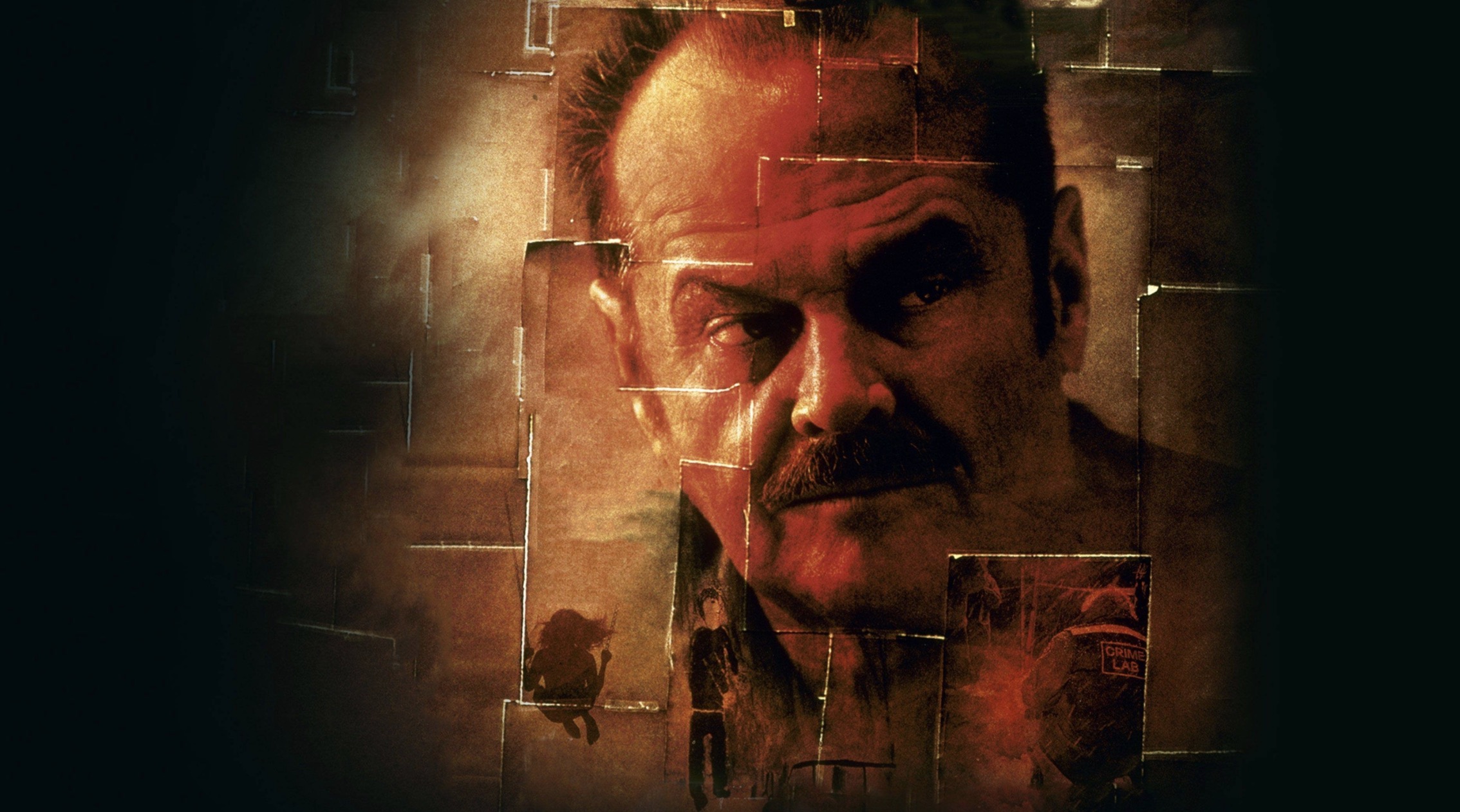

A retiring police detective pledges to catch the killer of a young child.
It’s been 16 years since Jack Nicholson gave his final film performance, and cinema sorely misses him. If we imagine for a moment that the retired actor hadn’t left such an indelible impact on the silver screen, it would be difficult to explain why he made such an ideal movie star. He has the appearance of an eccentric figure—a know-it-all and a wise-ass who’s always in on a joke lurking beneath the surface of everyday conversation (with a look that lets you know he’s eager to let you in on it, too). His prominent eyebrows and almost cartoonishly crazed demeanour were used to maximum effect in Stanley Kubrick’s The Shining (1980), though that was an outlier in Nicholson’s prolific career.
More often than not, he portrayed variations of everyman figures rarely seen on screen. Nicholson excelled at depicting realistically restless men haunted by visions of glory and despair, hidden behind a natural charm. As a lost man with no semblance of identity, he was spellbinding in Antonioni’s The Passenger (1975). It is sorrow, not dissociation, that mires protagonist Bobby Eroica Dupea in Five Easy Pieces (1970), yet both men are bound together by a lack of purpose and Nicholson’s superb acting. Films like these were the ideal stages for his talent, where everything rests on the weight of his expressions.
His lead role in Sean Penn’s The Pledge was his first of the 21st century and one of his final ten performances. The longtime leading man, once the ever-charming figure, was left with characters forced to ruminate on a lifetime of decisions that inevitably led to a late-stage crisis. This remained a fruitful period for the actor, whether in the devastatingly cruel comedy-drama About Schmidt (2002) or as a manic crime boss in The Departed (2006). These characters couldn’t be more different, but most of Nicholson’s roles this century have been men either doomed to look back on their legacy or left stumbling blindly through an unfamiliar world.
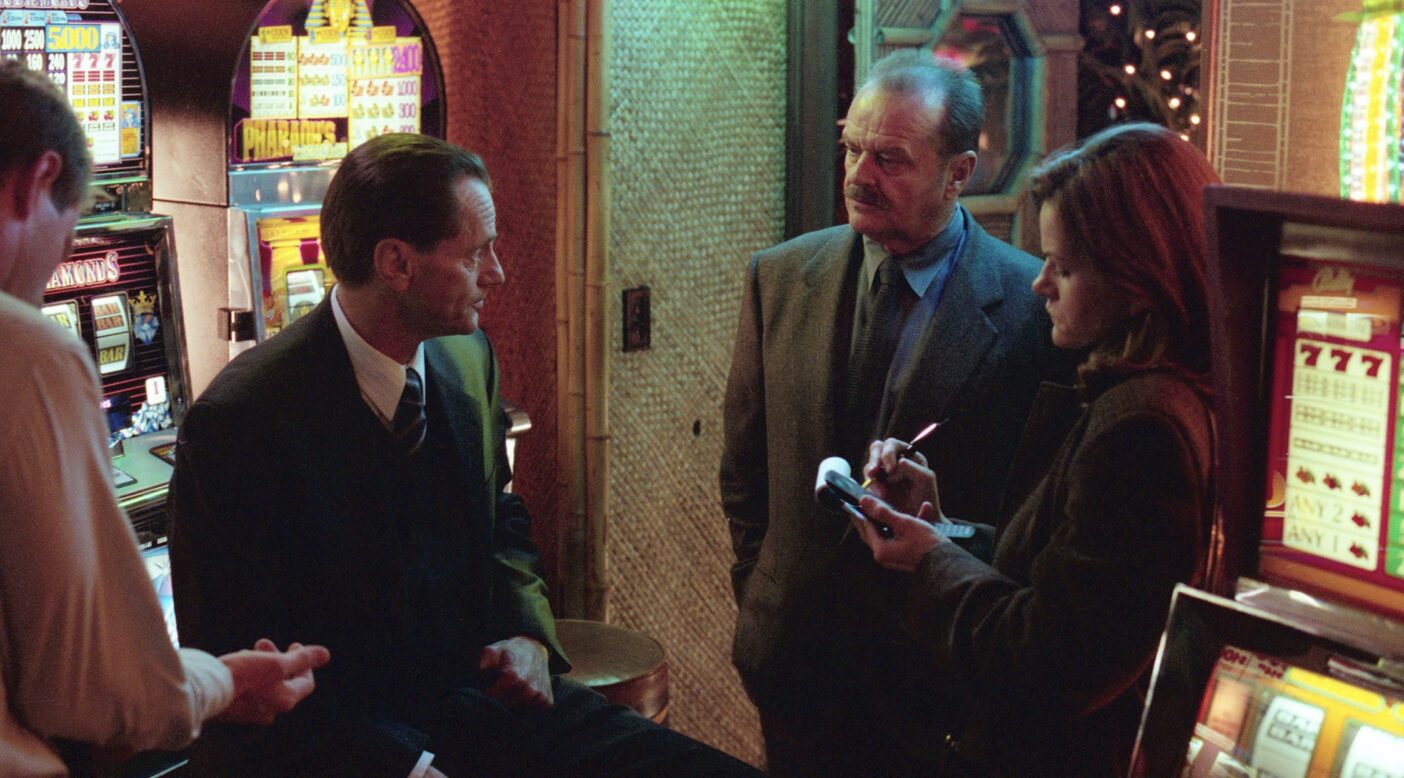
In The Pledge, Jerry Black (Nicholson) fits a recognisable mould: a weary, older detective with one bullet left in the chamber, eager to carry out a final mission. While at his retirement party, he learns of the murder of a young girl, Ginny Larsen—a case that captures his attention and won’t let go. Jerry sets up a new life near the crime scene, certain that the police have pinned the killing on the wrong man, the recently deceased Toby Jay Wadenah (Benicio Del Toro).
Jerry is seen as a has-been, a man with one foot out the door who has convinced himself he can still be useful. If his former colleagues don’t buy his theories, he’ll act on them himself to fulfil a pledge made to the victim’s mother, Margaret Larsen (Patricia Clarkson). In one of the film’s most essential scenes, Penn attempts to wring maximum sentimentality from the performers. As if the gravity of the pledge wasn’t already established by a child’s corpse, the mother touches a religious symbol above Jerry’s head, implying eternal damnation if he fails to find the killer.
The protagonist’s journey is further complicated by semi-frequent psychotic delusions. Specifically, they’re the kind of delusions lazy Hollywood writers love; they occur so sporadically that there’s no meaningful development of Jerry’s mental decline. While there are references to his drinking, chain-smoking, and sudden panic, the film fails to convincingly portray him as an incoherent mess to those around him.
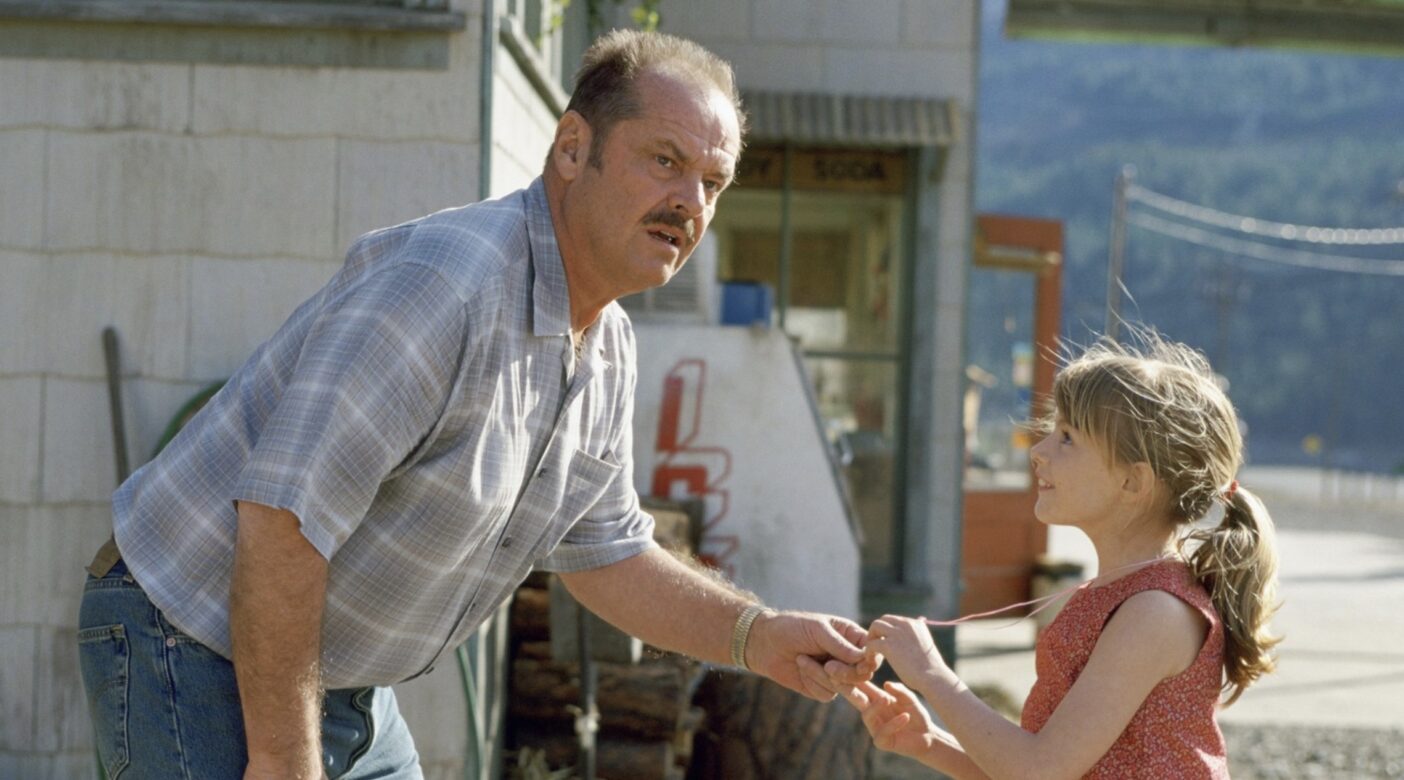
For starters, these breaks from reality are suspiciously convenient, never occurring in scenes with important characters like local bartender Lori (Robin Wright) or her daughter Chrissy. Even those who doubt Jerry aren’t often privy to these moments; instead, his former colleagues are fuelled by inherent ageism and a distrust of his unusual theory. With Jerry retired, the rest of the police force soon vanishes from this psychological thriller, leaving no one to react to his most crazed moments.
Lori serves as a humble ray of light in a cold world, though the character is a collection of clichés—a salt-of-the-earth single mother nursing wounds from past relationships. Screenwriters Jerzy Kromolowski and Mary Olson-Kromolowski fail to liven up these archetypes, while Penn’s shaky camerawork and awkward zooms make The Pledge feel like a TV movie rather than a $30M feature. The responsibility for the drama falls solely on the performers, who do a fine job. The film is never dull, perhaps because of its lack of focus. Is Jerry’s preoccupation his pledge, or a desire for a new life with Lori? Or is he simply drifting, slowly becoming unmoored from sanity?
The answers are never clear-cut. Unfortunately, there’s nothing truly experimental here that might lead us to question the validity of Jerry’s theories. At its core, The Pledge has the bones of a generic thriller. This rigid mould leaves little room for the disorientation that would better serve the protagonist.
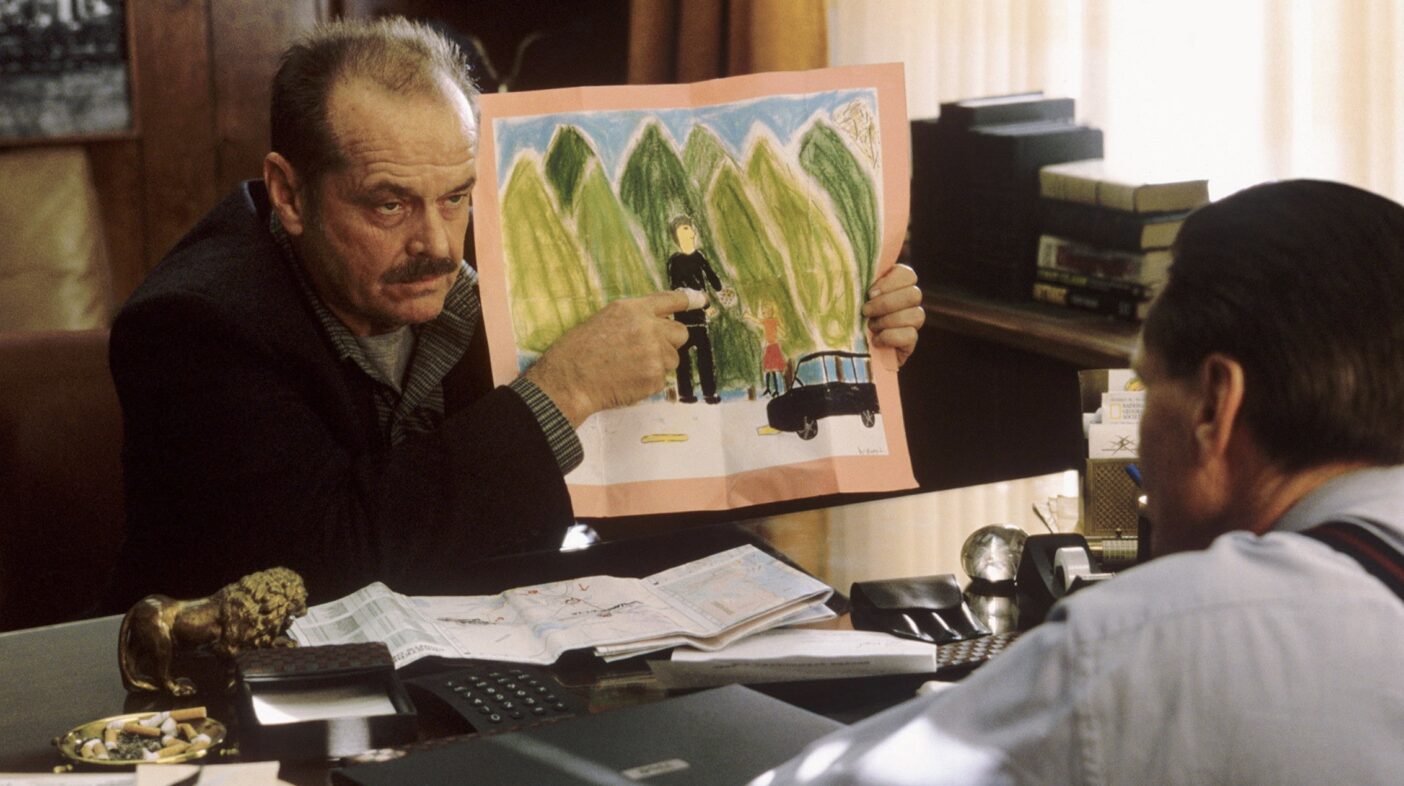
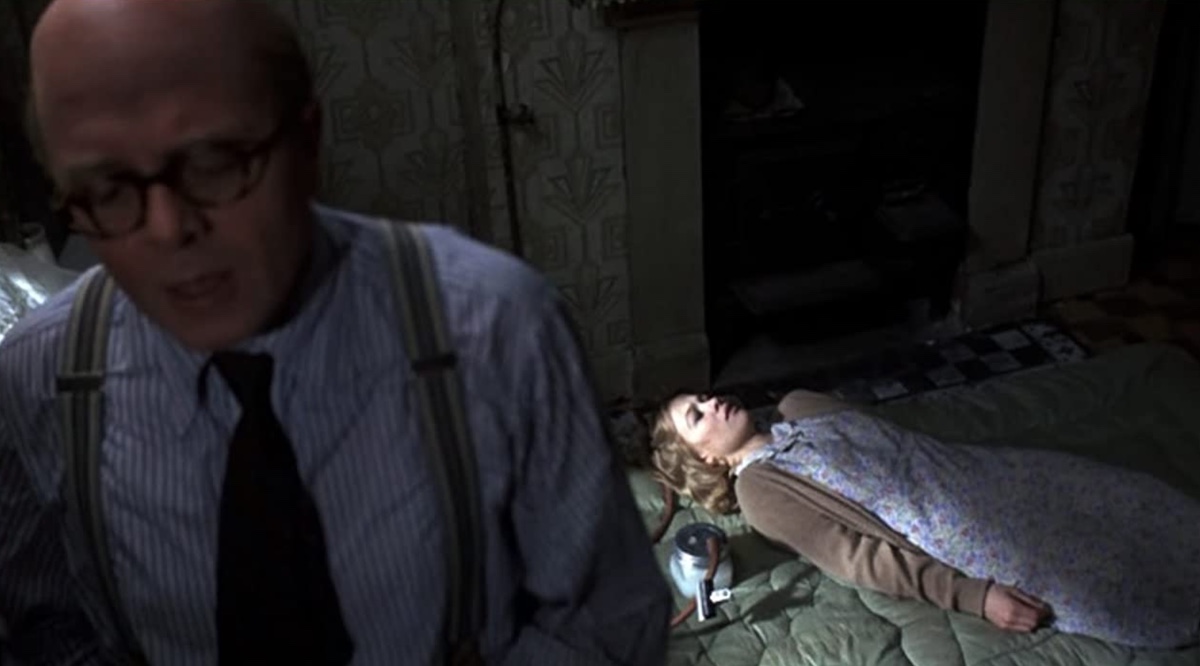
If the worst thing a film can do is bore its audience, this movie’s rough edges and uncertainty help it avoid that pitfall. It also boasts a wealth of talent. Nicholson is the standout, but Robin Wright deserves credit for transforming a “down-and-out” trope into a real person. The stellar supporting cast includes Aaron Eckhart, Mickey Rourke, Vanessa Redgrave, and Helen Mirren. Rourke is particularly incredible, appearing in a single scene that stands as the film’s finest due to his portrayal of absolute grief.
The Pledge never quite escapes its narrative haziness or uninspired camerawork. A more overtly experimental or straightforward approach might have salvaged it. Even the bleak ending feels mired in a fog of unclear vision, partly because scripted scenes weren’t filmed after the backers got cold feet following the box office failure of Battlefield Earth (2000). Production was cut short, leaving a mystery with only half an answer.
It’s a fittingly muddled conclusion for a tale that impressed critics but failed to resonate with audiences. A sense of bleakness lingers, but the experience is bogged down by a sappy score from Klaus Badelt and Hans Zimmer, a middling script, and counterintuitive direction. These technical flaws frequently distract from Jerry’s damaged mental state, even as Nicholson’s stellar acting and an intriguing tone attempt to counteract them.
USA • CANADA | 2001 | 124 MINUTES | 2.39:1 | COLOUR | ENGLISH

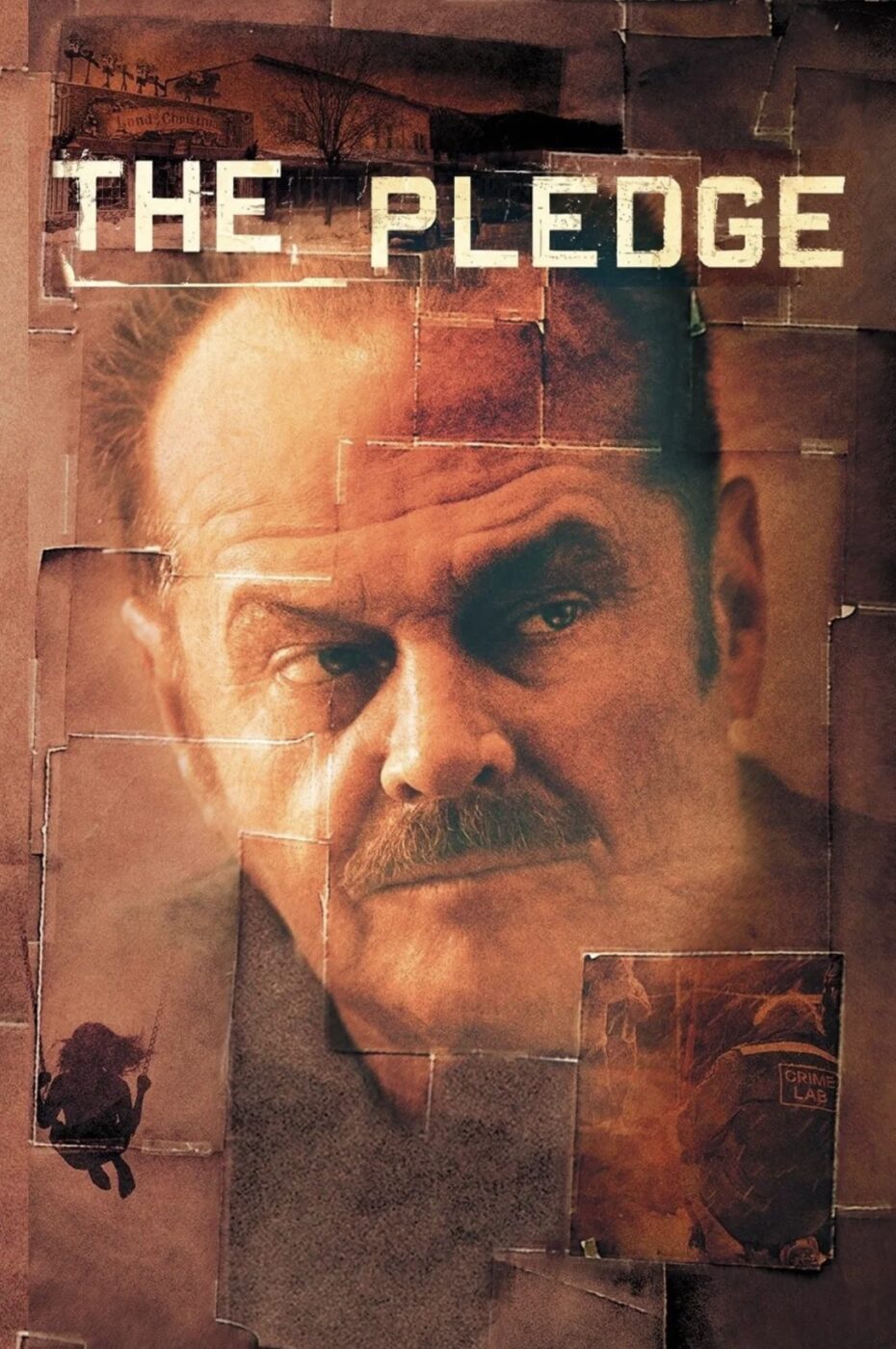
director: Sean Penn.
writers: Jerzy Kromolowski & Mary Olson-Kromolowski (based on the novella ‘The Pledge: Requiem for the Detective Novel’ by Friedrich Dürrenmatt).
starring: Jack Nicholson, Robin Wright, Patricia Clarkson, Tom Noonan, Benicio Del Toro, Aaron Eckhart, Helen Mirren, Vanessa Redgrave, Mickey Rourke, Harry Dean Stanton & Sam Shepard.