EXCALIBUR (1981)
Merlin the magician helps Arthur Pendragon unite the Britons around the Round Table of Camelot, even as dark forces conspire to tear it apart.

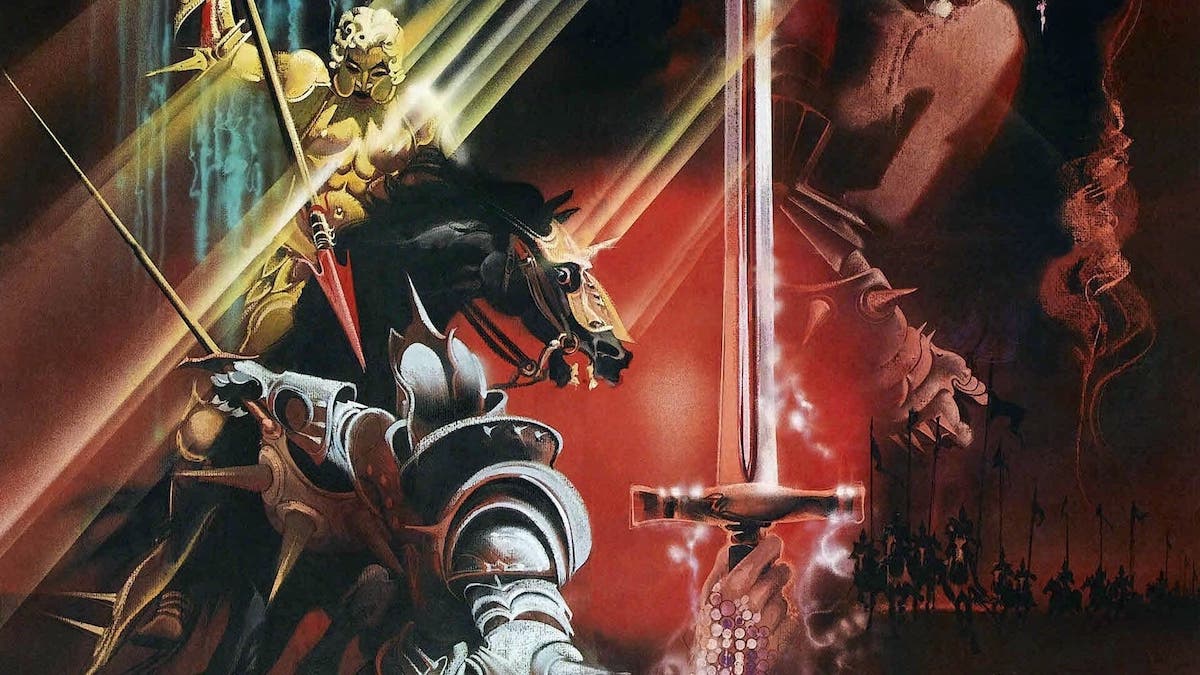

Merlin the magician helps Arthur Pendragon unite the Britons around the Round Table of Camelot, even as dark forces conspire to tear it apart.
John Boorman’s Excalibur is a wonderful oddity, even within the context of the British director’s varied career. As an epic fantasy like no other, it stands out from the long list of lesser films that have tried to put their own spin on the Arthurian legends. While detractors dismiss it as a piece of cheesy 1980s hokum, many love it as a definitive retelling of timeless myths that hold a profound ecological wisdom we need now more than ever. In recent interviews, Boorman has cited it as his personal favourite and his greatest cinematic achievement. That’s a bold claim, coming from the director of Point Blank (1967), his superb second feature and cinematic ‘calling card’.
Excalibur has never looked so beautiful as it does on the new Arrow Films 4K restoration scanned from the original 35mm negative that can now be enjoyed in its original aspect ratio for the first time on home video. This impressive box set presents the full 141-minute, director-approved theatrical cut and the more familiar 120-minute television edit, each on their own discs with a third full of of bonus material, much of the material has been specially produced for this new edition, plus some essential legacy content carried over from previous releases. Hyperbole such as ‘ultimate’ and ‘definitive’ are justifiably apt.
Tales of King Arthur, Merlin the Mage, and the sword in the stone, Excalibur, have fascinated Boorman since childhood; he sees his career as a lifelong quest to make mythic films. He was already pondering his Arthurian epic while busy on his third production, the unusual and intense war film Hell in the Pacific (1968). That film reunited him with Lee Marvin, who starred alongside Toshirô Mifune in a two-man cast. During this period, Boorman was also working with writer Rospo Pallenberg on an adaptation of Sir Thomas Malory’s sprawling literary classic, Le Morte d’Arthur.
The following year, the pair approached United Artists with an ambitious three-hour screenplay. The production company was in transition, having just been absorbed by Transmedia, and balked at the potential costs. Instead, they offered Boorman and Pallenberg a shot at what they must’ve thought was a more modest project: The Lord of the Rings! Their adaptation of J.R.R. Tolkien’s classic was completed by 1970 but the production never got off the ground. This was likely a blessing for several reasons—not least the plan to cast The Beatles as the four hobbits. Apparently, Pallenberg wanted Paul McCartney as Frodo Baggins!

They had reached the stage of scouting for locations and intended to shoot primarily in Ireland, drawn by the tax incentives. This was a factor John Boorman recalled when making his camp, dystopian science-fantasy film Zardoz (1974), filmed largely in County Wicklow. The lush, unspoiled landscape of rolling hills, lakes, and verdant woods—along with the well-preserved castles—would later draw him back to the area to film Excalibur.
Before any light hits the screen, we hear a phrase from Richard Wagner’s epic opera cycle, The Ring of the Nibelung. It is ‘Siegfried’s Funeral March’, and it adds instant gravitas. These notes are also the last we hear before the end credits, effectively bracketing a cyclic narrative where an ending is also a new beginning. For any subsequent viewing, they act as an instant mood anchor, immersing the viewer in this richly imagined version of the medieval world.
Apparently, prior to production, Boorman sat through the entire 15 hours of the opera to transport himself to the mythic landscape in which he hoped to set his film. Indeed, there are strong parallels between the two legends of a young man chosen to lead his world from primitive barbarity into a new era of structured culture. Both are aided by a magical item; for Wagner, it is the same ring from Norse mythology that inspired Tolkien. Ultimately, both are telling the same eternal tale.

The opening captions establish the setting as ‘the Dark Ages’, when ‘the land was divided and without a king’. It is fitting that we aren’t given a date and the land remains nameless; the mythic is universal and timeless, dealing with archetypal characters and motifs that still lurk within the human psyche.
The first scene depicts a brutal, chaotic battle. Silhouettes of horses and armour-clad foot soldiers stagger clumsily through smoke and mud, wielding battleaxes and hefty broadswords. An arm is severed; a burning spear impales another man, pinning him to a tree. It’s immediately clear that we aren’t in a romanticised world of chivalry. A figure in tattered robes emerges, backlit by fire until we see his face and hear his name: Merlin (Nicol Williamson).
“The sword!” shouts Uther (Gabriel Byrne), astride his armoured warhorse. “You promised me the sword!” Merlin assures him: “…you shall have it. But to heal. Not to hack.” In a matter of minutes, the entire premise is set out. Boorman maintains this fat-free storytelling throughout, making every shot count for the next 140 minutes.

The production’s original title was Merlin, and the character remains the narrative’s backbone; everything that occurs is set in motion by his actions—or his failure to act. In many ways, he fulfils the role of the villain. Propp’s Morphology of the Folktale defines the villain as the character who drives the story by inciting others to respond. Merlin performs several questionable deeds, and without his various interventions, there would be no story.
The truce he forges between Uther and the Duke of Cornwall (Corin Redgrave) is short-lived because Uther can’t contain his lust for his rival’s wife, Igrayne (Katrine Boorman). In the ensuing battle, Cornwall is drawn out of his castle. Merlin then casts a glamour so that Uther takes on the Duke’s semblance, allowing him to have his—rather raunchy—way with the fair Igrayne. This is permitted only after Uther promises that whatever issues from his lust will be handed over to the wizard.
It all seems somewhat immoral, but Merlin is simply manipulating likely events in the hope of a more advantageous outcome. We must bear in mind that the first act takes place in a pagan hinterland, where Christian notions of morality have yet to catch on. There is a conspicuous absence of the religious iconography that gradually asserts itself throughout the remainder of the film.

Nicol Williamson strikes a brilliant balance between camp theatrics and mesmerising mystery. His Merlin comes across as an otherworldly creature pretending to be human, finding our foibles both amusing and bemusing. If it weren’t for this remarkable performance, Merlin wouldn’t be so likeable and the film would fail to engage.
An established Shakespearean actor, Williamson was no stranger to reimagined British history. He’d already dabbled in the mythic past, playing Little John in Robin and Marian (1976) and Sherlock Holmes in The Seven-Per-Cent Solution (1976). The rest of the cast seem energised by his presence, not least Helen Mirren as his counterpart, Morgana, the half-sister of Arthur (Nigel Terry). Apparently, there was some ill will between Mirren and Williamson stemming from a falling-out on the Shakespearean stage shortly before filming. Both were reluctant to take their roles if the other were cast, but Boorman stood his ground; he believed their off-screen antagonism would add a frisson to their on-screen chemistry. He wasn’t wrong!
Excalibur is a collection of quirky performances that showcase considerable range and help create its unique, complex flavour. While some critics detect a hint of “ham”, and certain exchanges feel overtly theatrical—especially on the battlefield where snap decisions are delivered succinctly—this style suits the film’s scale. Most, if not all, the dialogue was redubbed for clarity, primarily because the authentic metal armour was so clanky and the logistics of freeing the camera made hiding microphones impossible. At times, this lends the film a “Spaghetti Western” vibe that is quite enjoyable. It also feels in keeping with Aubrey Beardsley’s fine illustrations for the 1893 edition of Le Morte d’Arthur, which presented captions within boxes, much like a comic strip.

The cast features some familiar faces but lacks major stars, aside from Williamson and Mirren. Boorman avoided creating a ‘star vehicle’, fearing that too many recognisable actors would break the spell he was weaving. This wasn’t solely a matter of budget; he had roughly £11M to play with—a respectable sum at the time, even if it seems modest by today’s standards. Instead, he chose to invest elsewhere and cast mainly newcomers. Among them, you might spot Gabriel Byrne, Liam Neeson, and Patrick Stewart, all of whom had only a handful of big-screen appearances to their names. Excluding a small, uncredited role in Zardoz, this was the debut for Katrine Boorman, while Charley Boorman had previously only appeared in his father’s harrowing thriller Deliverance (1972).
The investment is visible on screen through Anthony Pratt’s exquisite production design. Pratt had already worked with Boorman on Zardoz, and the pair would collaborate several more times on Hope and Glory (1987), Beyond Rangoon (1995), and Queen & Country (2014). A significant portion of the budget must have been absorbed by the props and costumes, particularly the stunning armour by Terry English. English’s craftsmanship is on permanent display at the Royal Armouries and features in almost every major film requiring plate mail.
He began making props in the 1960s—Doctor Zhivago (1965) was among his first notable projects—and crafted armour for epics such as The Lion in Winter (1968), The Charge of the Light Brigade (1968), and Jabberwocky (1977). He later returned to Arthurian legend for Sword of the Valiant (1984), First Knight (1995), King Arthur (2004), and Transformers: The Last Knight (2017).

Plate armour is anachronistic, as it wasn’t developed until the late 13th-century; however, when Malory wrote his classic, it was fashionable to recast historical characters in the contemporary mode. His descriptions of knights would’ve been exactly what people of his day recognised. Much of Excalibur’s imagery was inspired by the paintings of the Pre-Raphaelites, a prominent British movement of the mid-19th century that typically portrayed a lost English idyll they were desperate to reclaim. The Arthurian myths fascinated them; it was nostalgia for a time that never existed.
Likewise, Excalibur isn’t a historical drama. It’s a fantasy and a brilliant rendering of Malory’s work. In keeping with his approach, Rospo Pallenberg translated the flowery dialogue into straightforward contemporary English and followed the source material’s structure, which makes the film feel like a compilation of vignettes from a much bigger story—which is exactly what it is.
These legends never had a cohesive central narrative until Thomas Malory first attempted to make sense of the disparate stories in his epic work, published in 1485. To make the task even more difficult, the author embellished the tales by adding elements from 13th-century French romances written in Vulgate, a precursor to the modern French language. He was translating and writing against the tumultuous historical backdrop of the Wars of the Roses and was in prison for much of the time, accused of a succession of serious crimes.

The legends of King Arthur and the Knights of the Round Table originate from an array of separate stories that were merged and muddied through innumerable retellings long before they were first written down. Some aspects were borrowed from the Viking Eddas, while many of the tales are reworked from Celtic mythologies collected in the Mabinogion. Others stem from real historical events that have morphed to fit popular mythic characters from older legends.
On a recent research tour of Pembrokeshire, I visited at least three of King Arthur’s graves. This is likely because there was more than one Arthur. The name is believed to be derived from the Old Welsh Arth Fawr—meaning ‘Great Bear’—a title reserved for fierce warriors and powerful clan chieftains. There are also several versions of Merlin: one Scottish and two more from Wales (one a sane magus and the other a mad wizard), who are often combined as aspects of a single chaotic individual. Merlin also has roots in two characters who feature prominently in the Mabinogion: Gwydion and Taliesin. Aspects of both their stories are woven into the film Excalibur.
Nigel Terry was 36 when he was cast as Arthur, so he had to play a good 15 years younger as the ‘boy king’ and mature as the story unfolded, eventually becoming haggard and grey. Though the young Arthur is perhaps a bit too wide-eyed and bewildered, Terry handles the transition well. He adds extra layers as the character ages, letting Arthur grow through his experiences—including those implied during the passing years we don’t witness.

Of course, it’s really a ‘biopic’ of the most famous sword of all time. Boorman chose to focus on the era starting with its appearance—a gift from the Lady of the Lake (Hilary Joyalle)—and ending with its return to her. Some Arthurian scholars argue that Excalibur, the Sword in the Stone, and the Divine Sword of Kings are all distinct entities. Though proof is hard to come by, it’s likely that, just like Arthur, there was certainly more than one.
I like the notion that the original Excalibur may have been a Viking sword. At one time, these were the best blades in Europe in terms of strength, balance, and overall quality. They also carried an almost magical reputation and were always given names by their wielders. If a non-Viking brandished such a sword, the implication was that you’d either gained the respect of a high-ranking Viking warrior or taken his weapon in battle—both impressive feats.
Bronze Age and early Iron Age blades were cast in moulds of carved stone. Perhaps this was the original ‘Sword in the Stone’? Admittedly, this theory relies on a confusion of legendary proportions; by the time Viking blades earned such respect, they were being forged using a method akin to Damascus steel. An iron sword on a medieval battlefield would have been useless.

Apart from the numerous historical inaccuracies, which are wholly intentional, some critics argue that Excalibur is fundamentally flawed—a remnant of outmoded, gendered cinema. They contend that the myth itself is overtly masculine. It is true that the women here primarily support and motivate the men. The exception is Morgana: a powerful woman who repeatedly outwits the male protagonists, albeit through deception, manipulation, and her son, Mordred (born of an incestuous union with Arthur). However, she is often dismissed as the “evil temptress” archetype, eventually undone by her own vanity.
On the surface, I can appreciate the origin of this argument, but the crux of the mythic narrative is the failing of the masculine and its subsequent healing by feminine forces. Excalibur is a mighty sword; it is even called the “sword of kings”, not of queens. It is a clear phallic totem if ever there was one. Yet, it is the Lady of the Lake who imbues it with powers beyond the physical. Lakes are generally symbolic of feminine fertility and feature in Celtic myth as portals to the realm of the fae.
The Grail is the feminine vessel that carries knowledge and power from one generation to the next. The blood of Christ becomes eternal in the Grail, surviving his bodily absence after the Ascension. On the magus’s magical altar—as those who watch Hammer films or own a Tarot deck will know—sit the items of power. Among these are the pentacle, the wand, the chalice, and the athame (a dagger or sword). As part of ritual theatrics, the blade is often dipped into the cup to represent the act of sacrifice and (pro)creation.

The first half of the film tracks Arthur’s rise as he matures and successfully unites the warring clans into a single nation: one land under one king. We witness the formation of the Round Table and the ascent of Camelot, with its gilded halls and silvered ramparts. This is the Arthurian ideal the Pre-Raphaelites hankered for. But, of course, it’s too good to last.
Guinevere (Cherie Lunghi) can’t resist the charms of the arrogant Lancelot (Nicholas Clay), and the knightly fellowship is sundered as a result. Even Merlin falls victim to the womanly wiles of the revenge-fuelled Morgana, who tricks him into revealing his all-powerful ‘Charm of Making’. As Arthur falls ill and Lancelot descends into madness, the knights go their separate ways to seek the Grail, hoping its healing powers will restore the kingdom.
When Sir Perceval (Paul Geoffrey) eventually learns the secret of the Grail, it isn’t quite as Christian as one might expect. After his dreamlike, metaphysical experience, he presents the Grail to the King, and it certainly does the trick. We’re then treated to one of cinema’s most memorable moments as Arthur and his knights ride to battle in dazzlingly shiny armour. The ravaged countryside is reborn as they pass, trees bursting into bright white blossom to the rousing strains of Carl Orff’s ‘O Fortuna’ from Carmina Burana. Though it has since become familiar, this was the first time the classic cantata was used in a film.

Decades have passed and, having made amends with the estranged Guinevere, Arthur must embrace his inescapable destiny. Morgana has raised Mordred to lead an army of the dead against his father; the resulting descent into darkness leads to a spectacular finale that reputedly drained the entire supply of Kensington Gore—the stage blood used for special effects. On screen, the gore of the battlefield merges with the deep red of a sunset sky.
John Boorman has described the narrative as a damning critique of the ‘three ages of mankind’, a concept applicable to both the individual and our species. The Arthurian legends are rooted in a pre-agricultural era long before the medieval setting of their most famous retellings—a time of transition from hunter-gatherer migrants to settlers who began to domesticate animals and grow crops. This profound societal shift tied a clan’s survival to the concept of territory, making them reliant on a specific patch of land. Consequently, clan leaders became chieftains, chiefs became lords, and lords became kings. The land, and the people, were thus divided.

The Arthurian myths deal with those ancient times when the ‘world of mankind’ became separate and distinct from the ‘world of nature’. Human religion, established by the bureaucracy of the Church, shunned the pagan philosophies of nature and spirits. Bodily existence and the life of the soul parted ways. As Merlin puts it: “The one god comes to drive out the many gods. The spirits of wood and stream grow silent. It’s the way of things. Yes, it’s a time for men and their ways…”
Surrounded by the trappings of power and success, the nobility loses its connection with the world outside the shining citadel of Camelot. The walls of this man-made environment serve as both palace and prison. This distance from the common people, coupled with a deeper disconnect from nature, fails to bring them happiness. What’s more, this dysfunctional social structure will eventually, inevitably, bring about their doom. As a result, Mother Nature turns on her human tenants; the land is ravaged by famine and plague. Sound familiar?
Excalibur remains relevant and still bears up well to repeated viewing. Perhaps this is because we still need to hear these tales retold. The director, John Boorman, maintains that we are again stuck at that juncture and have yet to relearn that “the Land and the King are one!” Today’s politicians could learn a lot from taking a long, hard look at these age-old myths—reconnecting with the common folk and ending the destruction of the natural world for short-term gain.
UK | 1981 | 140 MINUTES • 119 MINUTES (EDITED) | 1.66:1 | COLOUR | ENGLISH



director: John Boorman.
writers: John Boorman & Rospo Pallenberg (based on ‘Le Morte d’Arthur’ by Thomas Malory).
starring: Nigel Terry, Helen Mirren, Nicholas Clay, Cherie Lunghi, Paul Geoffrey & Nicol Williamson.