BOTTLE ROCKET (1996)
Three friends plan to pull off a simple robbery and go on the run.

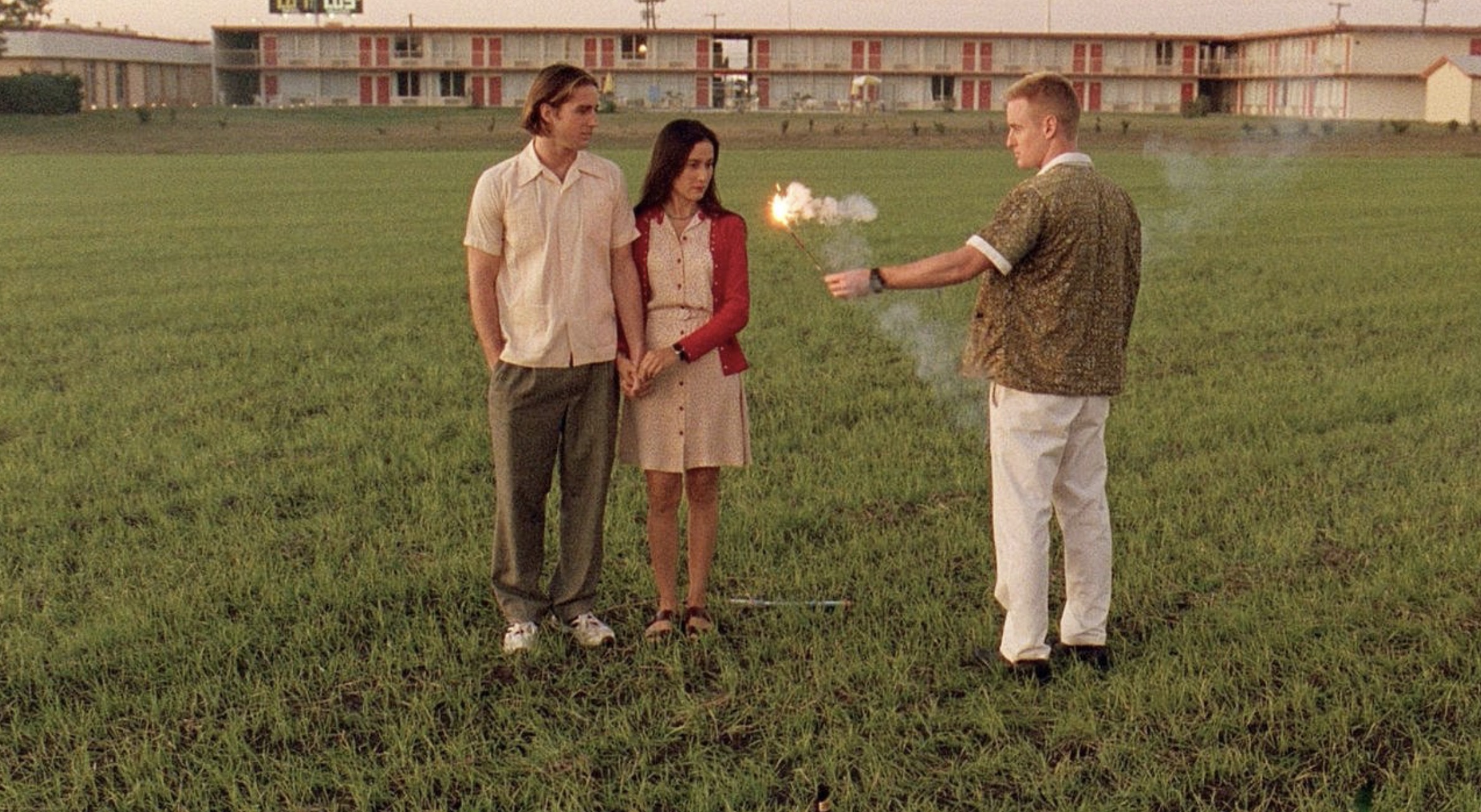

Three friends plan to pull off a simple robbery and go on the run.
Filmmaker Wes Anderson is someone whose films may seem a little unusual to many. Even weird. However, while he’s never directed a huge mainstream blockbuster, or been grouped together with other more fashionable directors like David Fincher, Anderson’s still achieved great success over the last three decades.
His debut movie, Bottle Rocket, wasn’t a commercial hit, but it picked up positive reviews and set Anderson on the right course for a solid career as a director. Other titles in his back catalogue—such as The Royal Tenenbaums (2001), Fantastic Mr. Fox (2009), and The Grand Budapest Hotel (2014)—all proved popular with audiences around the world. Moreover, such is Anderson’s reputation for being a collaborative filmmaker (one who’s also kind and generous to work with), his films regularly boast a cast list any big-time Hollywood name would envy. Who, you may ask? Well, for starters: Tom Hanks, Scarlett Johansson, Bill Murray, Tilda Swinton, Gwyneth Paltrow, and Jeff Goldblum. Impressed yet?
As with most things in life, timing and chance played a big part in how Anderson got his big break. With this director, though, both factors apply. For the first of these contributing elements, you have to go back over 100 years to the birth of American independent cinema.

In February 1919, prestigious names of the silver screen—D.W Griffith, Charlie Chaplin, Mary Pickford, and Douglas Fairbanks—came together to form United Artists. This happened partly because, in their eyes, Hollywood producers were getting far too rich, too quickly, while the real creatives were getting a lot less for their hard work in front of and behind the cameras. Not only that, it was apparent that the distribution and exhibition side of the industry had expanded massively since 1910, meaning more capital from the major studios was being funnelled in that direction. Subsequently, United Artists became the first independent film studio operating outside the traditional Hollywood system.
Flash-forward 70 years, and an aspiring 26-year-old filmmaker from Georgia called Steven Soderbergh burst onto the scene with his debut smash, Sex, Lies and Videotape (1989). Thanks to stellar reviews from the Sundance Film Festival, where it premiered in January ’89, and winning the prestigious Palme d’Or at Cannes a few months later, the film went on to earn Miramax a healthy $36.6M. Not bad considering it only cost $1.2M to make.
Why is any of this important? Because this tiny indie-arthouse hit heralded the beginning of the nineties independent cinema boom. Off the back of it, Miramax became a major industry player, and Sundance was transformed from a small, overlooked venue into a premier, must-attend marketplace for studio executives looking for the next “big thing”. From a creative perspective, it was also responsible for introducing some seriously talented new filmmakers. Alongside Soderbergh came Quentin Tarantino, Richard Linklater, Paul Thomas Anderson, Kevin Smith—and Wes Anderson.

Born in Houston, Texas, in 1969, Anderson’s creative instincts were shaped early by a mix of literature, theatre, and European cinema. As a child of divorce, he has often spoken about retreating into books and stories, which perhaps explains his lifelong fascination with tightly controlled worlds and characters who use fantasy, ritual, and play-acting to cope with emotional chaos. Much like Steven Spielberg’s first foray into movies, Anderson made films on his father’s Super 8 camera, using family and friends as his go-to cast.
While studying philosophy at Austin’s University of Texas, Anderson worked part-time as a cinema projectionist at the campus’s Hogg Memorial Auditorium. It was here that he met a young Owen Wilson. The pair soon became close friends and roommates, bonding over the work of great directors like François Truffaut, Jean-Luc Godard, Orson Welles, and Stanley Kubrick.
It’s impossible to be 100% sure, but if you’re familiar with his movies, you can see direct stylistic links between these names and Anderson’s own visual aesthetic. Truffaut, a prominent figure of the French New Wave, often examined the hurly-burly emotional lives of the young, fusing cinematic passion with sadness and troubled romance. From Kubrick came an obsession with precision and control; from Godard, a sense that movies could be playful, self-aware, and slightly anarchic.

All of these influences—a melting pot of themes, filming techniques, and tone—eventually coalesced into Anderson’s unique style. One adjective regularly used to describe his films is “quirky”, though that word barely scratches the surface of Anderson’s careful, deliberate oddness. Another phrase, perhaps more appropriate, is “eccentric”.
Before feature films were a realistic prospect, Anderson and Wilson’s combined talents produced a short film, also titled Bottle Rocket. Shot on black-and-white 16mm and first shown at Sundance in 1993, it followed a group of aimless young men pretending to be criminals. It was at this point that we encounter the second reason behind the filmmaker’s success: the short caught the attention of legendary producer-director James L. Brooks (Broadcast News). Brooks immediately felt it had the potential to be something bigger and helped push the project into a feature-length film, giving Anderson, then in his mid-twenties, a rare opportunity to expand his vision.
On the surface, Bottle Rocket looks like another rough-around-the-edges indie comedy about slackers and dreamers, a genre popular in that era. However, from its opening scenes, it’s clear Anderson is taking a different approach. Instead of starting in a bar or coffee shop, we see one of the protagonists, Anthony (Luke Wilson), about to leave a voluntary stay in a mental institution, while his best friend Dignan (Owen Wilson) signals to him from across the street with a mobile phone and silly bird noises, believing he is assisting an escape. This sequence perfectly sets the tone for the entire movie.

The story follows this pair of misfits as Dignan, who has a meticulously handwritten “50-year plan”, embarks on a series of ill-conceived crimes that are less about money than belonging and identity. Joining them, largely because he has nothing better to do besides being bullied by his older brother, is their slightly more sensible pal Bob (Robert Musgrave).
Aside from the unusual storyline, the most immediate observation is how unpolished the film feels compared to Anderson’s later work. This was the director’s first feature, and unlike the rest of his filmography, the symmetrical compositions, elaborate production design, and curated colour palettes are absent. Instead, Bottle Rocket is the visual antithesis: the camerawork is loose, often lingering at a distance, with wide shots and sequences full of awkward pauses.
Despite this, Anderson’s DNA is evident. The characters talk in a formal, slightly stiff manner, and there are numerous scenes involving maps, uniforms, and silly rules. Dignan certainly prefigures Anderson’s later protagonists: confident to a fault, yet underscored by insecurity. Like all the director’s movies, the cast does the heavy lifting. Alongside Owen Wilson’s intense Dignan, Luke Wilson’s Anthony is the complete opposite: quiet, aloof, and sad. His romantic fling with the motel housemaid Inez (Lumi Cavazos) provides the film’s emotional heart.

Perhaps most bizarrely, James Caan pops up as Mr Henry, the criminal figure Dignan worships. Caan’s appearance feels almost out of place, but his presence lends a surreal, dreamlike quality to the story. The legendary actor is clearly enjoying himself, and the cameo works well.
The inspiration behind Bottle Rocket is equally strange. Anderson and Owen Wilson conceived the idea using their own experiences as flatmates. To convince their landlord that their apartment’s windows needed fixing, they actually broke into the building—though the landlord reportedly suspected an “inside job”. That moment, combined with a mutual desire to make a film about inept criminals, eventually became the script.
Until writing this feature, I’d never seen Bottle Rocket, though I had watched the majority of Anderson’s other films. While I’ve enjoyed most to varying degrees—with the exception of Asteroid City (2023)—I’ve only ever truly loved Fantastic Mr. Fox and The Grand Budapest Hotel. This debut, however, surprised me with its effortless charm and technical confidence.
While it is unpolished, that isn’t a criticism. Despite it being Anderson’s first feature, it’s impressive how he directs the cast, keeps the story zipping along, and makes excellent use of the Texas locations.

Regarding technical skill, cinematographer Robert Yeoman, who has since worked on all of Anderson’s films, brings plenty of colour and light to the lens. It may be a far cry from the highly stylised visuals that followed, but there is keen use of natural light and a semblance of a controlled colour palette; for example, Dignan’s wardrobe is consistently bright and garish. Another effective touch is the use of occasional slow-motion sequences, a technique Anderson continues to utilise to great effect.
Made for around $5M, the film barely scraped past $500,000 at the US box office. Critics were split; some loved its originality, while others found it unfocused. At a time when indie films were marketed as edgy and shocking, Anderson’s gentle, old-school vibe didn’t immediately click. Interestingly, Martin Scorsese is a huge fan, naming it one of his favourite films of the decade. In an Esquire interview, he praised the young filmmaker’s ability to “convey the simple joys and interactions between people so well and with such richness”.
Ticket sales aside, Bottle Rocket has endured. Over time, it has achieved cult status. It’s easy to see why: the characters are fun to hang out with, each possessing quirks while simply trying to find their way. Watching them interact is genuinely entertaining. They’re far from perfect, but that’s the point. You can relate to them, and that is what makes the film so endearing.
USA | 1996 | 91 MINUTES | 1.85:1 | COLOUR | ENGLISH • SPANISH


director: Wes Anderson.
writers: Owen Wilson & Wes Anderson (based on their 1992 short film).
starring: Owen Wilson, Luke Wilson, Robert Musgrave, Andrew Wilson, Lumi Cavazos & James Caan.