CAST AWAY (2000)
A deliveryman undergoes a physical and emotional transformation after crash landing on a deserted island.

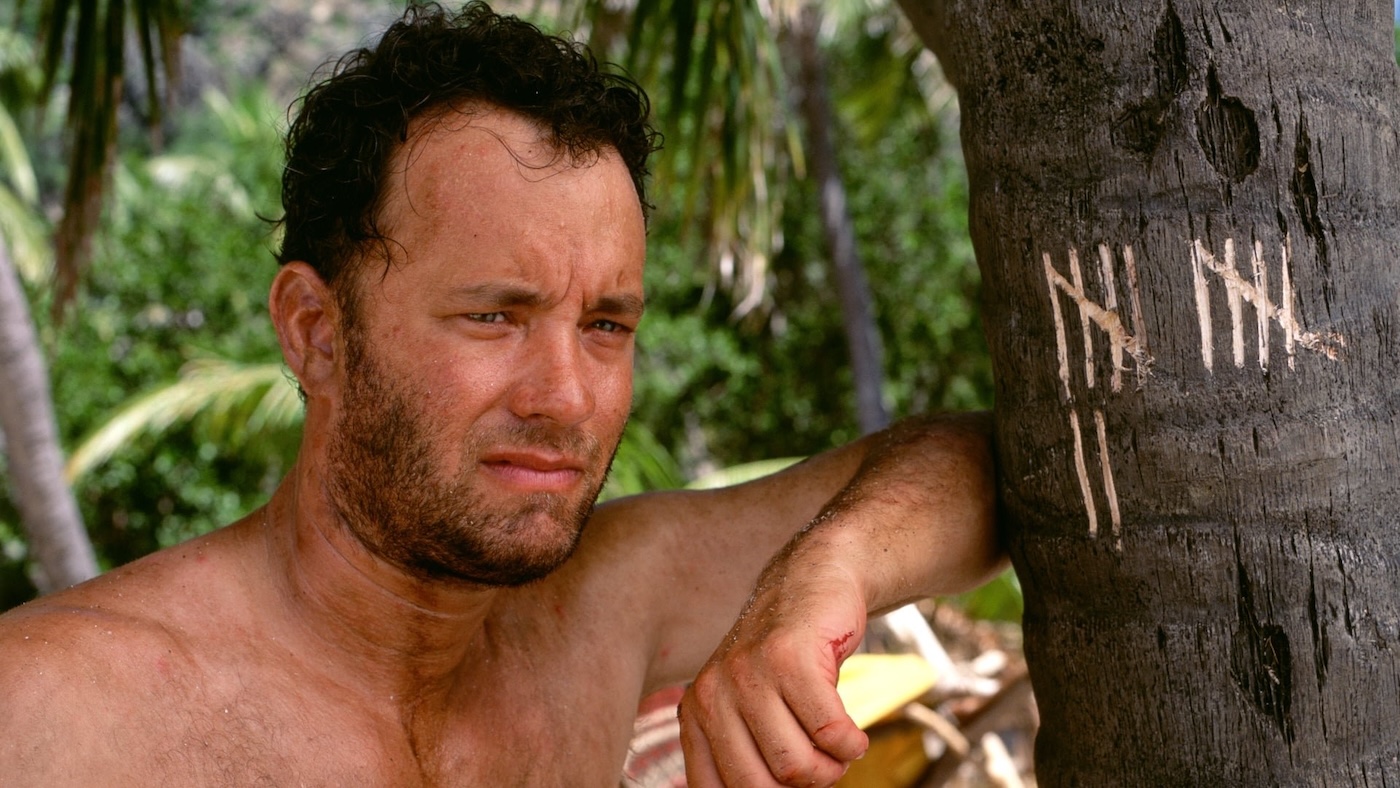

A deliveryman undergoes a physical and emotional transformation after crash landing on a deserted island.
Despite the constant references to FedEx—the delivery company that protagonist Chuck Noland (Tom Hanks) works for—Robert Zemeckis’ Cast Away feels timeless. It’s a story about all-consuming loneliness, the insignificance of a person’s existence in the face of unimaginable calamity, and the bottomless power of hope. It’s a movie that paces its 140-minute runtime with extreme patience while remaining a successful crowd-pleaser, easily recouping its sizeable $90M budget. In fact, it’s a minor miracle that the movie exists in its current state. Today, it’s almost impossible to fathom a studio allotting such a large budget to a film with lengthy stretches of silence, or one that features no music whatsoever for the majority of its duration.
Of course, having a major star like Tom Hanks in the lead role certainly helps. More often than not in Cast Away, the veteran actor is the only performer on screen. Even when he’s around other people at the film’s opening, he might as well be on his own. It’s clear from the outset that Chuck needs to change his life; his obsession with his job causes him to constantly neglect his personal life and his girlfriend, Kelly Frears (Helen Hunt).
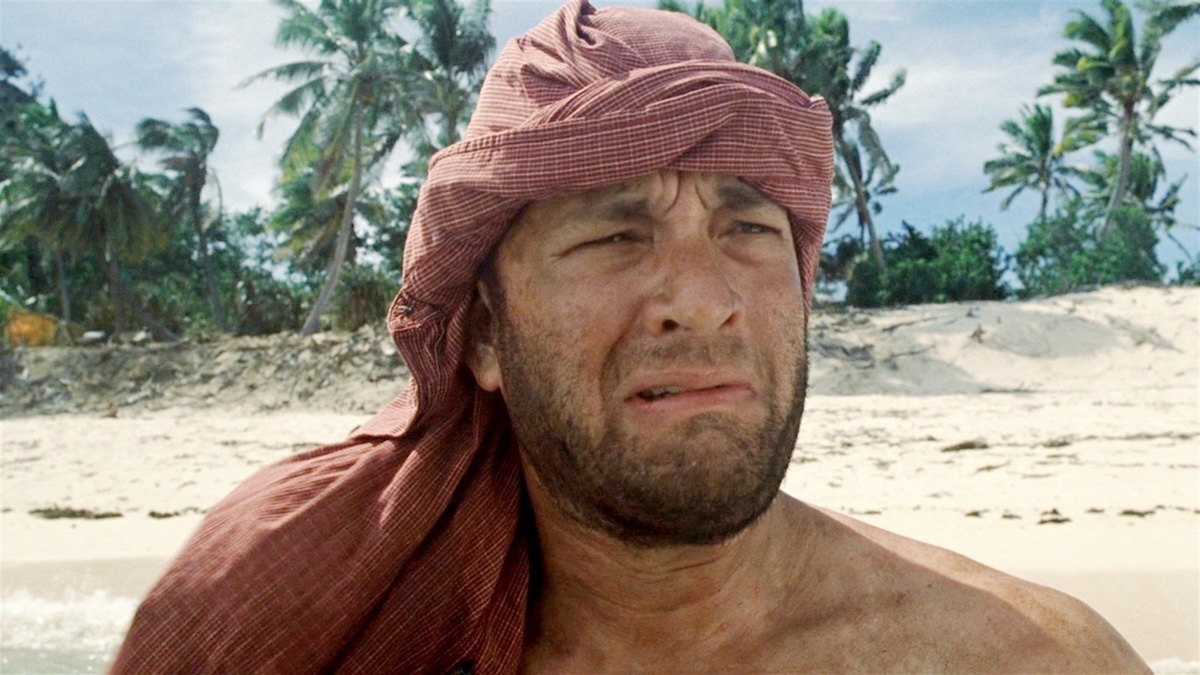
Everything in Chuck’s world is in service to a job that saps him of free time, while the position ironically offers him the opportunity to rule over time itself. He demands faster delivery speeds from his employees through angry, ostensibly rousing speeches. Chuck’s endless references to time are knowingly heavy-handed, adding splashes of absurd humour to our introduction to a man who has made his career his entire personality. However, these moments primarily exist to be savoured later, once this naïve protagonist’s life has been upended. With endless time to reflect, he cannot help but sadly remember how simple his problems once were, and how he let countless opportunities for precious memories slip by.
After the plane he boards for a last-minute work emergency crashes, Chuck must try to survive—both physically and psychologically—on the deserted island where he washes up. From then on, his life is a cruel endurance test, yet one that always retains a sliver of hope. There are times when Chuck’s existence appears pathetically arbitrary in the face of a world far larger than his former self could have ever understood. But while he suffers greatly throughout Cast Away, that spiritual void is slowly filled. He’s reminded that life can be precious, and that alone makes his survival worth clinging to, ensuring this bittersweet story soars to dramatic heights.
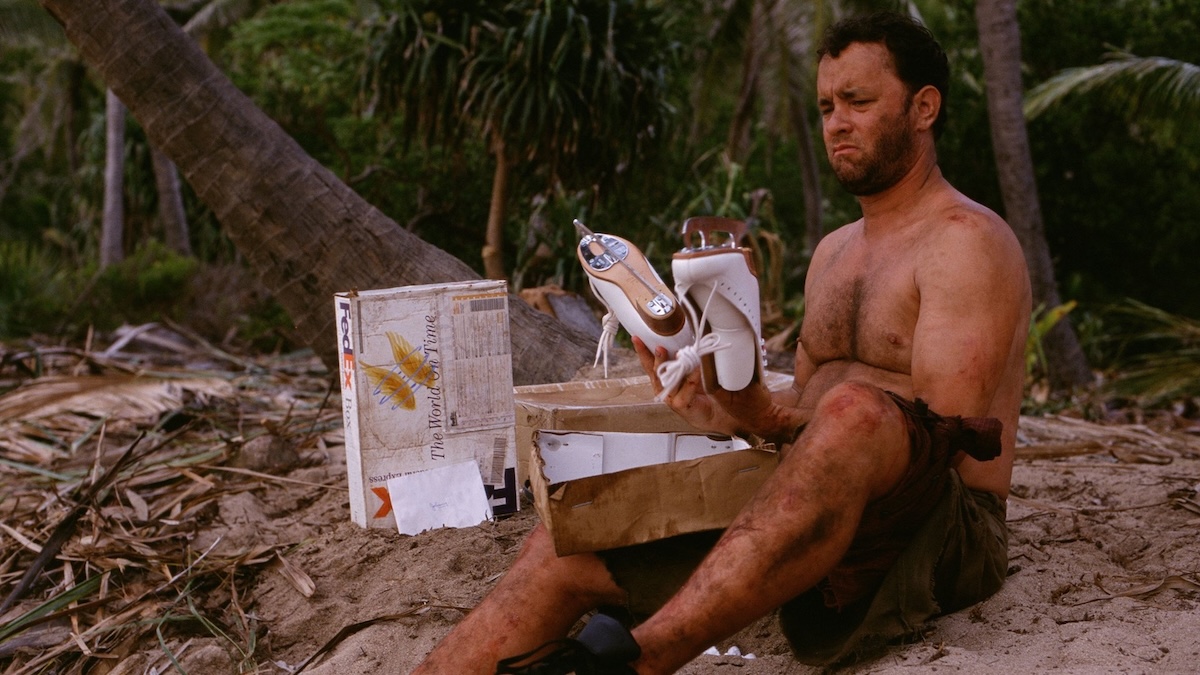
It’s not just for practical or budgetary reasons that it’s impossible to imagine anyone else in the role. Hanks is a remarkably talented actor, expert at portraying the “everyman”—or, more precisely, making even the most extraordinary men feel relatable. He was a pioneering leader in Steven Spielberg’s Saving Private Ryan (1998), but it was his natural ability to connect with others without putting himself on a pedestal that made him an admirable hero. Chuck is initially rather silly, larger than life, and perhaps even a little pathetic, before slowly transforming into a fully realised person instead of the caricature his time-oriented obsession had created. He has to relearn his humanity, resulting in an emotive combination of note-perfect acting and poignant storytelling.
Chuck also learns to stop performing—whether for himself or others. Far from civilisation and its comforts, Chuck no longer speaks to impress or humour anyone. Indeed, there are long stretches in Cast Away where not a single line of dialogue is uttered. Yet there’s never a moment where Hanks fails to communicate the character’s emotions acutely, portraying silent interactions and heartaches so naturally they seem effortless. Zemeckis has forged a reputation over the decades as an experimental, eclectic, and off-the-wall director, capable of both masterpieces and colossal failures. Here, however, he’s remarkably patient, mature, and earnest, capturing the day-to-day rhythms of an entirely unfamiliar way of life for this protagonist.
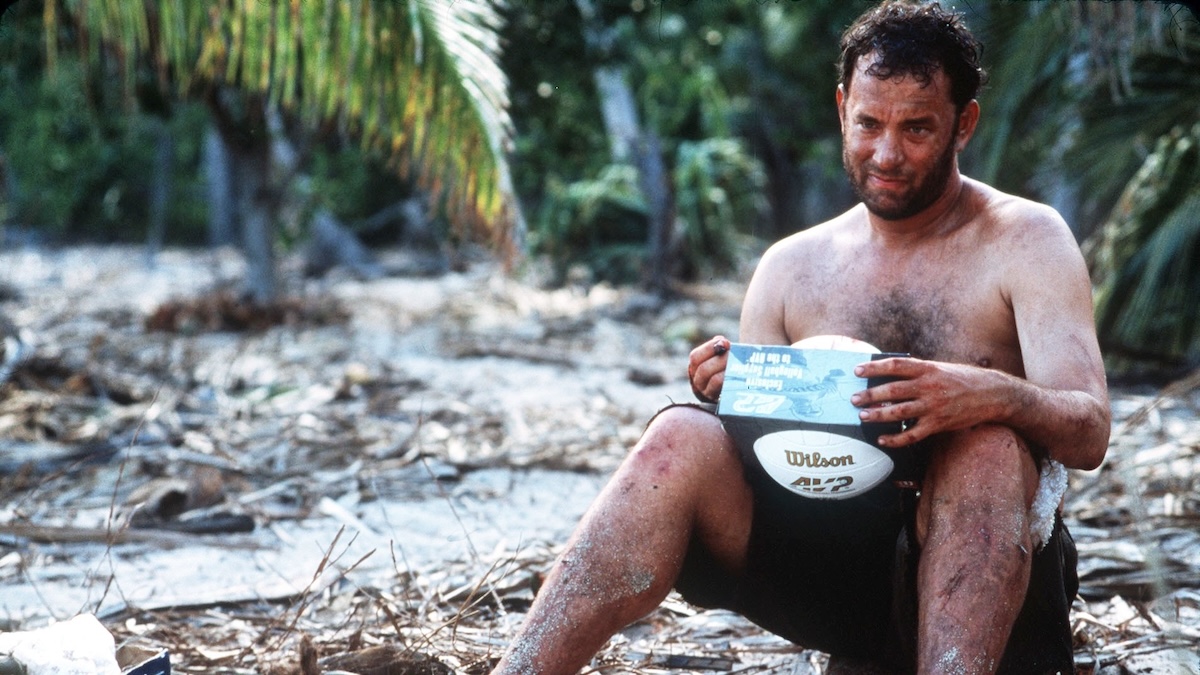
Watching this fairly average, middle-aged man navigate such bleak circumstances is equal parts terrifying and awe-inspiring. It’s remarkably easy to put yourself in Chuck’s shoes and imagine how you would respond to the film’s developments—aided in no small part by Hanks’s affable charm. It’s a pleasure to spend minutes at a time simply tracking his movements and realisations. When Chuck sparks a flame for the first time using nothing but natural elements, it feels as if both he and the audience have discovered fire for the very first time. Every minor victory is imbued with a sense of grandeur, as viewers recognise these tasks are no easy feat for the vast majority of us. Worse still, while Chuck appears to do everything right, these efforts only provide a direction for survival. Attempting to truly live amidst such dire circumstances, rather than merely survive, is another matter entirely.
For Chuck’s sanity and the sake of the movie possessing an accessible narrative, “Wilson”—a volleyball named after its manufacturer—becomes the protagonist’s only friend. This allows Chuck to engage in humorous, one-way conversations with the inanimate object. It doesn’t take long for the initial awkwardness of these scenes to vanish, replaced by an earnest relationship that provides a lifeline against insanity. After a while, it no longer feels notable, let alone bizarre, for the protagonist to ascribe emotions to his only companion. Without Wilson, there would be no Cast Away. Naturally, no studio would sign off on a $100M budget for a movie where the protagonist either mutters to himself or stays silent while stranded.
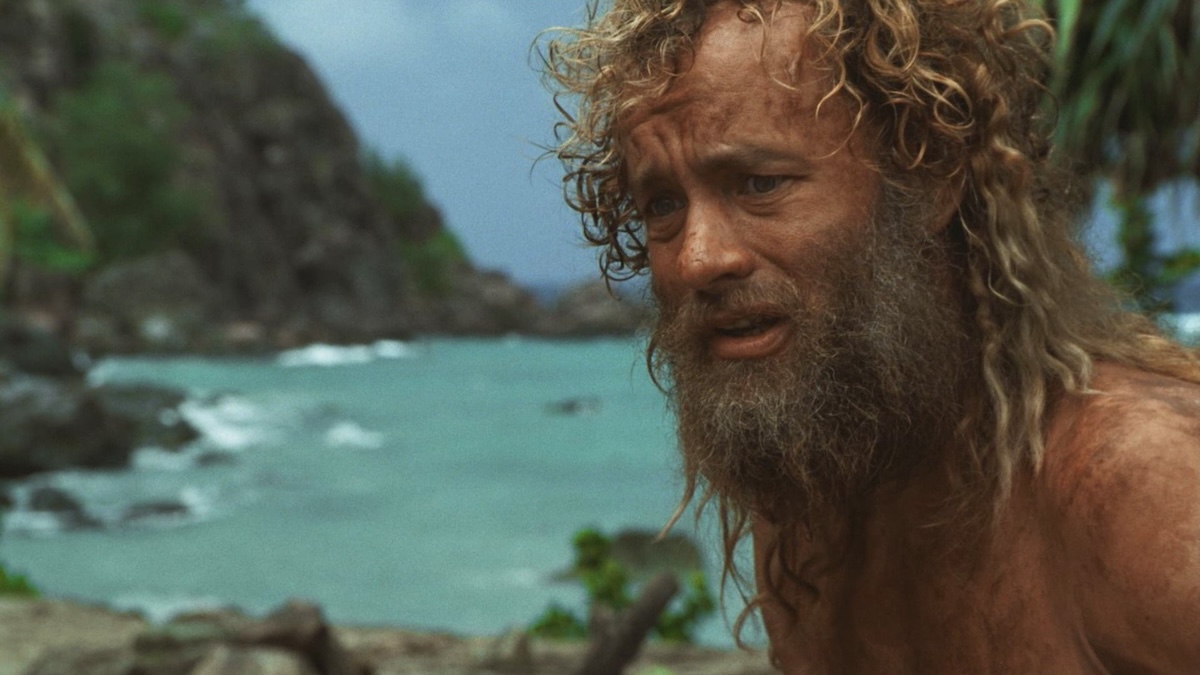
Wilson’s origins are fascinating. Screenwriter William Broyles Jr. came across a Wilson-branded volleyball while attempting to live for a week on an isolated beach in the Gulf of California for research. The name was also a significant memento for Hanks, as it’s the maiden name of his wife, whom he had to be away from for long periods during production. Wilson the volleyball is almost as famous as the film itself, and with so much meaning projected onto the object by Chuck, it’s easy to see why. He’s a vital component of the drama.
Despite being a sentimental tale with broad appeal, Cast Away is also merciless. It teases the idea that Chuck might not be strong enough to survive, let alone escape, the prison surrounding him. The island’s terrain and views are gorgeous, creating an unusual hellscape, but it takes little time for the gravity of the situation to sink in. In one early scene, a distant ship seems to exist only to taunt him; Chuck yells and signals with his torch to no avail. Yet there’s no cosmic injustice at play, no plot to strip him of his rights. It’s all entirely arbitrary, and in many ways, that is the film’s most devastating blow.
The audience never quite knows if Chuck is ready to give up on life. Fortunately, this film is clever and heartfelt enough to avoid a sugary-sweet or maudlin resolution. For Chuck, hope is a ray of sunlight peeking over a horizon that tortures him daily. With gorgeous imagery, sublime acting, and heart-wrenching yet uplifting scenes, Cast Away is at its best when depicting his attempts to reach for that distant light—a light so small that only those in the most desperate circumstances will ever see it.
USA | 2000 | 144 MINUTES | 1.85:1 | COLOUR | ENGLISH • RUSSIAN

director: Robert Zemeckis.
writer: William Broyles Jr..
starring: Tom Hanks, Helen Hunt, Nick Searcy, Jennifer Lewis, Geoffrey Blake, Peter Von Berg, Chris Noth & Lari White.