PEE-WEE’S BIG ADVENTURE (1985)
When eccentric man-child Pee-wee Herman gets his beloved bike stolen in broad daylight, he sets out across the US on the adventure of his life.


When eccentric man-child Pee-wee Herman gets his beloved bike stolen in broad daylight, he sets out across the US on the adventure of his life.
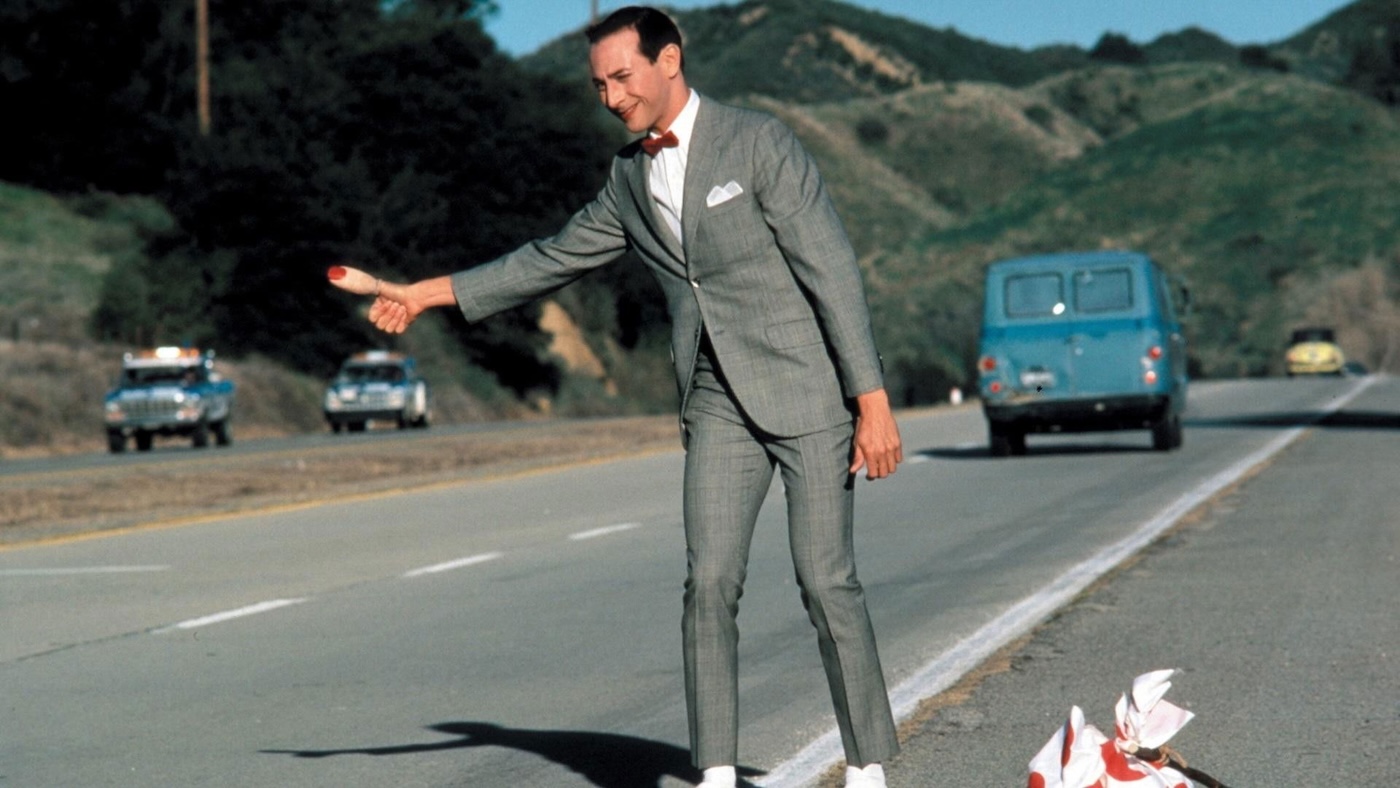
A frenetic marionette of a man (outfitted in an intentionally undersized grey suit, complemented by white shoes, with his signature diminutive red bow tie), Pee-wee Herman emerged as one of the most exasperating and oddly endearing pop culture creations of the 1980s. The character was first introduced during Paul Reubens’s tenure with the venerable Los Angeles comedy troupe, The Groundlings. Drawing inspiration from the manic vaudeville energy of Pinky Lee (Lady of Burlesque) and the unnervingly subversive humour of Andy Kaufman (Taxi), alongside the refined guidance of fellow Groundling Phil Hartman (Kiki’s Delivery Service), Reubens fashioned Pee-wee into a truly sui generis persona. The result was a figure Gene Siskel infamously described as “tolerable in Pee-wee doses”. Indeed, he’s an acquired taste, but he radiates an eccentric charisma and an anarchic brilliance reminiscent of a particularly unhinged Looney Tunes creation.
While developing the character during the early 1980s, Reubens secured several minor film appearances that hinted towards his unique capacity for surreal comedy. He portrayed an exquisitely irksome waiter in The Blues Brothers (1980) and as an extravagantly peculiar hamburger enthusiast in Cheech and Chong’s Nice Dreams (1981). After an unsuccessful audition for Saturday Night Live, the comic secured a modest loan from his parents, gathered a troupe of collaborators, and dedicated the subsequent years to refining the character through his stage production The Pee-wee Herman Show.

Set within the whimsically anarchic Puppetland Playhouse, the stage show served as the conceptual blueprint for what would become the wildly successful Saturday morning television series. Its peculiar alchemy of childlike innocence, subversive humour, and surreal supporting characters resonated with audiences, culminating in an HBO special that brought the production to the mainstream. Inevitably, The Pee-wee Herman Show caught the attention of Hollywood, and Warner Bros. soon commissioned Reubens and Hartman to craft the screenplay for Pee-wee’s Big Adventure.
There are several different versions about how the comedian and Tim Burton came to forge their oddly harmonious partnership. Indeed, Reubens and Hartman had already drafted a tentative screenplay long before anyone suggested the burgeoning filmmaker who had freshly escaped the confines of Disney’s animation department helm the project. Meanwhile, Burton’s charmingly morbid Frankenweenie (1984) had begun accumulating cultish admiration among Hollywood’s circles.
Over the decades, the chronology of events has gained a pleasing layer of rose-tinted mythology. One version credits Warner Bros. as the spearhead, introducing a sceptical Reubens to Burton. Whereas a more fanciful tale finds Stephen King playing catalyst, passing the comic a VHS of Frankenweenie. However, the most frequently repeated account suggests that Reubens took inspiration from Sylvester Stallone’s iron grip on Rocky (1975), refusing to relinquish creative control to the studio’s original directing choice.

Only after viewing Frankenweenie and consulting with Shelley Duvall (The Shining) did the comic recognise that Burton’s playfully macabre sensibilities aligned unexpectedly well with Pee-wee’s childlike persona. Once Reubens, Hartman, and Michael Varhol (The Number) revised their screenplay, the stage was set. Pee-wee’s Big Adventure became Burton’s first true cinematic canvas, where he could splash his developing aesthetic, launching his career as Hollywood’s purveyor of the whimsically grotesque.
Taking place in a brightly decorated suburban wonderland filled with meticulously crafted kitsch contraptions, Pee-wee Herman (Paul Reubens) lives in a suspended state of gleeful infantilism. At the centre of this universe is his ingeniously customised red bicycle, and his attachment to it provokes the jealousy of his pampered neighbour, Francis (Mark Holton). After visiting his friend Dottie (Elizabeth Daily), Pee-wee discovers his treasured possession has mysteriously disappeared. Determined to recover his cherished bicycle, he launches himself into an audaciously misguided cross-country odyssey that carries him far beyond the comforts of his eccentric home. After stumbling across a surreal American landscape filled with a cavalcade of idiosyncratic characters, Pee-wee learns that his coveted bicycle is being unceremoniously used as a movie prop. To retrieve what is rightfully his, he must ultimately navigate the spectacle of Hollywood that mirrors the very childishness he embodies.

Nearly four decades have passed since its release, but much of Pee-wee’s Big Adventure’s enduring charm rests on Paul Reubens’ committed performance. As the titular character, the comic crafts a figure governed by a worldview steeped in childlike naïveté and imaginative delirium that borders on the anthropological. He imbues Pee-wee with an anarchic energy and unshakeable optimism, with every elastic facial reaction and slapstick bodily movement operating like a carefully calibrated piece of absurdist physical theatre. Although it initially appears as grating infantilism, in Reubens’ hands it’s actually an exquisitely controlled turn. He coerces the audience into accepting the character’s heightened reality through his indefatigable enthusiasm. The entire 90-minute runtime operates according to the emotional logic of a child’s imagination, and the actor’s unwavering commitment and anchoring presence establishes the whimsical tone.
What becomes clear in retrospect is how perfectly Pee-wee anticipates the kinds of protagonists Burton would come to favour. Throughout his career, the filmmaker has consistently gravitated toward figures relegated to the fringes of a stiflingly conservative world, crafting narratives that celebrate their endearing eccentricities. Pee-wee arguably stands as the prototype for Edward Scissorhands, Ed Wood, and Jack Skellington.
During a decade that embraced Judd Nelson’s brooding cool in The Breakfast Club (1985) and celebrated Michael J. Fox’s affable awkwardness in Back to the Future (1985), Pee-wee emerges as an endearing outsider. He’s beloved by everyone in his neighbourhood, from the old man next door to the magic shop proprietor, Amazing Larry (Lou Cutell). Yet, Burton resists the temptation of lampooning his flamboyant personality and eccentric idiosyncrasies. He frames the character as an earnest dreamer with a pure heart, moving through a world that can’t quite contain his singularity. Through his affectionate lens, Pee-wee becomes a celebration of the whimsical and the wonderfully unclassifiable.

Reubens, Hartman, and Varhol’s screenplay adheres almost dutifully to a familiar quest narrative. At its core, it functions like a gleefully absurd parody of Bicycle Thieves (1948). The premise follows a man losing his most treasured possession and embarking upon a journey to reclaim it. Yet, where Vittorio De Sica’s masterwork employed that structure to explore human vulnerability, Pee-wee’s Big Adventureuses it as a skeletal framework to support a cascade of gags. The fundamental weakness of this approach is its inability to coalesce into something substantial.
Instead, it unfolds like a succession of comedic vignettes tenuously strung together by the thinnest threads. As Pee-wee makes his way across Southwest America, he encounters a plethora of idiosyncratic characters and improbable situations. He hitchhikes a ride with an escaped convict (Judd Omen), receives assistance from a supernatural truck driver (Alice Nunn), meets a roadside waitress (Diane Salinger) dreaming of a Parisian romance, and performs an impromptu dance to The Champs’ “Tequila” in a bar full of surly bikers. These whimsical detours may be memorable in isolation, but collectively they amount to an anthology of sketches masquerading as a fully formed cinematic adventure.
Yet, it’s precisely this picaresque looseness that allows Burton to articulate his idiosyncratic worldview that’s defined by heightened artificiality, theatrical whimsy, and an unapologetic rejection of conventional realism. Although his phantasmagoric visual iconography was yet to fully crystallise, Pee-wee’s Big Adventure provides a fascinating preliminary glimpse into the cinematic language he would spend the next four decades elaborating with increasing confidence. The filmmaker’s fascination with manufactured environments and meticulously contrived artifice is already unmistakable as he embraces the peculiarities simmering beneath the White Picket Fence America.

The colour palette is aggressively saturated, roadside dinosaur monuments are absurdly oversized, and kitsch 1950s pop iconography manifests everywhere. Having developed an affinity for surreality during his formative years at Disney, Burton imbues every composition with spectacle and exaggeration with the assistance of Victor J. Kemper (Dog Day Afternoon) cinematography. He constructs a universe in which the eccentrically absurd is routine, and the heightened aesthetic is natural, as though reality has been refracted through a funhouse mirror. These sensibilities would eventually evolve into the expressionist urban labyrinths of Batman (1989) and the delicately warped suburbia of Edward Scissorhands (1990). Yet, the seeds of those later achievements are undeniably sown in his charmingly unruly directorial debut.
Hidden deep within the rambunctious humour and gleefully cartoonish exterior lies the unmistakable imprint of Burton’s singular brand of playful macabre that would eventually become quintessential throughout his oeuvre. The infamous sequence involving Large Marge (Alice Nunn) particularly stands as the most overt manifestation of these horror instincts. What begins as a standard hitchhiking scene quickly mutates into a mischievous moment of terror as the undead trucker’s face metamorphoses into a deliriously grotesque corpse. Drawing from the nightmarish doodles of Burton’s sketchbook, Stephen Chiodo (Critters) crafts a ghoulish punchline that resembles a perverse combination of Dr Seuss’s warped whimsy and the gruesome iconography of classic Hammer horror.
Admittedly, the rubbery facial distortions, bulging eyes, and exaggerated rictus grin appear somewhat primitive when viewed through a contemporary lens. However, they possess the charming crudeness of an artist earnestly attempting to combine the macabre with the comedic. These exaggerated practical effects and bursts of stop-motion animation are all trademarks that the filmmaker would later refine and have since become a part of his visual lexicon. Beetlejuice (1988) revelled in similar grotesqueries, Batman endured misplaced criticism for employing them, and Mars Attacks! (1996) attempted to translate their tactile eccentricity into glossy CGI.

While Pee-wee’s Big Adventure marks Reubens transition from stage performer to leading man, it also inaugurates one of the most influential partnerships in contemporary cinema. At the time, Danny Elfman was known as the charismatic frontman of Oingo Boingo and had only one composing credit for the anarchic musical, Forbidden Zone (1980). He was far from an obvious choice for a Hollywood project, but his band’s sonic eccentricity and offbeat energy captured Burton’s imagination. Although Elfman was to fully mature into the symphonic storyteller he would eventually become, his propulsive rhythms and carnivalesque buoyancy align perfectly with the filmmaker’s heightened visual whimsy. The opening cue “Breakfast Machine” still remains a quintessential expression of Elfman’s musical identity four decades since its release. Drawing inspiration from Nino Rota’s score for Federico Fellini’s The Clowns (1970), the piece blends joyfully chaotic keys with bold brass flourishes to perfectly match Pee-wee’s childlike exuberance and carefree optimism.
Elfman’s talent for emotional clarity is also evident, effortlessly transitioning between inventive orchestrations to mirror the narrative’s fluctuating moods without ever feeling chaotic. The screeching staccato strings of “Stolen Bike” convey Pee-wee’s desolation when he discovers his beloved bicycle has been stolen. It’s an unmistakable homage to Bernard Herrmann’s score for Psycho (1960) filtered through Elfman’s own mischievous sensibilities. Meanwhile, “Simone’s Theme” showcases his burgeoning gift for the gothic operatics that would eventually shape Burton’s most iconic work. Foreshadowing the emotional textures in his later works such as The Nightmare Before Christmas (1993) and Corpse Bride (2005), the plaintive number serves as a melancholic reflection of the distance between Simone’s reality and her dreams. The balance between cartoon elasticity, orchestral melodrama, and gothic romanticism would not only become Elfman’s signature but also define Burton’s entire aesthetic identity.

Released during a period when comedy was becoming increasingly defined by sarcasm and cool detachment, Pee-wee’s Big Adventure proved there was an appetite for the whimsical. It was a commercial success at the box office, grossing $4M from a miniature $7M budget. Unfortunately, it’s not without its imperfections. The screenplay often functions as a pretext to stage a succession of surreal vignettes designed to observe how Pee-wee’s childlike energy distorts the reality around him. Regardless, its success reshaped the professional trajectories of both Paul Reubens and Tim Burton.
What began as a modest adaptation of a cult stage character cemented Pee-wee as a pop-cultural phenomenon, granting an entire generation to embrace their eccentricities. Simultaneously, it announced the arrival of one of contemporary cinema’s most idiosyncratic directorial voices. Tim Burton fully understood the sincerity beneath Reubens’ childish creation, and used the project to articulate his emerging aesthetic preoccupations. While Pee-wee’s Big Adventure offers no grand moral revelations or overwhelming spectacle, what Reubens and Burton create is an uncompromising vision of youthful exuberance and imaginative freedom.
USA | 1985 | 90 MINUTES | 1:85:1 | COLOUR | ENGLISH • FRENCH

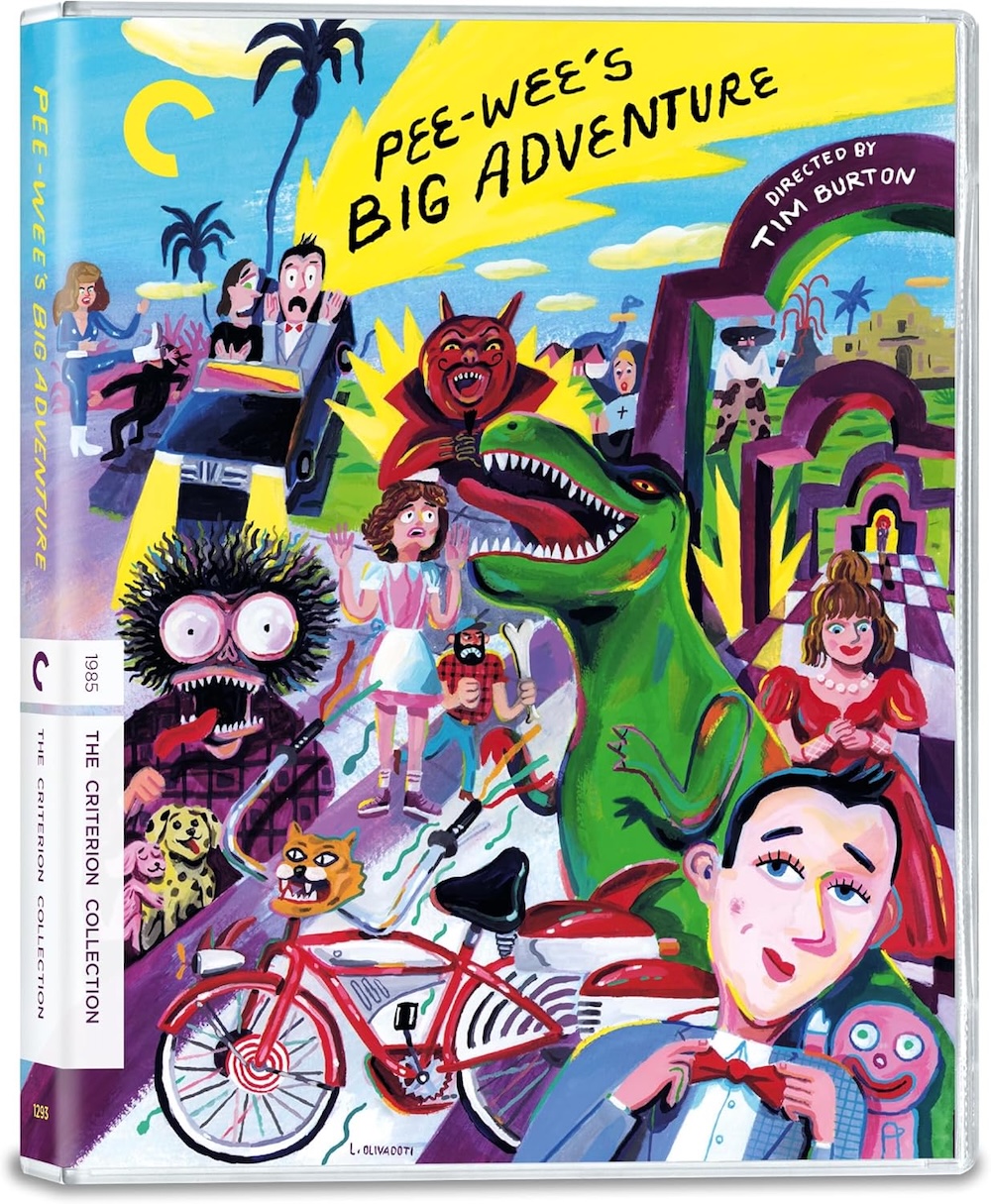
Hitchhiking its way onto 4K courtesy of the Criterion Collection, Pee-wee’s Big Adventure arrives with a wonderful 2160p Ultra HD restoration. Sourced from the original 35mm camera negative and presented in its original 1:85:1 aspect ratio, the brand new transfer was supervised and approved by director Tim Burton.
In allegiance with the presentation’s overtly cartoonish sensibilities, the Dolby Vision HDR grading lends a welcome level of increased richness to the saturated colour palette. The exaggerated primaries practically radiate off the screen, boasting a strong colour reproduction without becoming overblown. Similarly, the pastel suburban hues are invigorated with a heightened vibrancy that permeates every frame. Contrast levels are impressively managed, and black levels during nighttime sequences remain satisfyingly deep.
The image contains an excellent level of depth with a deceptive level of rendering that draws out a striking level of delineation to Burton’s stylised environments. The background detail inside Pee-wee’s immaculately curated home offers a treasure trove of textural excellence. The kitsch 1950s paraphernalia remains crisply defined without ever appearing artificially sharpened. Whereas tight compositions reveal a deceptive amount of detail, showcasing everything from the intricate clothing patterns on Reubens’ undersized grey suit to the faint layer of powder makeup on his face. Overall, Criterion’s new restoration offers a stunning visual upgrade over Warner Bros. Home Entertainment’s 2011 Blu-ray release, delivering a vibrant and meticulously resolved presentation of Pee-wee’s Big Adventure that appears as bold and expressive as Burton always intended.

The 4K release of Pee-wee’s Big Adventure features two audio tracks with optional English subtitles. Unfortunately, the disc doesn’t receive a Dolby Atmos upgrade, but The Criterion Collection provides an immersive English DTS-HD 5.1 Master Audio and English LPCM 2.0 stereo that boasts excellent fidelity.
Unlike Warner Bros. Home Entertainment’s previous release, which offered only modest surround engagement, this new presentation delivers two markedly more dynamic mixes. Danny Elfman’s playful and ebullient score sounds precise and reverberates across the soundstage with newfound clarity. The side and rear channels effectively envelop the listener with orchestral strings, whereas the strong piano motifs remain anchored at the front. The occasional supporting sound effects such as falling rain or thunderclaps, are spread evenly through the rear channels, heightening the atmosphere during key moments. Although the absence of Dolby Atmos feels like a missed opportunity, Criterion’s release is a massive upgrade and a welcome improvement over its predecessor.

director: Tim Burton.
writers: Paul Reubens, Phil Hartman & Michael Varhol.
starring: Paul Reubens, Elizabeth Daily, Mark Holton, Diane Louise Salinger & Judd Omen.