ELLA McCAY (2025)
An idealistic young woman juggles her family and work life in a comedy about the people you love and how to survive them.



An idealistic young woman juggles her family and work life in a comedy about the people you love and how to survive them.
Mid-budget, adult-oriented dramedies like Ella McCay rarely make it into cinemas these days. They used to be everywhere, from James L. Brooks’ As Good As It Gets (1997) to the late Rob Reiner’s The American President (1995) and Nancy Meyers’ What Women Want (2000). Now they seem confined to streaming; their closest relatives in cinemas are the occasional low-effort rom-coms like Anyone But You (2023).
Their absence from cinemas is a shame. Part of the reason cinema is calcifying into trashy IP exploitation and general slop is the removal of mid-market work — films that tell simple, human stories with laughs, tears, and a bit of intelligence. I don’t agree with Simon Pegg’s once-stated (and hastily apologised for) belief that sci-fi and fantasy are tools to keep the “worker bees” infantilised. Instead, I think focus-grouped, purposefully meaningless genre work does that, alongside a lack of entertainment for discerning adults who don’t want to watch “hunks-in-trunks” punching each other constantly.

I’d love to say that 85-year-old writer-director Brooks’ new dramedy, Ella McCay, bucks the trend and brings quality mid-budget work back to the big screen, but… well, let’s start with the plot. Ella McCay (Emma Mackey — I genuinely wonder if Brooks wrote this as a vehicle for Mackey and simply didn’t bother to change the name) is a politician in 2008. She’s handed the governorship of her state for 14 months because the incumbent is due to be confirmed as a senator; she’s there merely to keep things afloat until the election.
She’s told bluntly that she wouldn’t have landed the role any other way because she’s too much of a “nag” about policy and refuses to “play politics”. Her honesty and tenacity stem from a childhood overshadowed by her philandering doctor father, Eddie (Woody Harrelson), who humiliated the family with his affairs.
Ella once tried to understand why her mother, Claire (Rebecca Hall), kept returning to him. She remains close with her aunt, Helen (Jamie Lee Curtis), while her younger brother, Casey (Spike Fearn), has grown up to be a reclusive internet bookmaker. Now, Ella needs her support system more than ever as a scandal brews regarding her and her husband, Ryan Newell (Jack Lowden), making love in a government building.

If that sounds like a structureless information dump, that’s exactly how the film feels. Ella McCay is vapid nonsense intended, I suspect, to be a political satire. However, it sabotages any chance of trenchant critique by pointlessly setting itself in 2008 — midway through the Great Recession, though the story ignores this — and rejecting any comment on party politics. It’s a mess of cardboard characters and ‘tell-don’t-show’ storytelling. It’s a tragedy that this may be the final work of a once-great director. In this piece, Brooks feels profoundly out of touch; the jokes are shopworn and poorly executed.
I knew I was in trouble when a scene featuring a child grieving his mother almost made me laugh, so treacly and obvious was its presentation. It felt like watching a Bertolt Brecht play where characters wear sandwich boards with their names, and all artifice is stripped away to hammer home a point.
The characters talk like they’re in a Saturday Night Live sketch parodying this very genre. The story is narrated by one of Ella’s staffers, Estelle, played by Julie Kavner — best known as Marge in The Simpsons, which Brooks co-created. At least Kavner gets a rest from the raspy voice she’s maintained for 30 years.
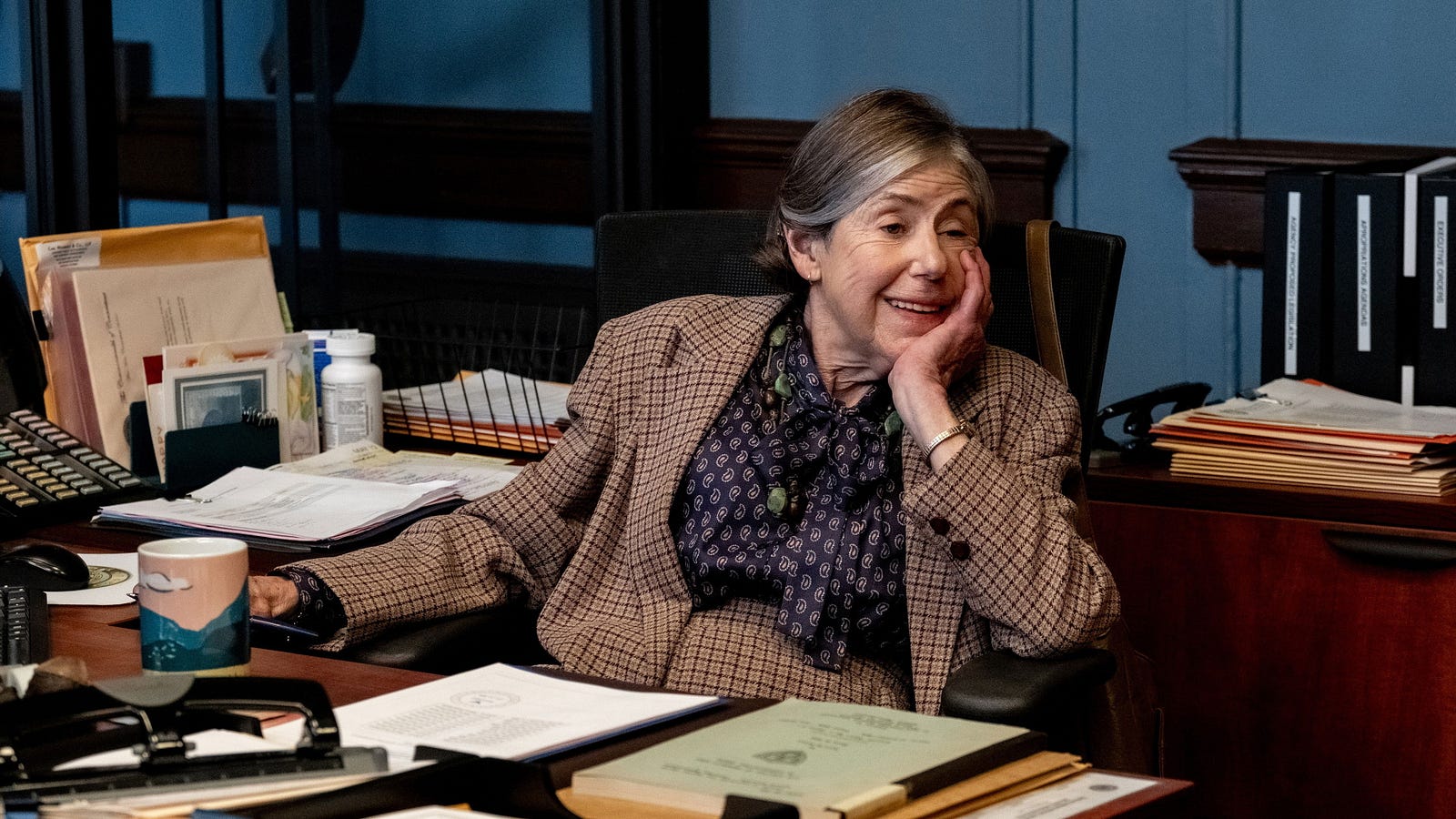
The narration exists only to communicate plot points, tie scenes together, and manufacture a “message” that doesn’t actually exist. Estelle is otherwise a non-character. Indeed, her role should have been subsumed into Jamie Lee Curtis’s Helen. Why isn’t Helen narrating? It would have been easy to eliminate Estelle and make Helen a local activist who followed her niece to Washington. Perhaps Brooks simply wanted to hang out with Kavner.
The screenplay is bafflingly unpolished and groaning with useless “gubbins”. Subplots, such as Casey’s romance, rely on characters stating things that are never shown, as if this two-hour film didn’t have time to actually plot anything. Even the supposed driving force — the sex scandal — feels underwritten.
Then there’s the comedy. It’s remarkable how flat the comic scenes fall. When Jamie Lee Curtis shouts across the street to ask if her niece’s boyfriend wore a condom, the scene is void of surprise or amusement. Brooks co-created The Simpsons; why can he no longer execute a simple joke?

It’s easy to forget, but The Simpsons was distinctive in the 1990s for its lack of sentimentality. George Bush Sr. once famously declared that Americans should be more like the Waltons and less like the Simpsons. Ella McCay feels written with the caustic political wit of The Waltons (1972–1981).
The edges have been sanded off. One suspects Brooks chose a past setting because he wouldn’t know what to make of the current political climate. I don’t necessarily blame him for that, but it’s indicative of a desire to write a witty political fable without doing the work. It isn’t impossible to address the Trump era in a genre film while remaining uplifting — Rian Johnson’s recent mystery Wake Up Dead Man (2025) did this perfectly. Johnson’s script embodies the ethos of the age through Josh Brolin’s bigoted, hypocritical priest, rather than mentioning names. I wish Brooks’ script had a fraction of that thematic sensibility.
At times, the film is so ill-executed it becomes surreal, such as a scene where a security official rambles about child visitation. Its only function is to explain why they’re sitting in a car overnight while Ella recovers from an accidental marijuana high inside. The dialogue is void of humour or connection to the plot. I felt as though I was watching footage from an entirely different movie.

This subplot drags on, only to make the protagonist seem like a horrible boss when she eventually takes the guards to task. Why anyone thought it was funny to show a man scrabbling for overtime to afford Christmas gifts, only to be dressed down by his privileged boss — who created the situation herself — is anyone’s guess.
I wonder if Brooks is simply unable to be honest about who these characters are. Woody Harrelson’s character is essentially a monster who cheated on his wife while she was dying. In the real world, he’d likely face misconduct charges. The script tries to sidestep this by mentioning that the women he slept with wrote “letters of support”. How nice for him.
The script lacks the teeth to approach the reality of the situation: Claire McCay was dying in hospital while the man she dedicated her life to was “wetting his wick” elsewhere. Brooks doesn’t present him as redeemable, exactly — he sees him as a laughable dolt — but to me, he seems less like a “light-hearted buffoon” and more like a disgusting user.
Ella McCay is a disappointing oddity to appear near the end of an illustrious career that includes classics like Terms of Endearment (1983) and Broadcast News (1987). The mid-budget movie for adults will have to wait a little longer for its cinematic saviour.
USA | 2025 | 115 MINUTES | 1.85:1 | COLOUR | ENGLISH


writer & director: James L. Brooks.
starring: Emma Mackey, Jamie Lee Curtis, Jack Lowden, Kumail Nanjiani, Ayo Edebiri, Spike Fearn, Julie Kavner, Rebecca Hall, Albert Brooks & Woody Harrelson.