HARD EIGHT (1996)
A stranger mentors a young, troubled Reno gambler.


A stranger mentors a young, troubled Reno gambler.
Paul Thomas Anderson’s debut feature, Hard Eight, is habitually introduced with a faint, almost condescending apology. It’s often filed away as the “small” film: a muted prelude to the baroque confidence of Boogie Nights (1997) and the operatic sprawl of Magnolia (1999). This lens misreads the work. Hard Eight isn’t a rough draft or a stepping stone; it’s a fully formed statement of intent — low-volume, high-precision — carved out of the fluorescent wasteland of Reno and Sparks, Nevada.
Set on Nevada’s unglamorous fringes, the film treats the casino not as a neon spectacle or a site of high-rolling glamour, but as routine, weary labour. Working with cinematographer Robert Elswit, Anderson photographs gambling as tactile banality: the rhythmic hiss of espresso machines in a 3 a.m. diner, the muffled shuffle of feet on damp moquette, and the cold, bureaucratic transaction at the cashier’s window. The subject isn’t luck, or even the “big win”. Hard Eight is a film about the perimeter, not the outcome. “All we can do is bet on it,” Sydney says — and the entire style follows that ethic. It’s about control: how it’s performed, how it’s taught, and what it costs to maintain.
An older gambler, Sydney (Philip Baker Hall), takes a broke drifter, John (John C. Reilly), under his wing, teaching him the grammar of survival within the casino economy. The bond hardens when Clementine (Gwyneth Paltrow) and Jimmy (Samuel L. Jackson) enter the picture, pulling mentorship into a world of debt, threats, and moral bargaining.
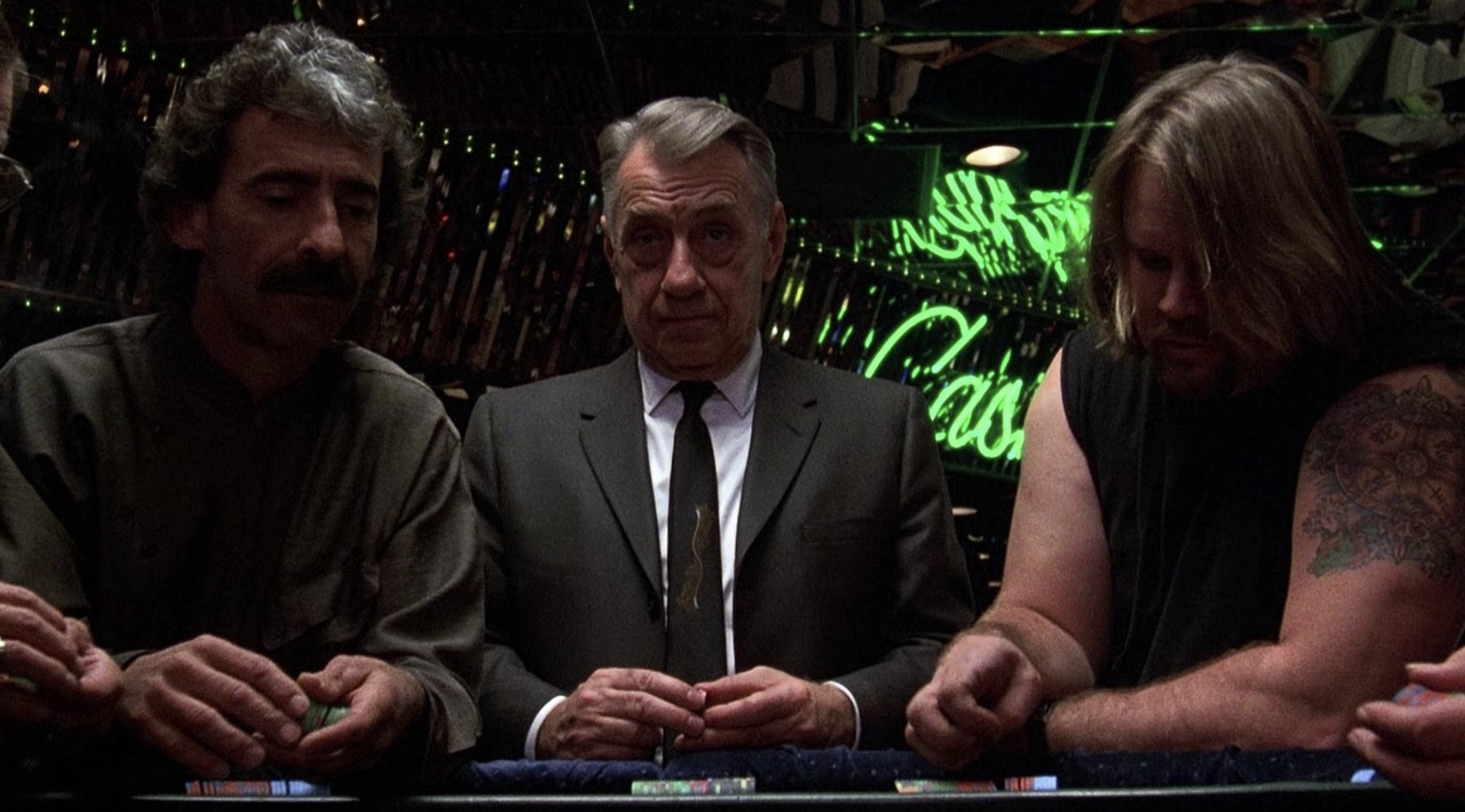
The first surprise of Hard Eight is formal. It’s shot in anamorphic 2.39:1, a ratio usually built for horizons — westerns, road movies, and desert epics. Anderson uses that “big” frame to achieve the inverse. He transforms Reno into a vitrine: a glass display case where people don’t roam, but circulate like captive specimens.
In this widescreen world, the frame doesn’t liberate the characters; it pins them down. Anderson and Elswit exploit a specific lateral pressure: a face may fill one side of the image while an unnerving margin of empty space remains beside it. This negative space feels like atmospheric force — a vacuum threatening to pull the character into the background. The close-up doesn’t monopolise the frame; it competes with it.
Anderson also contaminates the purity of the traditional shot/reverse-shot. The “other” in a conversation often survives at the very edge of the frame as a dark, intrusive mass — a shoulder, a silhouette, a block of woollen coat — turning dialogue into surveillance. Elswit’s palette reinforces this entrapment: jaundiced ochres, tobacco-stained greys, and sickly greens — the visual equivalent of a carpet saturated with decades of ash and spilt drinks.
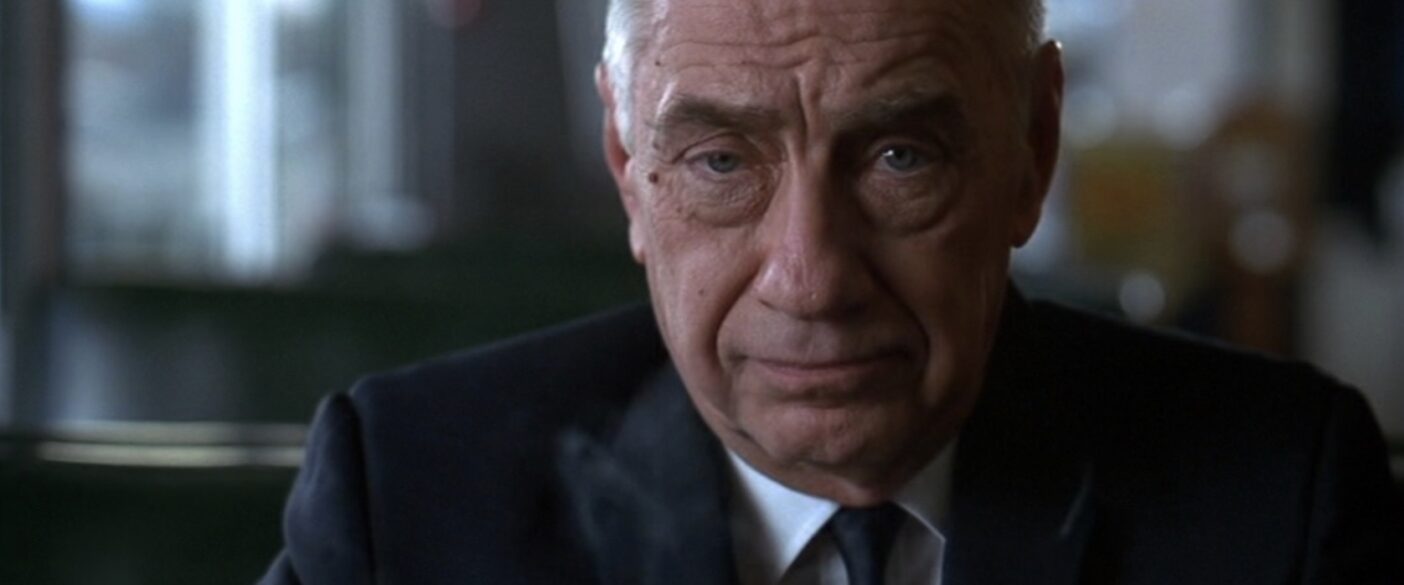
At the heart of this vitrine sits Sydney, an older gambler of meticulous, almost ecclesiastical decorum. When he encounters John, Sydney doesn’t offer pity; he offers a vocation. He installs himself as a tutor, teaching John how to dress, how to play the system, and how to carry a dignity he hasn’t yet earned.
Philip Baker Hall’s performance is a masterclass in density. He plays restraint not as blankness, but as a high-pressure seal. You feel history vibrating behind Sydney’s calm — and, more crucially, you understand how violently disciplined that calm must be to remain intact.
Sydney isn’t omniscient; he’s operational. His knowledge isn’t mystical; it’s lived-in competence. He reads people and timings with the weary eye of a foreman. He knows the topography of the room — where to stand, when to move, and when to vanish behind the moving architecture of bodies. He anticipates the typical frictions of the gambling world: the flare of pride, the panic of debt, and the stench of a ruse. To say Sydney “knows what he’s doing” is to say he knows exactly which move he’s making and exactly which risks he’s accepting. He doesn’t control outcomes; he controls the perimeter.
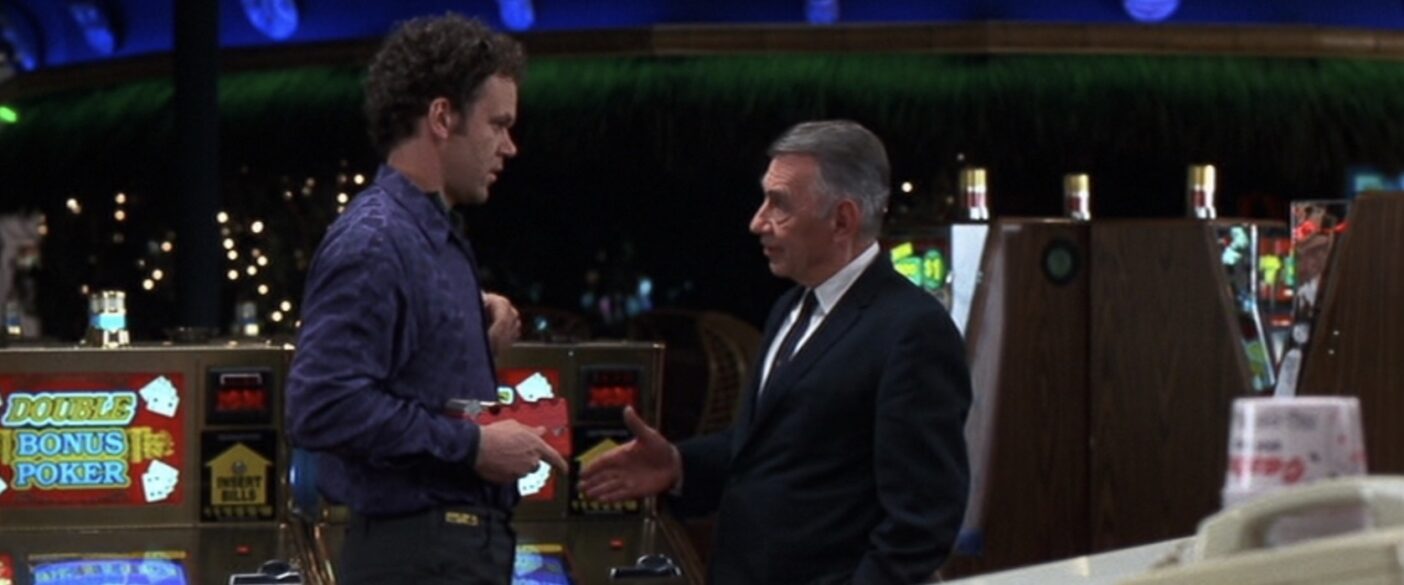
Nowhere is Sydney’s operational mastery more evident than in Anderson’s subversion of the tracking shot. In a conventional virtuoso take, control is synonymous with visibility: the camera is a tether that refuses to lose its subject. In Hard Eight, control is the inverse. Sydney can afford to disappear.
In a pivotal casino-floor sequence, the camera follows Sydney’s purposeful stride. As he moves through the crowd, he is briefly eclipsed by a passing body. For a few seconds, he goes dark. He isn’t swallowed by the room; he’s using it. The casino is not a backdrop but a map, and Sydney knows its blind spots. While the camera maintains its forward momentum, fixed on the hum of the system, Sydney operates in occluded space — using the crowd as a curtain and the staff as camouflage. When he re-emerges, greeted with familiarity, it registers as a demonstration of off-screen governance. Sydney doesn’t need the centre of the frame to remain at the centre of the game.
The narrative appears to follow a familiar mentor-protégé dynamic, but Anderson constantly undermines the sentimentality of the bond. Sydney’s kindness is real, but it’s also tactical. He has selected John as a project — perhaps to fill a void, or perhaps to balance a debt we haven’t yet seen.
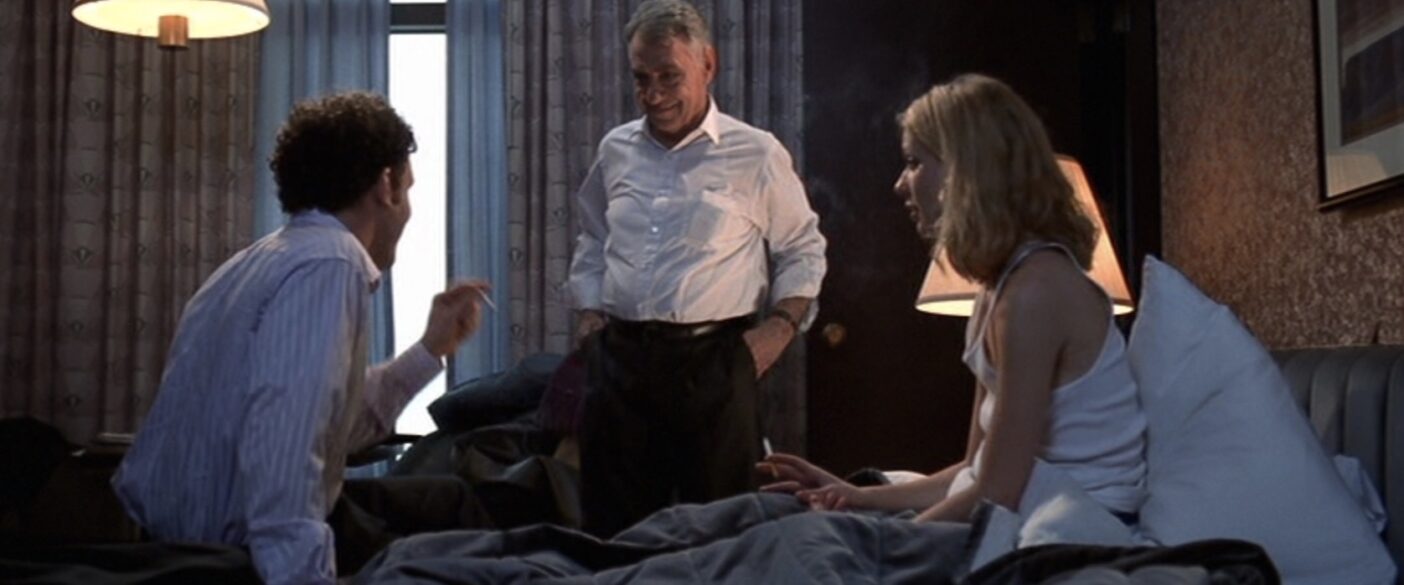
John is the perfect rube: socially clumsy, perpetually out of step, and devastatingly readable. His vulnerability is the friction Sydney tries to smooth over. But as the film progresses, the variables become increasingly human and therefore uncontrollable. Clementine and Jimmy don’t arrive as mere side characters; they introduce volatility — desire, threat, and humiliation — that Sydney’s operational map cannot fully contain.
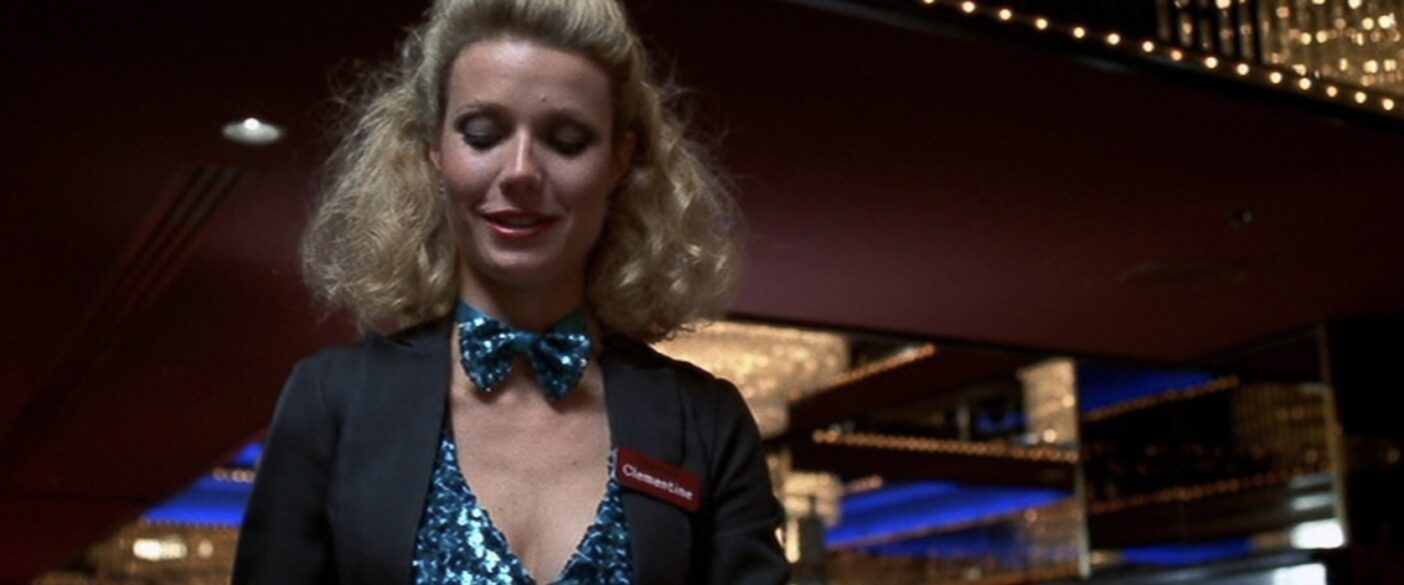
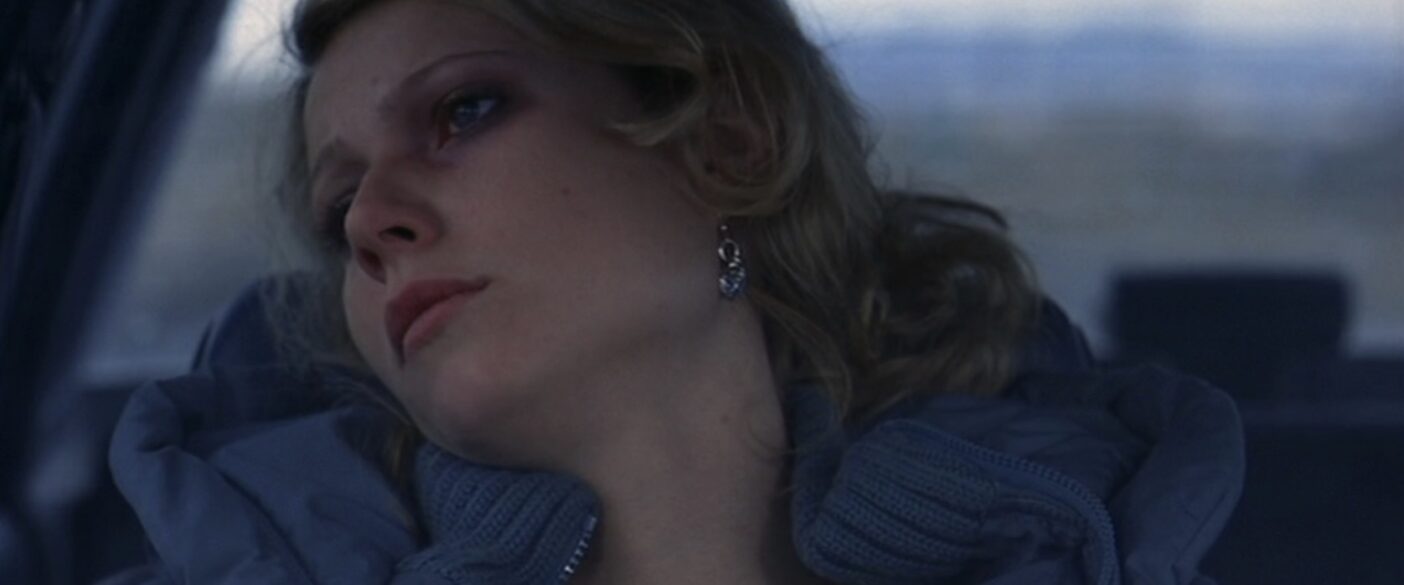
Paltrow’s Clementine is a masterclass in low-emission truth. She refuses the glamour of the femme fatale. Her pain is claustrophobic and realistic. When she breaks, she doesn’t do it for the gallery; she does it within the narrow bandwidth of someone used to being ignored. She, like John, is a variable that threatens to drift.
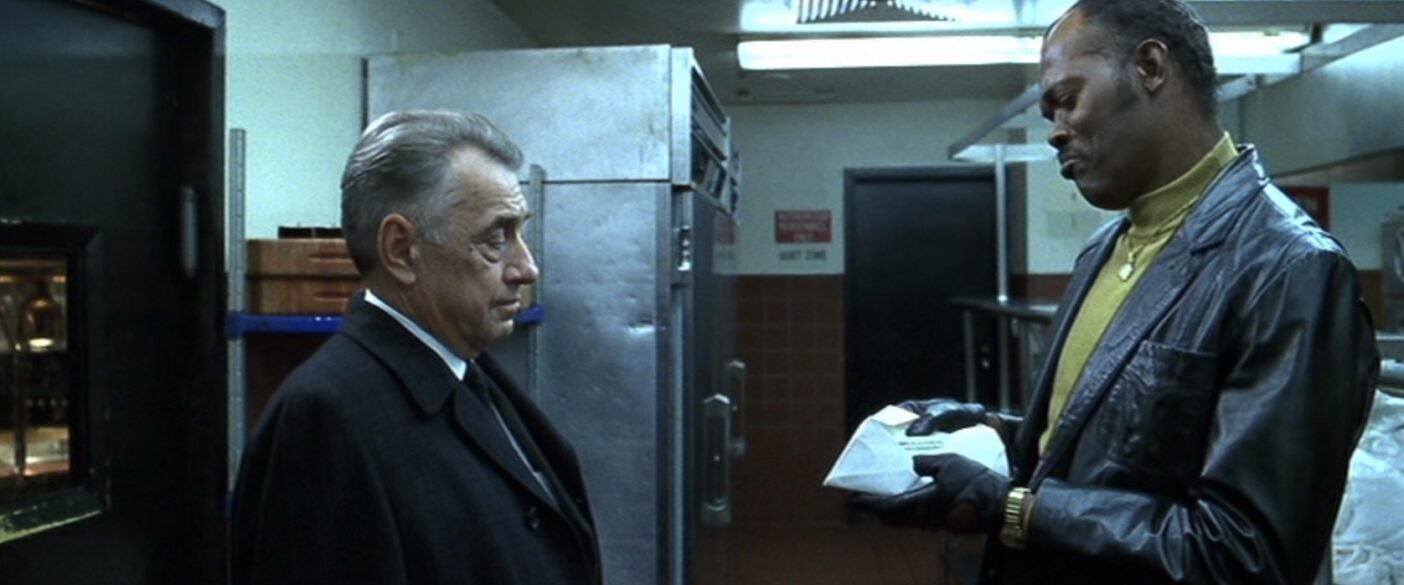
Jimmy’s speech isn’t exposition; it’s territory. Jackson plays the near-monologue as a pressure tactic, a verbal enclosure designed to shrink Sydney’s perimeter in public. It isn’t dialogue that opens character; it closes space. Cadence becomes intimidation; humour becomes a blade; the sentence lasts just long enough to make the room belong to the speaker. Anderson keeps it tethered to the film’s austerity: no ornamental detour, just language used as leverage.
The title, imposed by the studio against Anderson’s wishes, becomes an inadvertent metaphor. A “Hard Eight” in craps (two fours) is a rigid wager: few combinations, high precision, and a narrow margin for error. This is the architecture of Sydney’s life.
Sydney is a moral cheat. He isn’t merely helping John; he’s wagering on John’s life to rebalance a private ledger. He attempts to fix the universe in silence: to turn a rube into a man, a prostitute into a wife, and a tragedy into a solvable equation. But because the materials he works with are human, the wager is hard. There’s too much precision required and too many points of collapse. Sydney stays in control not to “win”, but to prevent the entire structure of his manufactured reality from crumbling.
There is a trade-off to such absolute governance. Hard Eight withholds warmth not by accident, but by design: the film rarely grants gestures that aren’t already entangled with procedure. Kindness arrives as instruction. Affection arrives as transaction. Even intimacy tends to be framed with lateral pressure — someone at the edge, space refusing to soften, the room overhearing.
This is why the film can feel airless: not because it lacks feeling, but because it keeps feeling under seal. Where later Anderson will let scenes swell and spill into operatic excess, this debut works by containment — by the disciplined refusal of release. If Boogie Nights is a fever, Hard Eight is a clinical observation: a film that makes control its atmosphere and asks the viewer to breathe inside it.
Anderson’s direction turns genre scaffolding into something haunted. He uses blackouts and abrupt temporal leaps as moral commas. The cut doesn’t simply move the story forward; it lands like a heavy lid. The darkness between scenes doesn’t soothe; it erases — implying that the characters are perpetually incomplete and that something is always being swallowed by the past.
This same coldness governs the film’s moments of crisis. When the story crosses lines it has been measuring all along, it does so without fanfare: action arrives like procedure, consequence like paperwork. Hard Eight isn’t interested in adrenaline; it’s interested in residue — the feeling that even the cleanest solution leaves a mark.
Ultimately, Hard Eight is a study in how control masquerades as care. The moral cheat isn’t a theatrical villain; he’s an exhausted man trying to maintain a dignity constantly under threat from the “rube” inside himself.
Anderson understands that, in the Nevada night, omission is louder than exposition. By letting Sydney go dark within the very takes meant to capture him, he shows that true authority doesn’t shout — it operates in the gaps. Hard Eight remains a masterpiece of the perimeter: a film that asks to be watched with the same cold, operational discipline Sydney applies to his life. It’s a debut by a director who already knew that the most important things in a room are often the ones the camera — and the world — choose to lose.
USA | 1996 | 102 MINUTES | 2.39:1 | COLOUR | ENGLISH

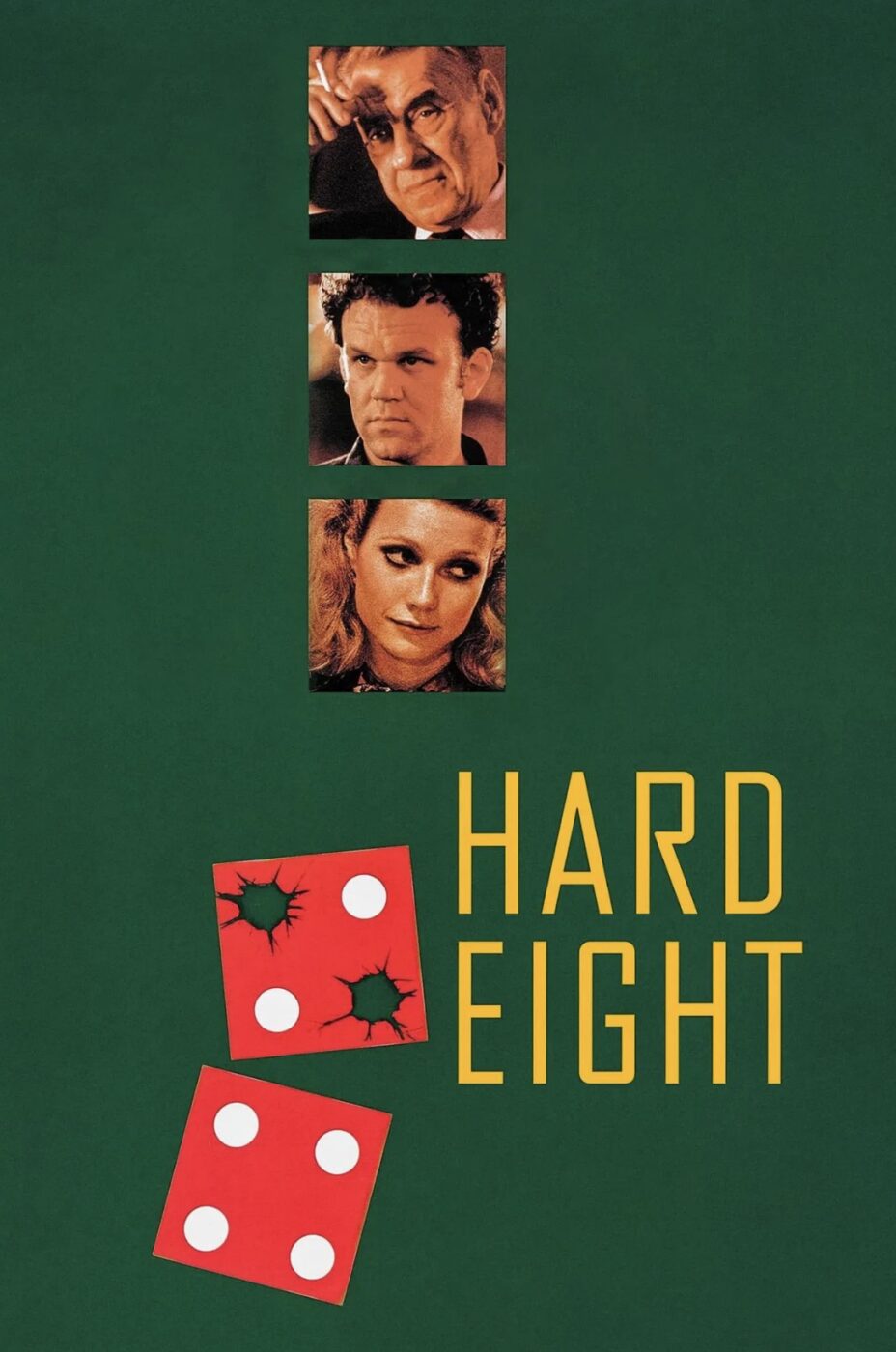
director: Paul Thomas Anderson.
writer: Paul Thomas Anderson (based on his 1993 short film ‘Cigarettes & Coffee’.
starring: Philip Baker Hall, John C. Reilly, Gwyneth Paltrow & Samuel L. Jackson.