PLURIBUS – Season One (2025)
The most miserable person on Earth must save the world from happiness.

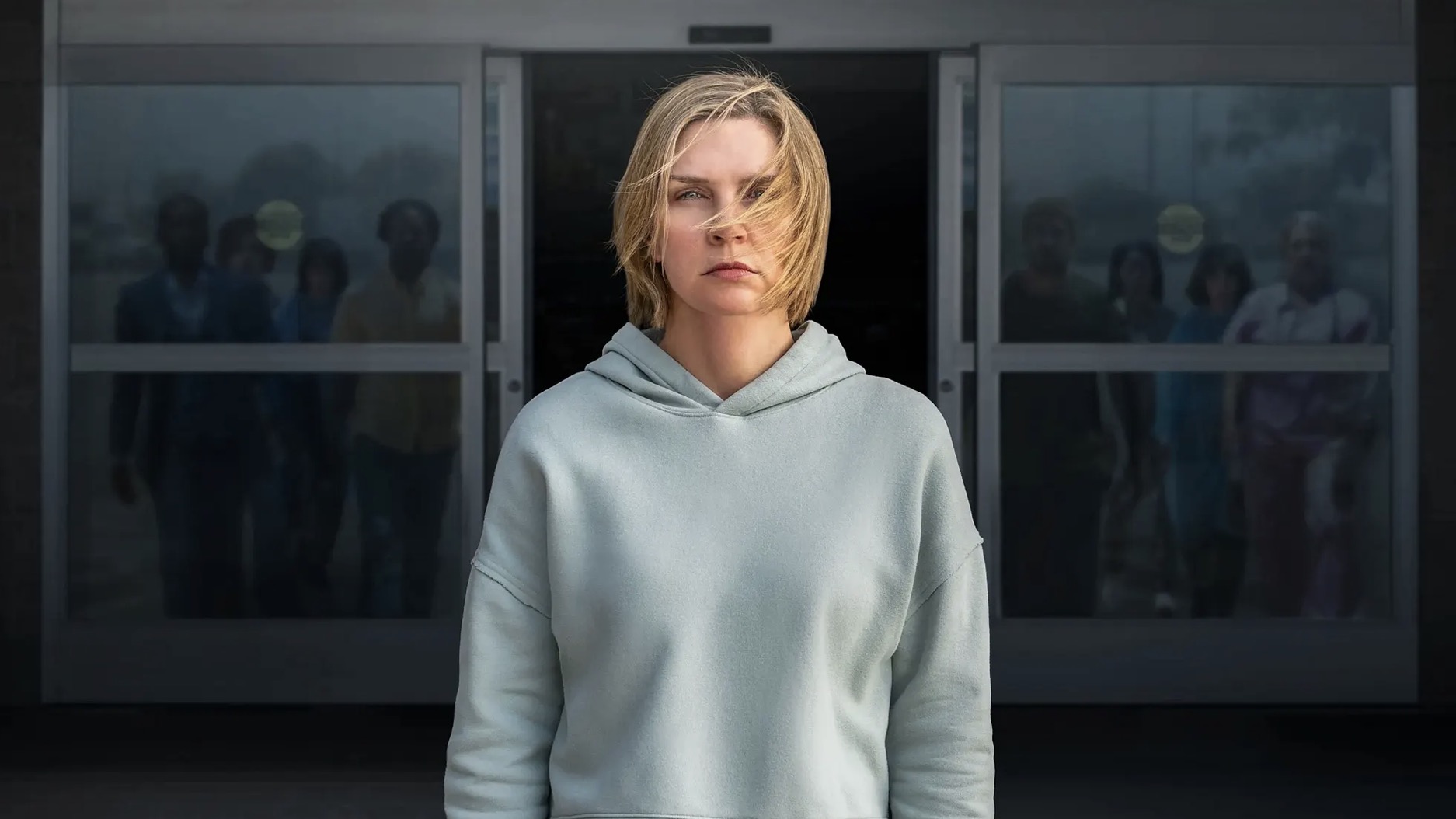

The most miserable person on Earth must save the world from happiness.
Whenever someone creates anything that becomes an iconic piece of pop culture, critics have the knives out for whatever they do next. It’s rarely as impactful, so even great work is unfairly compared to something that was lightning in a bottle. George Lucas chose to produce more movies than he ever again directed after Star Wars (1977), and eventually only worked within his imagined universe; while Chris Carter, creator of The X-Files (1993–2002), never really did anything that surpassed his phenomenal TV series.
Vince Gilligan, creator of Pluribus, is perhaps only too aware of the situation Carter found himself in, as a veteran staff writer on The X-Files. After the remarkable success of Breaking Bad (2008–2013), Gilligan risked but avoided failure with a prequel series set in the same universe, Better Call Saul (2015–2022), and now aims to escape the George Lucas trap by doing something completely different. The result is the aforementioned Pluribus, which harkens back to his work on X-Files, but tackles a global event it would be impossible for Mulder and Scully to fix within an hour.
Carol Sturka (Rhea Seehorn) is an acclaimed fantasy romance author living in Albuquerque, New Mexico, with her agent and wife Helen (Miriam Shor). The pre-publicity for Pluribus avoided making it obvious what the show is actually about, leaning into a sense of mystery, which made the premiere a delightful surprise, so… spoiler warning if you want the same optimal experience…

That all said, Carol survives a sudden and global event — referred to as ‘The Joining’ — shortly after an alien intelligence transmits a radio signal that’s decoded and used by scientists to produce a viral RNA sequence. This results in a contagion that turns people into a hive mind and compelled to ensure everyone else becomes part of their shared blissful consciousness.
It’s Invasion of the Bodysnatchers (1956) without the replacement ‘pod people’, or a benevolent and biological version of The Borg from Star Trek: The Next Generation (1987–1994). There’s even a dose of Soylent Green (1973) thrown in later. Gilligan’s riffing on classic sci-fi themes and ideas, but with a refreshing modern twist driven by his meticulous approach to exploring big ideas and complex sequences.
This was evident in both Breaking Bad and Better Call Saul, which often contained scenes that took their time and felt like short films within a larger narrative. Pluribus takes that approach a step further, with entire episodes that maintain that same hypnotic quality, where the visual storytelling is so creative and precise that it’s intoxicating to watch. The downside is that, to be honest, sometimes entire episodes go by and what happened of true significance is reducible to a paragraph of text.

Pluribus is part of a the “cosy apocalypse” tradition, a term coined by sci-fi author Brian Aldiss, where the aftermath of a world-ending event turns out to be relatively peaceful and manageable. The classic example is John Wyndham’s The Day of the Triffids, where carnivorous alien plants are definitely to be avoided but everyday life isn’t particularly nightmarish for the survivors — compared to, say, Stephen King’s The Stand or Cormac McCarthy’s The Road. Or even more modern fare like The Walking Dead(2010–2022) and The Last of Us, with their zombie-infested worlds and scumbag fellow survivors.
Pluribus is perhaps the cosiest of all apocalypses, as the world Carol finds herself living in is seemingly “better”. There’s no violence, no wastage, no hierarchy, no poverty, everyone’s vegetarian, kindness and happiness is widespread, and the billions of ‘Others’ (as they’re colloquially known) are interconnected and thus share humanity’s entire knowledge and expertise. A little boy can be an expert gynaecologist, while a TGI Fridays waitress can fly a passenger jet. And they’re all entirely driven by a heartfelt desire to please, so Carol isn’t a threat or someone they fear — she’s just a genetic anomaly they hope to correct.
The amusing irony of Pluribus is that you’re in a highly privileged position as a “survivor”, as the Earth’s population is happy to dedicate their lives to ensuring your well-being and happiness. You can be treated like royalty if you’re that selfish.

Like all the best “what if?” scenarios, Pluribus gets audiences theorising about various matters; predicting where events might be headed, and trying to rationalise the nature of this new society if individuality’s been replaced by a euphoric collective.
Does what you’d gain outweigh the loss of your own uniqueness? If everyone who’s been joined remembers their prior existence, but prefers this new one, why should Carol want to deny them it? It’s almost as if Carol’s the square college student who refuses to take a drag on a joint being passed around, trying in vain to explain to everyone that what they’re feeling isn’t normal or good for them. It falls on deaf ears.
There are, of course, fun complications along the way. Carol soon learns she’s not the sole survivor of the Joining, and that the Others have a dangerous intolerance for stress. To say more would ruin things, but every episode drops at least a few nuggets of information to deepen our understanding of what this event’s done and the longterm ramifications for mankind. And Carol’s soon scrawling them on a hidden whiteboard at her home, like a proxy for the audience keeping notes.

The greatest obstacle to Carol’s saving the world is Zosia (Karolina Wydra), a beautiful Polish member of the Others, who becomes her chaperone and the collective’s spokesperson by virtue of her physical likeness to Raban, the dashing male hero of Carol’s fantasy series Winds of Wycaro who was intended to be female. And while Zosia isn’t an individual — you can talk to any Other and have the same conversation and memory of past discussions, right? — Carol develops a bond that clouds her thinking and makes her rebellion more difficult once she starts falling in love…
Pluribus is an excellent TV series and a welcome change of genre for Gilligan after two modern-day crime dramas, but it’s difficult to imagine how long it can last. The first three episodes quickly answer big questions (ones you’d imagine would be withheld for ages), which is both refreshing and concerning. Maybe this is why many episodes luxuriate in leisurely scenes of routine and silent pragmatism, which are mesmerisingly assembled but also help to obscure how not a lot happens at times.
Rhea Seehorn was cast as Carol after impressing Gilligan on Better Call Saul, where she played Kim Wexler, and is the reason the hero of Pluribus changed gender during its development. Seehorn’s enjoying a late-career boom and she’s great in this role as a miserable would-be saviour, but there are times when Carol’s abrasive attitude can get tiresome. It wouldn’t matter if Pluribuswas always able to switch focus to other characters during an episode, but by the nature of its concept there aren’t many other co-stars — just a handful of survivors, including an important one called Manousos Oviedo (Carlos-Manuel Vesga), and the aforementioned Zosia.

Seehorn carries the show on her shoulders, and while she does a good job it’s sometimes tough going due to the prickly temperament of her character.Carol is fairly one-note in her obstinance and there isn’t much opportunity to show other sides to her, given the predicament she’s in. But even in a flashback to happier times with her girlfriend on vacation in Norway, she seems just as dour. Considering Carol’s also a world-class fiction writer of romance, her cold demeanour sometimes feels counter to the traits one would expect from an author of fantastical romantic fiction.
However, despite some misgivings and concerns, Vince Gilligan has earned our trust as an audience. I’m sure he’s aware Pluribus likely couldn’t last six seasons, as three or four seems about right, and he’ll know when to bring things to an end before we get bored. I hope there’s at least a solid arc sketched out, but I know Gilligan loves to improvise his way out of tight spots he writes himself into because he doesn’t like to overthink where things could go… and that leaves me with a degree of anxiety about how well Pluribus can flourish.
USA | 2025 | 9 EPISODES | 2.39:1 | COLOUR | ENGLISH • SPANISH


writers: Vince Gilligan, Gordon Smith, Alison Tatlock, Ariel Levine, Vera Blasi, Jenn Carroll & Jonny Gomez.
directors: Vince Gilligan, Gordon Smith, Zetna Fuentes, Gandja Monteiro, Adam Bernstein & Melissa Bernstein.
starring: Rhea Seehorn, Karolina Wydra, Carlos-Manuel Vesga, Miriam Shor, Samba Shutte, Menik Gooneratne & Darinka Arones.